
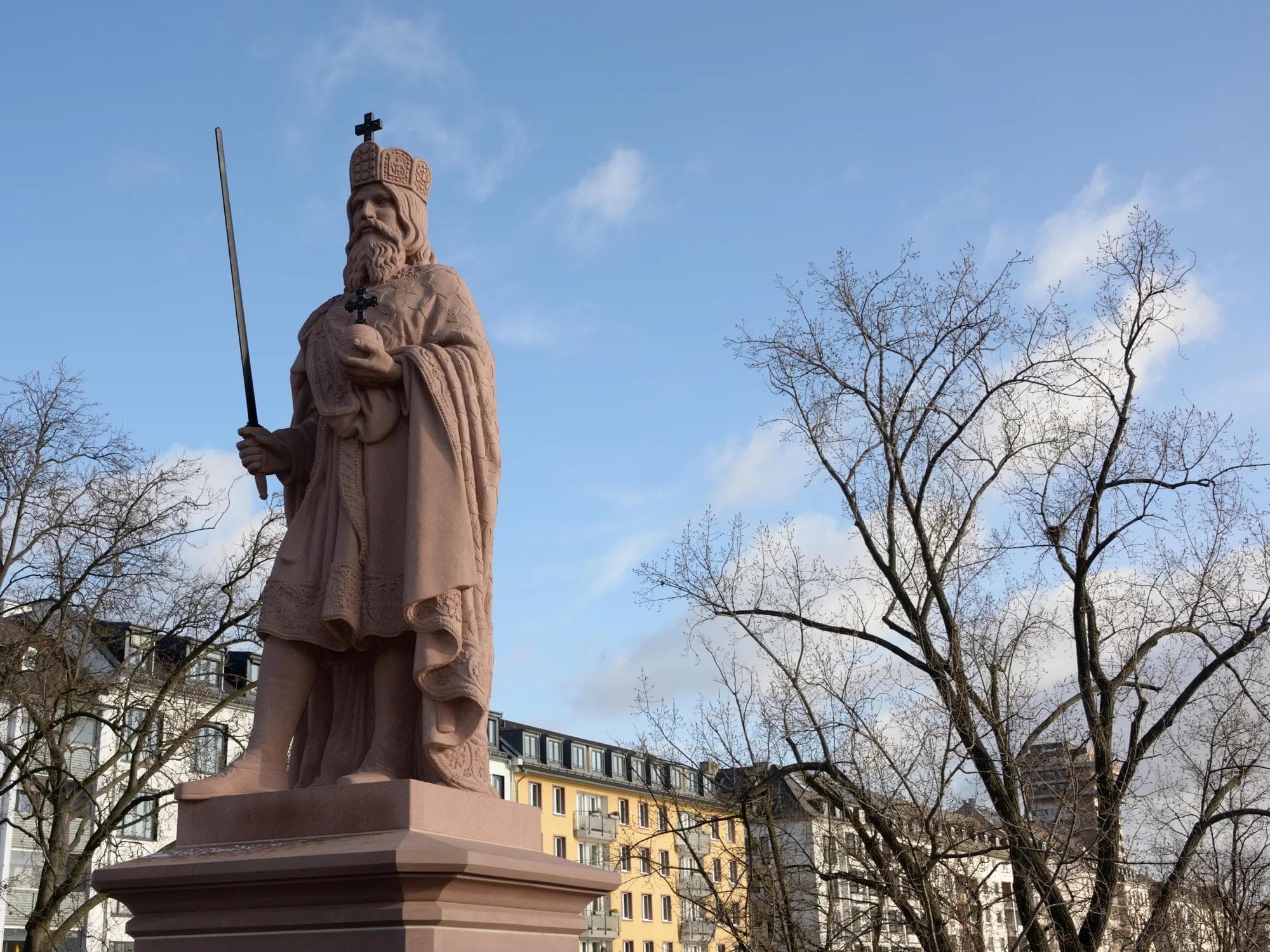
Charlemagne - King of the Franks
Step back in time and immerse yourself in the rich history of Charlemagne, the legendary King of the Franks, as you explore Frankfurt. Imagine the grand imperial assemblies that took place in this city, where decisions were made that shaped the future of Europe. With its deep historical roots and the legacy of one of the most influential rulers of the early Middle Ages, Frankfurt offers a unique glimpse into the past. Discover the stories, the architecture, and the vibrant history that make this city a must-visit destination for history enthusiasts.
Charlemagne (c. 742–814), known in German as Karl der Große, was King of the Franks and later crowned Emperor in 800. He built one of the largest political territories in Western Europe since the Roman Empire and became one of the most important rulers of the early Middle Ages. The Franks were a group of Germanic peoples who became one of the most powerful kingdoms in Western Europe after the decline of the Roman Empire. Their kingdom eventually gave its name to France, while their presence in the Frankfurt area is reflected in the name Franconofurd — “the ford of the Franks.”
Historical Context: Charlemagne became King of the Franks in 768 and spent much of his reign expanding the Frankish kingdom across Western and Central Europe. His empire eventually covered large parts of what are now France, Germany, Belgium, the Netherlands, Switzerland, Austria, and Italy. In 794, Charlemagne came to Franconofurd, the settlement that would later become Frankfurt, and held an important imperial assembly here. A document issued during this gathering provides the first written record of the name Franconofurd. This makes 794 one of the most important dates in Frankfurt's history. Charlemagne was crowned Emperor by Pope Leo III in Rome on Christmas Day 800, becoming the first Western European emperor in centuries. He promoted Christianity throughout his empire and supported education, writing, and the preservation of ancient texts, contributing to what historians call the Carolingian Renaissance. His most important royal residence was Aachen, but he traveled extensively throughout his empire, using royal residences such as Frankfurt to govern his territories, hold political assemblies, meet nobles and religious leaders, and make important decisions. Charlemagne died in 814 and was buried in Aachen Cathedral. His reign had a lasting influence on the political and cultural development of medieval Western and Central Europe.
History
Charlemagne became King of the Franks in 768 and spent much of his reign expanding the Frankish kingdom across Western and Central Europe. His empire eventually covered large parts of what are now France, Germany, Belgium, the Netherlands, Switzerland, Austria, and Italy.
In 794, Charlemagne came to Franconofurd, the settlement that would later become Frankfurt, and held an important imperial assembly here. A document issued during this gathering provides the first written record of the name Franconofurd. This makes 794 one of the most important dates in Frankfurt's history.
Charlemagne was crowned Emperor by Pope Leo III in Rome on Christmas Day 800, becoming the first Western European emperor in centuries. He promoted Christianity throughout his empire and supported education, writing, and the preservation of ancient texts, contributing to what historians call the Carolingian Renaissance.
His most important royal residence was Aachen, but he traveled extensively throughout his empire, using royal residences such as Frankfurt to govern his territories, hold political assemblies, meet nobles and religious leaders, and make important decisions.
Charlemagne died in 814 and was buried in Aachen Cathedral. His reign had a lasting influence on the political and cultural development of medieval Western and Central Europe.
Fun Facts
- His empire was enormous, but Frankfurt wasn't his capital. Places such as Frankfurt and Aachen were important royal residences where he could govern different parts of his empire.
- He had many children. He had at least 18 children, although not all survived to adulthood.
- He probably couldn't speak modern German or French. Neither language existed in its modern form. He spoke a form of Frankish and also knew Latin.
Guide Tips
- Visit the Römer, where Charlemagne once held assemblies.
- Explore the Dom Museum to learn about the Carolingian Renaissance.
- Take a walk along the Main River, where Franconofurd once stood.
Opening Hours
24/7 - Street Monument