
Place de la Concorde
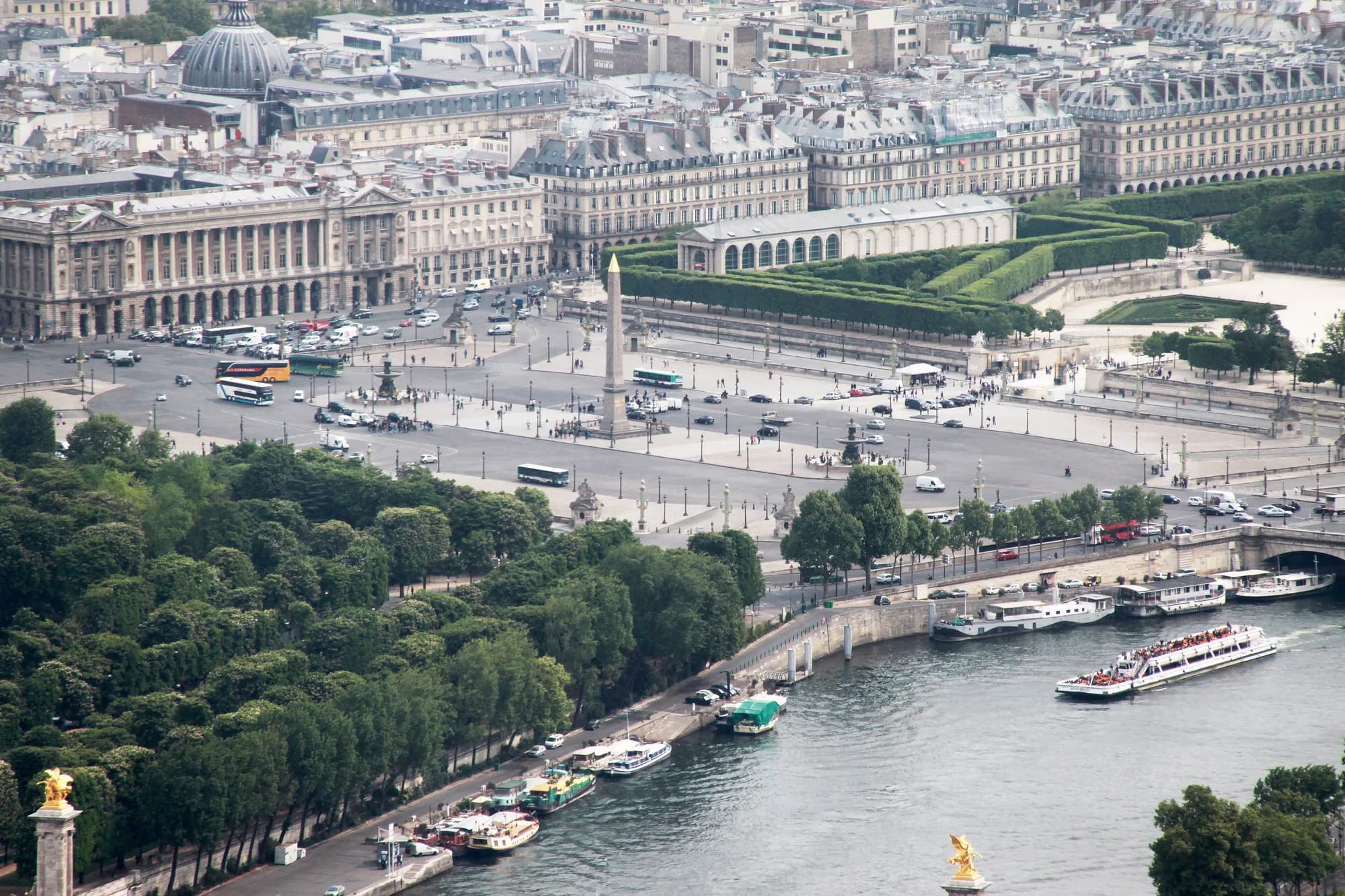
Spanning over 7.5 hectares between the Tuileries Garden and the Avenue des Champs-Élysées in the 8th arrondissement, Place de la Concorde is the largest and most historically charged public square in Paris. Commissioned in 1755 by King Louis XV and designed by master royal architect Ange-Jacques Gabriel as an octagonal neoclassical esplanade, the square is an architectural masterpiece framing Paris's legendary Axe Historique (Historical Axis). At its center rises the monumental 23-metre Luxor Obelisk (Obélisque de Louxor)—a 3,300-year-old ancient Egyptian yellow granite monolith capped with a sparkling gilded pyramidion, gifted to France in 1830. Flanking the obelisk are two magnificent 19th-century bronze fountains designed by Jacques-Ignace Hittorff: the Fontaine des Mers (celebrating maritime navigation) to the south and the Fontaine des Fleuves (celebrating river navigation) to the north. Anchored by the majestic neoclassical colonnades of the Hôtel de la Marine and the Hôtel de Crillon to the north, and eight monumental stone pavilions topped with statues honoring major French cities, Place de la Concorde offers sweeping panoramic vistas connecting the Louvre, the Tuileries, the Champs-Élysées, the Arc de Triomphe, the Palais Bourbon, and the Eiffel Tower.
Spanning over 7.5 hectares between the Tuileries Garden and the Avenue des Champs-Élysées in the 8th arrondissement, Place de la Concorde is the largest and most historically charged public square in Paris. Commissioned in 1755 by King Louis XV and designed by master royal architect Ange-Jacques Gabriel as an octagonal neoclassical esplanade, the square is an architectural masterpiece framing Paris's legendary Axe Historique (Historical Axis). At its center rises the monumental 23-metre Luxor Obelisk (Obélisque de Louxor)—a 3,300-year-old ancient Egyptian yellow granite monolith capped with a sparkling gilded pyramidion, gifted to France in 1830. Flanking the obelisk are two magnificent 19th-century bronze fountains designed by Jacques-Ignace Hittorff: the Fontaine des Mers (celebrating maritime navigation) to the south and the Fontaine des Fleuves (celebrating river navigation) to the north. Anchored by the majestic neoclassical colonnades of the Hôtel de la Marine and the Hôtel de Crillon to the north, and eight monumental stone pavilions topped with statues honoring major French cities, Place de la Concorde offers sweeping panoramic vistas connecting the Louvre, the Tuileries, the Champs-Élysées, the Arc de Triomphe, the Palais Bourbon, and the Eiffel Tower.
Histoire
Conceived in 1748 when the Paris merchants' guild commissioned a monumental public plaza to honor King Louis XV, Place de la Concorde was designed by premier royal architect Ange-Jacques Gabriel in 1755. Gabriel designed an expansive octagonal square framed by dry moats, eight stone sentry pavilions, and two grand classical palaces with Corinthian colonnades along the northern perimeter (now the Hôtel de la Marine and Hôtel de Crillon). Inaugurated in 1763 as 'Place Louis XV' with a bronze equestrian statue of the king by Edmé Bouchardon, the square became the premier stage for royal celebrations.\\n\\nWith the outbreak of the French Revolution in 1789, the royal statue was toppled and melted for cannon bronze, and the site was renamed 'Place de la Révolution'. A permanent guillotine was erected near the entrance to the Tuileries, where King Louis XVI was executed on January 21, 1793, followed by Queen Marie Antoinette on October 16, 1793, and hundreds of prominent figures during the Reign of Terror. In 1795, under the Directory, the site was officially renamed 'Place de la Concorde' to symbolize national peace, harmony, and unity after the revolutionary bloodshed.\\n\\nBetween 1836 and 1840, King Louis-Philippe and architect Jacques-Ignace Hittorff transformed the plaza into the monumental civic space admired today. In October 1836, the ancient Egyptian Luxor Obelisk—transported from Luxor in a remarkable nautical voyage led by engineer Apollinaire Lebas—was hoisted into position as a politically neutral centerpiece. Hittorff complemented the obelisk with two monumental cast-iron fountains adorned with gilded figures celebrating France's maritime and river commerce, alongside rostral columns and gas streetlights. Today, as part of the UNESCO World Heritage Site along the Banks of the Seine, Place de la Concorde remains a quintessential symbol of Parisian elegance, history, and civic grandeur.
Anecdotes
- 🏺 3,300-Year-Old Egyptian Monolith: The 23-metre Luxor Obelisk standing at the center is Paris's oldest monument, dating to the reign of Pharaoh Ramesses II in the 13th century BC; it was gifted to King Charles X and France by Egypt's Viceroy Muhammad Ali in 1830 and erected in 1836 before 200,000 cheering spectators.
- 👑 Site of the Revolutionary Guillotine: During the French Revolution, the plaza was renamed Place de la Révolution and became the primary execution ground where more than 1,100 people were guillotined, including King Louis XVI, Queen Marie Antoinette, Georges Danton, and Maximilien Robespierre, before being rechristened 'Place de la Concorde' in 1795 as a gesture of national reconciliation.
- 🏙️ Statues of Eight French Cities: The eight corners of the octagonal plaza feature stone pavilions crowned by monumental allegorical sculptures representing France's major cities: Brest, Rouen, Lyon, Marseille, Bordeaux, Nantes, Lille, and Strasbourg (sculpted by James Pradier).
- 🧭 Colossal Solar Sundial: In 1999, the City of Paris embedded bronze Roman numeral markers and lines into the square's paving stones, turning the Luxor Obelisk into the world's largest functioning solar gnomon sundial.
- ✨ The 1998 Gilded Pyramidion: The top of the obelisk was originally missing its pyramidion cap; in May 1998, France installed a 3.6-metre bronze pyramidion covered in 23.5-carat gold leaf to restore the monument to its ancient Egyptian sun-temple grandeur.
Conseils du guide
- 📸 Axe Historique Perspective: Stand next to the Luxor Obelisk and look westward up the Avenue des Champs-Élysées toward the Arc de Triomphe, then turn 180 degrees eastward for a direct view through the Tuileries Garden to the Louvre.
- 🌅 Golden Hour & Night Illumination: Visit in late afternoon as golden hour casts a warm glow on the stone city statues and fountains, or return after sunset when warm architectural floodlights illuminate the obelisk's gilded tip against the night sky.
- 🏛️ Explore Hôtel de la Marine: On the north side of the square, visit the newly restored 18th-century Hôtel de la Marine, the historic royal furniture depository and naval ministry, featuring lavish period apartments and open loggia views over the square.
- 🚶 Seamless Walking Route: Combine Place de la Concorde with a stroll through the Tuileries Garden and Musée de l'Orangerie, or cross Pont de la Concorde toward the Assemblée Nationale and the Left Bank quays.
Horaires d'ouverture
24/7 - External Public Square Visit