
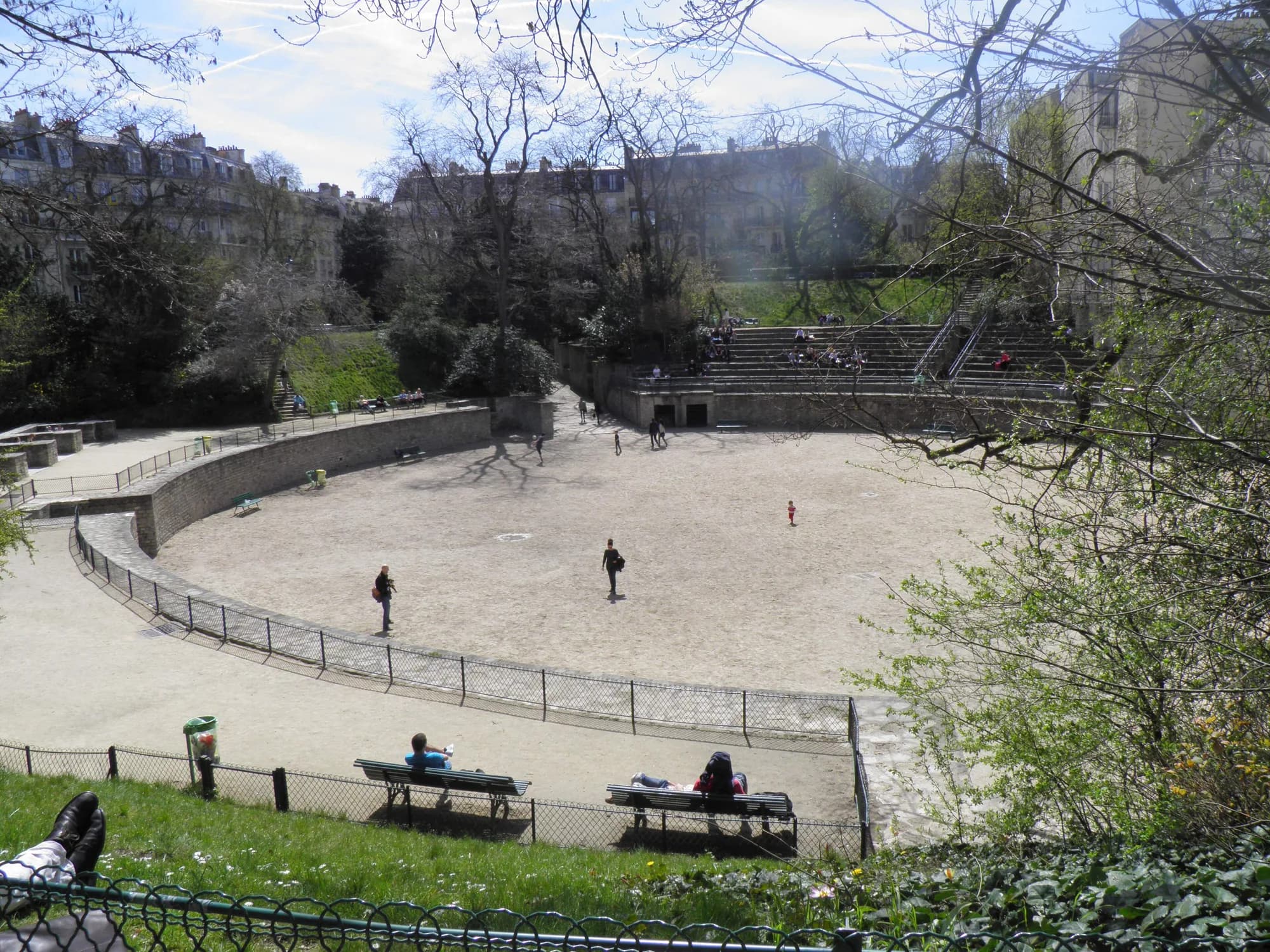
Arènes de Lutèce
Imagine stepping back in time, wandering through the ancient streets of Paris, where the echoes of Roman gladiators and the roar of the crowd still linger in the air. The Arènes de Lutèce, a hidden gem in the heart of the Latin Quarter, invites you to explore its storied past and vibrant present. This remarkable Gallo-Roman amphitheatre, one of the oldest surviving structures in the city, was once the epicenter of entertainment in ancient Lutetia. Today, it stands as a peaceful public park, where the past seamlessly blends with the present, offering a unique glimpse into the rich tapestry of Parisian history. Whether you're marveling at its architectural ingenuity, enjoying a leisurely stroll among the ruins, or simply soaking in the atmosphere, the Arènes de Lutèce promises an unforgettable journey through time.
Tucked discreetly behind residential apartment buildings in the heart of the 5th arrondissement's Latin Quarter, the Arènes de Lutèce is one of the oldest and most remarkable surviving Roman monuments in Paris. Constructed in the late 1st to early 2nd century AD when the city was known as Lutetia (Lutèce), this massive Gallo-Roman amphitheatre was designed as an ingenious hybrid structure—a combined theatre and amphitheatre capable of accommodating roughly 15,000 to 17,000 spectators for both dramatic theatrical performances and gladiatorial combats or wild animal games. Today, the sunken elliptical arena, restored stone bleachers, and preserved stage niches form a peaceful, public urban park where visitors can wander ancient ruins, sit in the terraced stone bleachers, and watch local Parisians play pétanque and football in the very space where Roman gladiators once stood.
History
Erected around the end of the 1st century or early 2nd century AD during the reigns of Emperors Trajan or Hadrian, the Arènes de Lutèce stood on the eastern slope of the Montagne Sainte-Geneviève, just outside the dense urban core of Gallo-Roman Lutetia. For over two centuries, it formed the beating heart of local entertainment, staging tragedies, comedies, athletic games, and combats. \n\nFollowing the barbarian invasions of 275 AD, the city's inhabitants partially dismantled the arena to use its heavy limestone blocks to fortify the defensive ramparts around Île de la Cité. Although King Chilperic I briefly restored the structure for public spectacles in 577 AD, the site fell into disuse during the Middle Ages, gradually serving as a necropolis and eventually being buried beneath earth and debris during the excavation of ditches for King Philippe Auguste's city wall around 1210.\n\nFor nearly seven centuries, the exact location of the arena was lost to memory, persisting only in the name of the surrounding 'rue des Arènes' district. In 1869, during Baron Haussmann's urban renewal and the construction of Rue Monge, archaeologist Théodore Vacquer uncovered the forgotten ruins. When the Compagnie Générale des Omnibus planned to build a municipal tramway depot over the archaeological site, a vigorous preservation campaign led by literary titan Victor Hugo and the Société des Amis des Arènes persuaded the City of Paris to acquire the land in 1883. Officially classified as a Historical Monument in 1884, the site was meticulously excavated and restored by anthropologist Dr. Jean-Louis Capitan and architect Julien Formigé, opening to the public as a municipal park in 1896.
Fun Facts
- Hybrid Amphitheatre Design: Arènes de Lutèce is a rare 'amphithéâtre à scène', featuring a 41-metre-long raised stage flanked by an elliptical sunken arena for gladiatorial bouts and beast hunts.
- Saved by Victor Hugo: In 1883, Victor Hugo's impassioned public letter preserved the site from a bus depot project.
- Hidden Residential Portal: The primary entrance on Rue Monge is concealed within the carriage gateway of a 19th-century Haussmannian apartment building (No. 49).
- Historic Sports Venue: The arena hosted the French National Basketball Championship final in 1926 and served as the home court for France's national basketball team.
- Ancient Animal Cages: Visitors can still view the five recessed stone chambers (carceres) built beneath the lower seating tiers, which once held wild animals before they were released into the arena during games.
Guide Tips
- Finding the Entrance: Enter through the arched stone passageway at 49 Rue Monge (look for the gladiator relief above the door) or via the tranquil garden pathways of Square Capitan and Rue des Arènes.
- Architectural Highlights: Walk along the western perimeter to examine the original Roman stage podium wall, the statue niches, and the nine recessed chambers used as dressing rooms and animal cages.
- Neighborhood Pairing: After exploring the ruins, stroll 5 minutes up Rue Monge to Place de la Contrescarpe and the lively market street Rue Mouffetard for coffee or a French pastry.
- Photography Tip: Sit high on the northern stone tiers for a wide panoramic shot looking down over the sun-dappled sand arena framed by century-old verzy beech and chestnut trees.
Opening Hours
Open daily: 08:30 - 17:00 (Winter) / 08:00 - 21:30 (Summer) - External Visit / Public Square