
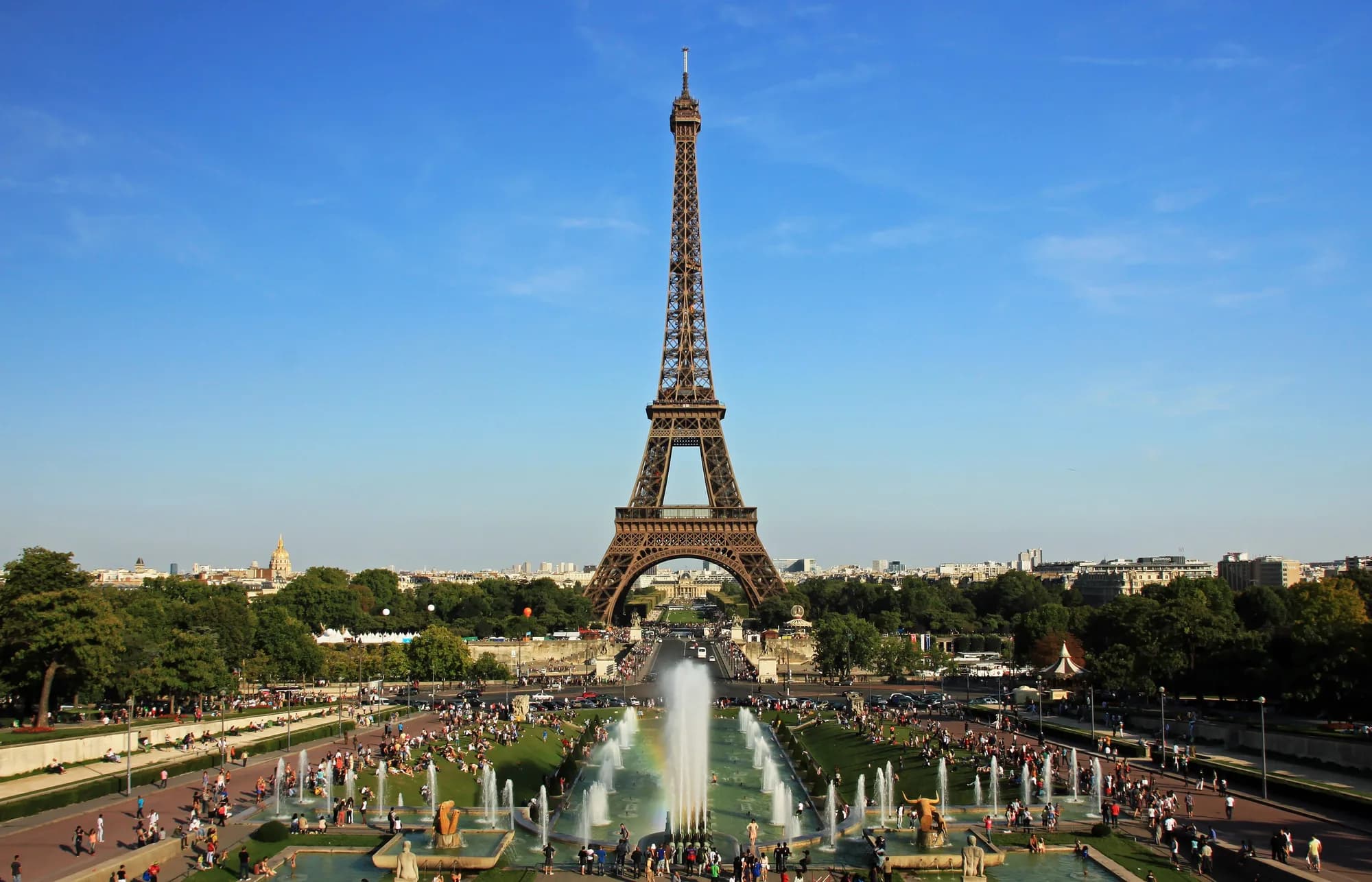
Eiffel Tower
Imagine standing atop one of the world's most iconic landmarks, the Eiffel Tower, gazing out over the sprawling cityscape of Paris. This towering wrought-iron marvel, standing at 330 meters, is not just a symbol of France but a testament to human ingenuity and engineering prowess. Whether you're ascending its three observation decks, marveling at its intricate ironwork, or simply soaking in the breathtaking views, the Eiffel Tower promises an unforgettable experience that captures the essence of Parisian charm and history. As the sun sets, the tower transforms into a dazzling spectacle with its golden floodlights and hourly diamond sparkle, making it a must-see destination for every traveler.
Soaring 330 meters (1,083 feet) above the Champ de Mars in Paris's 7th arrondissement, the Eiffel Tower (La Tour Eiffel) is the world's most universally recognized architectural icon and the quintessential symbol of France. Designed by engineers Maurice Koechlin and Émile Nouguier alongside architect Stephen Sauvestre, and constructed under the visionary leadership of Gustave Eiffel between 1887 and 1889, this monumental wrought-iron lattice tower was built as the triumphant entrance arch for the 1889 Exposition Universelle (World's Fair) celebrating the centennial of the French Revolution. Comprising 18,038 individual puddle-iron components bound by 2.5 million rivets, the tower surpassed the Washington Monument upon completion to become the tallest human-made structure in the world—a record it held proudly for 41 years until 1930. Today, visitors from across the globe gather on the verdant Champ de Mars, the Pont d'Iéna, and the elevated terraces of the Trocadéro to marvel at its soaring architectural silhouette, ascend its three panoramic observation tiers, and witness its spectacular golden floodlighting and hourly diamond sparkle after nightfall.
History
The creation of the Eiffel Tower was born from the French Republic's ambition to showcase its industrial mastery, engineering genius, and economic resurgence at the 1889 Exposition Universelle, coinciding with the 100th anniversary of the storming of the Bastille and the French Revolution. In May 1884, senior engineers Maurice Koechlin and Émile Nouguier of the Compagnie des Établissements Eiffel drafted the initial concept for a 300-meter metal pylon. Architectural embellishments by Stephen Sauvestre added the monumental decorative ground arches, glazed viewing pavilions, and refined cupola. Gustave Eiffel enthusiastically backed the venture, securing private and municipal financing and signing the construction contract on January 8, 1887.\n\nWork on the deep caisson foundations beside the Seine began on January 28, 1887, followed by the erection of the four massive inclined iron piers using wooden scaffolding and hydraulic alignment jacks. Despite a fiery public protest published in Le Temps by prominent French writers and artists—including Guy de Maupassant, Charles Garnier, and Alexandre Dumas fils, who decried it as a 'useless and monstrous column of bolted sheet metal'—Eiffel championed the aesthetic unity of natural forces and industrial design. The tower was completed in just 2 years, 2 months, and 5 days on March 31, 1889, when Gustave Eiffel unfurled the French Tricolour from the pinnacle accompanied by a 25-gun salute. Over 1.9 million visitors climbed the monument during the 1889 World's Fair.\n\nWhile originally intended to be dismantled in 1909, Eiffel championed scientific experimentation atop the summit, installing meteorological stations, wind resistance laboratories, and military radio antennas. During the First Battle of the Marne in 1914, the tower's wireless station jammed German military communications, solidifying its permanent national utility. Classified as a Historical Monument (Monument Historique) in 1964 and inscribed as part of the UNESCO World Heritage Banks of the Seine in 1991, the Eiffel Tower remains one of the world's most enduring symbols of human innovation and French culture.
Fun Facts
- The World's Tallest Monument for 41 Years: Rising 300 meters at its 1889 inauguration (now 330 meters with broadcast aerials), the Eiffel Tower was the world's tallest human-made structure until the Chrysler Building was completed in New York City in 1930.
- 2.5 Million Rivets and Puddle Iron: The structure was fabricated using 7,300 tonnes of wrought iron (puddle iron) and assembled with 2.5 million rivets, designed with such mathematical precision that rivet holes were aligned to within 1 millimeter.
- 72 Names of French Scientists: Engraved on the friezes under the first-floor balcony are the names of 72 prominent French scientists, mathematicians, and engineers (including Fourier, Laplace, Ampère, and Lavoisier) in recognition of their contributions to the nation.
- Thermal Expansion and Wind Sway: Because iron expands when heated, the tower grows by up to 15 centimeters (6 inches) in peak summer heat and subtly tilts a few centimeters away from the sun due to thermal expansion.
- Saved by Radio Telegraphy: Originally granted a 20-year concession slated for demolition in 1909, Gustave Eiffel saved the tower by demonstrating its strategic value for wireless telegraphy and meteorology, later proving crucial for intercepting enemy transmissions during World War I.
Guide Tips
- Premier Photography Viewpoints: Capture the quintessential full-tower shot from the elevated Place du Trocadéro marble plaza, from the green lawns of the Champ de Mars, or framed through the neoclassical arches of the Pont de Bir-Hakeim.
- Evening Light Show & Diamond Sparkle: The tower illuminates automatically at dusk with golden floodlights, followed by a dazzling 5-minute diamond sparkle show every hour on the hour until 01:00.
- Stairs vs. Elevator Ascent: Climbing the 674 stairs to the second floor is faster and more affordable than waiting for the elevators, providing a close-up perspective of the intricate lattice ironwork.
- First & Second Floor Amenities: The first floor features an exhilarating transparent glass floor 57 meters above ground, while the second floor offers panoramic viewing telescopes, gift boutiques, and Michelin-starred dining at Le Jules Verne.
Opening Hours
Open daily: Jun 14–Aug 31: 09:00 - 00:00 (Stairs & Elevator); Sep 1–Jun 13: 09:30 - 23:45 (Elevator), 09:30 - 23:00 (Stairs) - External Esplanade Viewing: 24/7