
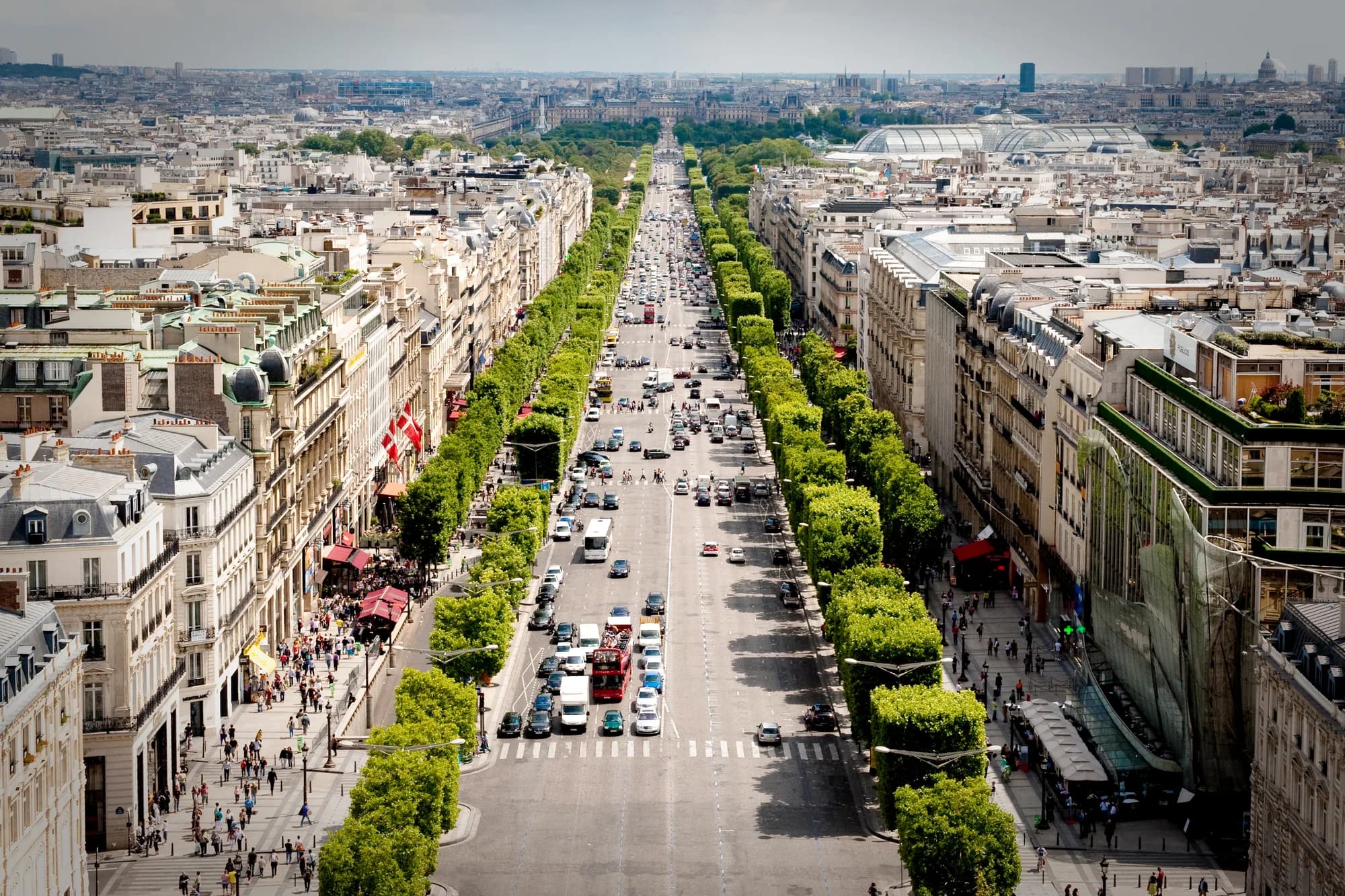
Champs-Élysées
Imagine yourself walking down one of the world's most iconic boulevards, the Champs-Élysées, where history and modernity converge in a spectacular display of Parisian elegance. Stretching nearly two kilometers from Place de la Concorde to the majestic Arc de Triomphe, this grand avenue is not just a thoroughfare but a living testament to the grandeur of Paris. Whether you're strolling through the tranquil lower gardens, lined with historic palaces and lush greenery, or exploring the upper section's luxury boutiques and vibrant cafés, the Champs-Élysées offers a quintessential Parisian experience that captivates the heart and soul.
Stretching nearly two kilometers through the heart of the 8th arrondissement, the Avenue des Champs-Élysées is one of the world's most famous and celebrated monumental boulevards. Known affectionately in France as 'la plus belle avenue du monde' (the most beautiful avenue in the world), this grand 70-meter-wide thoroughfare forms the central artery of Paris's legendary Axe Historique (Historical Axis), connecting Place de la Concorde in the east to Place Charles de Gaulle and the Arc de Triomphe in the west. The avenue divides naturally into two distinct sections: the tranquil lower portion, framed by the lush English-style gardens of the Jardins des Champs-Élysées, the Grand Palais, the Petit Palais, and the Élysée Palace; and the bustling upper portion, lined with flagship luxury boutiques, historic cinema halls, flagship concept stores, and iconic Parisian café terraces. A leisurely stroll along its broad, tree-shaded sidewalks offers travelers quintessential panoramic vistas across the French capital.
History
The history of the Champs-Élysées mirrors the urban expansion and ceremonial grandeur of modern Paris. In the early 17th century, the area beyond the Tuileries Garden was largely uninhabited marshland, fields, and market gardens. In 1667, King Louis XIV and his premier royal landscape designer, André Le Nôtre, created a wide promenade planted with double rows of elm trees, extending the central visual axis of the Tuileries Palace toward the west. By 1709, this popular royal boulevard was officially renamed the 'Avenue des Champs-Élysées'.\n\nThroughout the 18th and 19th centuries, the avenue underwent dramatic transformations. In 1724, the Duc d'Antin extended the avenue to the summit of the Chaillot hill (now Place Charles de Gaulle). Following the French Revolution, the Champs-Élysées became a vibrant public gathering place. Between 1834 and 1840, architect Jacques-Ignace Hittorff redesigned the promenade with cast-iron gas lamp posts, decorative stone fountains, and public garden pavilions, while Emperor Napoleon III and Baron Haussmann integrated the avenue into Paris's grand urban master plan, paving the way for grand Haussmannian hotels, theaters, and diplomatic residences.\n\nOver the 20th and 21st centuries, the Champs-Élysées cemented its status as France's foremost stage for historical milestones: the 1919 Allied Victory Parade following World War I, the joyous march led by General Charles de Gaulle on August 26, 1944, during the Liberation of Paris, and monumental New Year celebrations. Today, preserved as a premier global cultural, fashion, and civic corridor, the avenue continues to evolve with ambitious ecological and pedestrian enhancement projects.
Fun Facts
- Ancient Greek Mythology: The name 'Champs-Élysées' translates to 'Elysian Fields', the paradise reserved for heroes and virtuous souls in Greek and Roman mythology.
- Royal Landscaping Origins: Originally marshland and vegetable gardens, the avenue was first laid out in 1667 by André Le Nôtre, master landscape architect of Versailles and the Tuileries Gardens, as the 'Grand-Cours' promenade extending westward from the royal palace.
- The Grand Tour de France Finale: Since 1975, the Champs-Élysées has served as the iconic final stage and sprint finish line of the Tour de France cycling race, culminating in thrilling laps around the avenue and Place de la Concorde.
- National Ceremonial Stage: The boulevard is France's premier ceremonial thoroughfare, hosting the annual Bastille Day military parade every July 14th, as well as historic national celebrations including the 1944 Liberation of Paris and World Cup victory parades in 1998 and 2018.
- Paris Respire Initiative: On the first Sunday of every month, the entire 1.9-kilometer avenue is completely closed to automobile traffic and reserved exclusively for pedestrians, rollerbladers, and cyclists.
Guide Tips
- Best Walking Direction: Start at Place de la Concorde and walk uphill toward the Arc de Triomphe, which creates a dramatic, continuously expanding architectural perspective framing the monument.
- Twilight & Evening Illumination: Visit during the evening when the avenue's iconic ornate street lanterns, historic palace façades, and the Arc de Triomphe are illuminated against the Parisian night sky.
- Explore the Lower Gardens: Take time to wander through the quiet tree-lined Jardins des Champs-Élysées on the lower avenue to admire the glass-domed Grand Palais and the ornate Beaux-Arts façades of the Petit Palais.
- Traditional Pastries & Cafés: Stop by legendary establishments such as Ladurée or stroll down neighboring Avenue Montaigne to explore the historic 'Golden Triangle' (Triangle d'Or) of Parisian haute couture.
Opening Hours
24/7 - External Public Avenue & Promenade (Shops & cafes typically daily 10:00 - 20:00)