
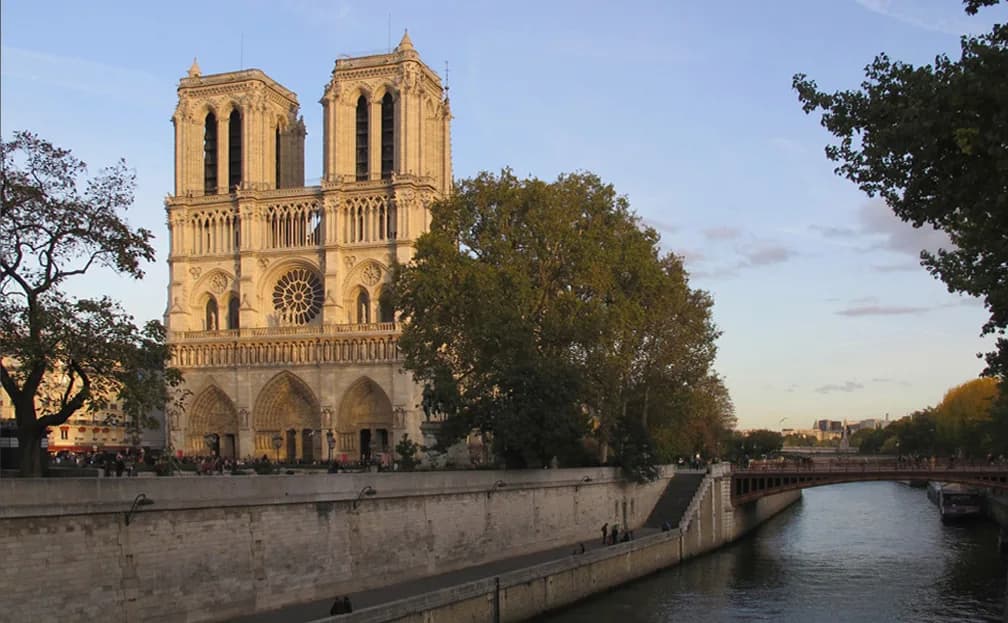
Cathédrale Notre-Dame de Paris
Imagine standing before the awe-inspiring Cathédrale Notre-Dame de Paris, a timeless beacon of French Gothic architecture that has stood proudly on the eastern end of the Île de la Cité for centuries. This iconic landmark, commissioned in 1163 and largely completed by 1250, is a testament to the ingenuity of its creators, featuring pioneering ribbed vaults, soaring flying buttresses, and three magnificent stained-glass rose windows. As you walk the external circuit, you'll be captivated by the intricate details of the West Façade, the dramatic flying buttresses, and the newly reconstructed spire, all of which tell the story of a cathedral that has weathered centuries of history and emerged more magnificent than ever. Whether you're a history buff, an architecture enthusiast, or simply a traveler seeking to experience the essence of Paris, Notre-Dame offers a journey through time and a glimpse into the heart of French culture.
Standing majestically on the eastern end of the Île de la Cité, Cathédrale Notre-Dame de Paris is one of the world's most celebrated masterpieces of French Gothic architecture. Commissioned in 1163 by Bishop Maurice de Sully and largely completed by 1250, the cathedral is renowned worldwide for its pioneering ribbed vaults, soaring flying buttresses, monumental twin 69-meter bell towers, and three magnificent stained-glass rose windows. An external walking circuit allows visitors to marvel at the harmonious West Façade with its three intricately sculpted portals (Virgin, Last Judgment, and St. Anne), the Gallery of Kings, the dramatic Gothic flying buttresses arching over the Seine from the south quays, and the reconstructed 96-meter oak-and-lead spire designed by Eugène Viollet-le-Duc.
History
Construction of Notre-Dame began under Bishop Maurice de Sully in 1163 during the reign of King Louis VII, marking a pivotal transition from Romanesque to high Gothic architectural design. Over its eight-century history, the cathedral has stood at the center of momentous French historical events: the coronation of King Henry VI of England in 1431 during the Hundred Years' War, the rehabilitation trial of Joan of Arc in 1456, the coronation of Napoleon Bonaparte as Emperor in 1804, and the Te Deum celebrating the Liberation of Paris in 1944. After suffering damage during the French Revolution, Victor Hugo’s 1831 masterpiece novel 'The Hunchback of Notre-Dame' sparked a massive national preservation movement, leading to a legendary 19th-century restoration by architect Eugène Viollet-le-Duc. Following the devastating fire of April 15, 2019, an unprecedented international restoration effort meticulously rebuilt the timber frame ('the forest') and iconic spire according to Viollet-le-Duc's original historic designs, leading to its historic reopening in December 2024.
Fun Facts
- In the paving of the cathedral's parvis sits 'Point Zéro des Routes de France' (Kilometre Zero), the geographic reference point from which all highway distances in France are measured.
- The South Tower houses the cathedral's heaviest bell, the historic 'Emmanuel' bourdon, cast in 1681 and weighing over 13 tonnes (sounded only on major historical and religious occasions).
- Victor Hugo wrote his famous 1831 novel 'Notre-Dame de Paris' specifically to raise public awareness about the neglected cathedral, inspiring a nationwide restoration movement led by Eugène Viollet-le-Duc.
- The 28 stone figures on the Gallery of Kings above the western portals represent the Kings of Judah and Israel; revolutionaries in 1793 mistakenly believed them to be French monarchs and decapitated them (many original heads are now preserved in the Musée de Cluny).
- The famous whimsical gargoyles (chimeras) perched on the upper balustrades, including the iconic 'Stryge', were added during Viollet-le-Duc's 19th-century restoration rather than medieval times.
Guide Tips
- Complete the full 360-degree exterior loop: start in front of the West Façade on the parvis, walk along the Left Bank on Quai de Montebello to admire the soaring south flying buttresses, cross Pont de la Tournelle for a classic postcard view of the apse, and view the north transept from Rue du Cloître-Notre-Dame.
- Best photo spots: Pont Saint-Louis and Pont de la Tournelle provide stunning unobstructed angles of the choir, flying buttresses, and spire rising above the Seine.
- Visit at sunset or early morning when golden light illuminates the limestone façades and the parvis is comparatively peaceful.
- Look down right in the middle of the parvis square to find the bronze octagonal 'Point Zéro' medallion embedded in the stone.
Opening Hours
24/7 - External Parvis & Quayside Viewing (Cathedral interior: Mon-Wed, Fri 07:50 - 19:00, Thu 07:50 - 22:00, Sat-Sun 08:15 - 19:30)