
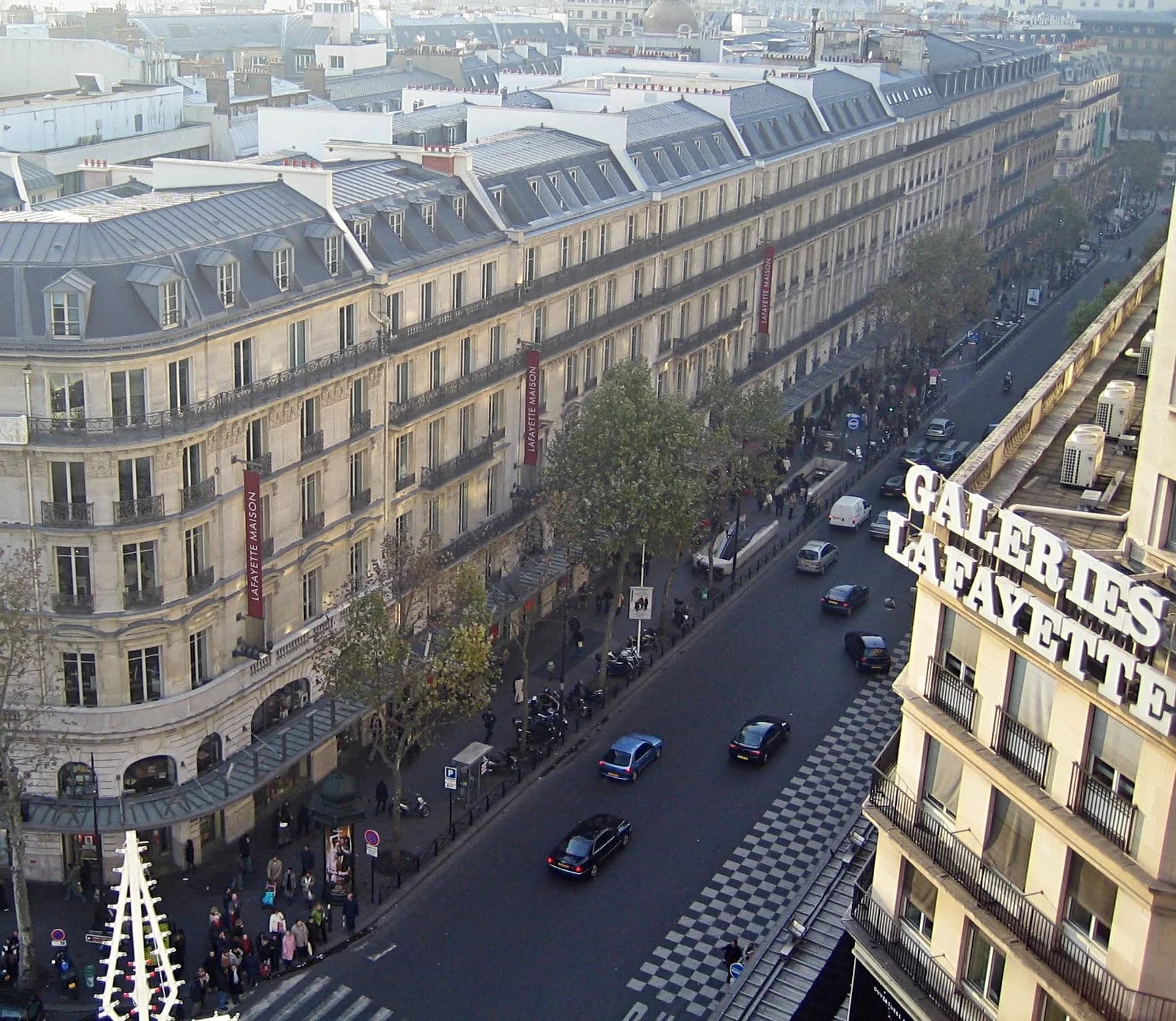
Boulevard Haussmann
Imagine strolling down one of Paris's most illustrious avenues, where every turn reveals a new facet of the city's rich history and architectural splendor. Boulevard Haussmann, stretching majestically across the 8th and 9th arrondissements, is not just a thoroughfare but a living testament to the grandeur of the Belle Époque. From the elegant limestone façades and wrought-iron balconies to the iconic department stores that line its path, this boulevard offers a captivating journey through time. Whether you're admiring the Art Nouveau dome of Galeries Lafayette or discovering the literary legacy of Marcel Proust, Boulevard Haussmann promises an unforgettable experience steeped in Parisian elegance and charm.
Stretching 2.53 kilometers across the 8th and 9th arrondissements from Rue Drouot in the east to Avenue de Friedland in the west, Boulevard Haussmann is one of Paris's grandest and most celebrated thoroughfares. Created as the flagship arterial corridor of the monumental 19th-century urban redesign commissioned by Emperor Napoleon III and directed by Baron Georges-Eugène Haussmann, the boulevard is a textbook showcase of classical Haussmannian urban planning. Lined with majestic cream-colored Lutetian limestone façades, rhythmic wrought-iron balconies on the second and fifth floors, elegant mansard slate roofs, and rows of plane trees, it represents the architectural harmony of the Belle Époque. Boulevard Haussmann transitions seamlessly from an aristocratic residential and financial quarter in the west into Paris's vibrant epicenter of luxury fashion and retail in the east, anchored by the world-famous flagship department stores Galeries Lafayette and Printemps Haussmann, the monumental Church of Saint-Augustin, and the historic residence of author Marcel Proust.
History
Boulevard Haussmann stands as one of the most prominent monuments to the urban metamorphosis that modernized Paris during the Second French Empire. In 1853, Emperor Napoleon III tasked Georges-Eugène Haussmann with transforming Paris from a crowded, disease-prone medieval city into a modern, airy, and well-connected metropolis. \n\nCommissioned by decree in 1857, Boulevard Haussmann was engineered as a grand east-west transversal axis linking the bustling business district of the Grands Boulevards and the newly planned Palais Garnier to the affluent residential neighborhoods of the 8th arrondissement. Constructing the thoroughfare involved clearing older medieval and neoclassical street patterns and enforcing strict architectural regulations to ensure uniform limestone masonry, continuous balcony lines, and proportional building heights.\n\nFollowing Haussmann's departure in 1870, construction paused before being completed in stages. The final eastern link between Rue Taitbout and Boulevard des Italiens was officially inaugurated on January 15, 1926, by President Gaston Doumergue. Across the late 19th and 20th centuries, Boulevard Haussmann established itself as a nexus of high society, international finance, literature, and world-leading department stores, maintaining its status as a timeless symbol of Parisian grandeur.
Fun Facts
- Named After Paris's Modern Architect: The boulevard is named in honor of Baron Georges-Eugène Haussmann, the Prefect of the Seine who directed the radical transformation and modernization of Paris under Emperor Napoleon III.
- A 70-Year Construction Timeline: While initiated under imperial decree in 1857, the final eastern segment connecting Rue Taitbout to the Grands Boulevards was only completed in 1926, when it was inaugurated by French President Gaston Doumergue.
- Marcel Proust's Cork-Lined Haven: French author Marcel Proust lived at 102 Boulevard Haussmann from 1906 to 1919, where he famously soundproofed his bedroom with cork panels to write his magnum opus 'In Search of Lost Time' in complete silence.
- Epicenter of 'Grands Magasins': The boulevard became the global birthplace of modern department store shopping with the emergence of Printemps (1865) and Galeries Lafayette (1893), featuring spectacular stained-glass domes and opulent balconies.
- Haussmannian Geometry: Every building along the boulevard conforms to strict 19th-century regulations governing stone material, balcony alignment, roof pitch (45 degrees), and proportions tailored to the street's 30-meter width.
Guide Tips
- Free Panoramic Rooftop Views: Visit the rooftop terrace of Galeries Lafayette Haussmann (7th floor) for sweeping, unobstructed panoramic views of the Palais Garnier, Eiffel Tower, and Parisian skyline.
- Gaze at the Art Nouveau Dome: Step inside Galeries Lafayette to admire the monumental 43-meter neo-Byzantine glass dome (Coupole) designed by master glass artist Jacques Grüber in 1912.
- Discover the Musée Jacquemart-André: Toward the western end at No. 158, explore this lavish Second Empire private mansion holding an extraordinary collection of Italian Renaissance and French 18th-century art.
- Recommended Walking Direction: Start at the Church of Saint-Augustin and walk eastward toward Opéra Garnier to experience the transition from quiet Haussmannian avenues to the bustling shopping district.
Opening Hours
24/7 - External Public Boulevard & Promenade (Department stores & boutiques typically Mon-Sat 10:00 - 20:00, Sun 11:00 - 20:00)