
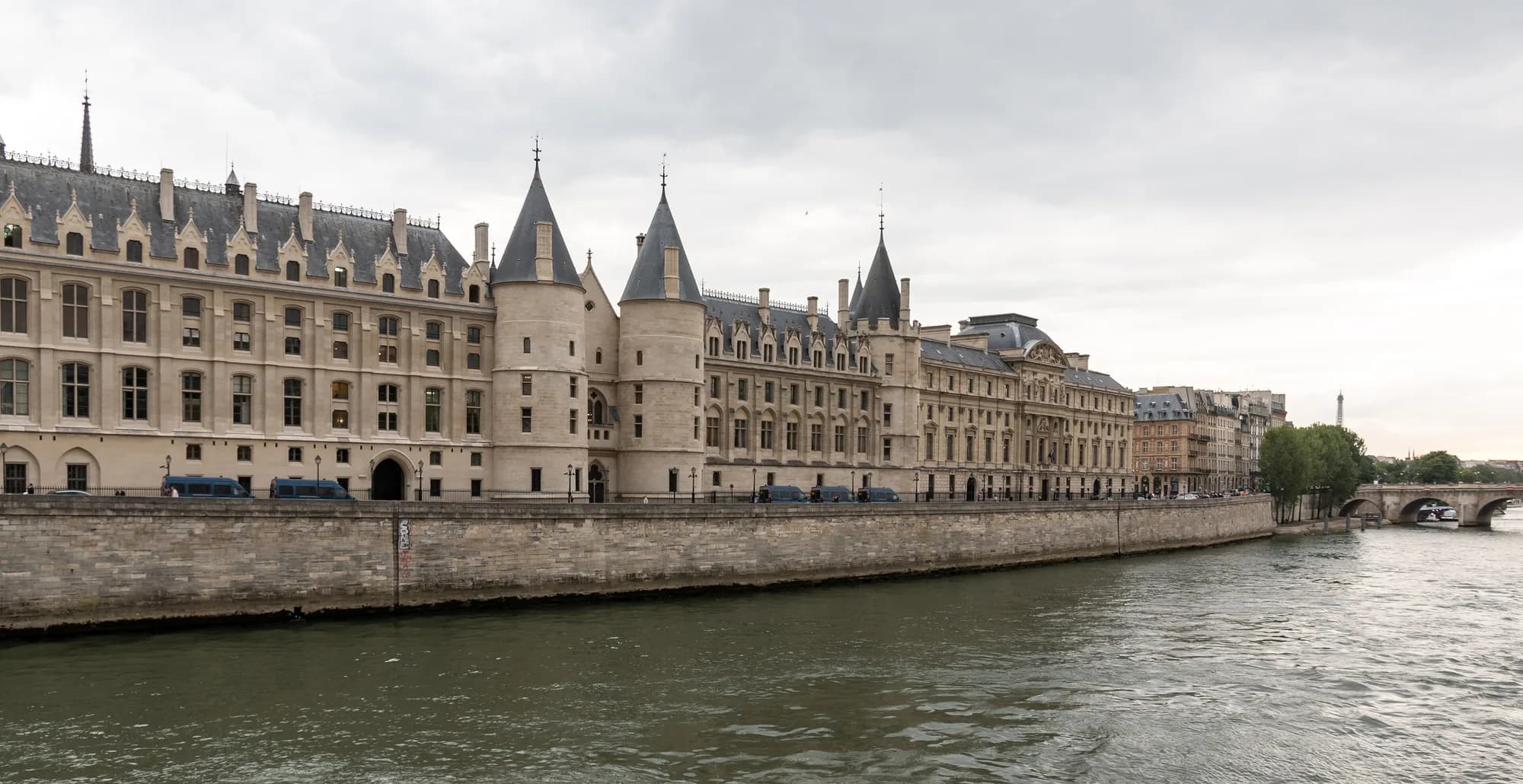
Conciergerie
Imagine standing on the banks of the Seine, gazing up at the majestic Conciergerie, a testament to Paris's rich medieval and revolutionary history. This imposing fortress, with its four magnificent stone towers, has witnessed centuries of power, justice, and tragedy. From the oldest public clock in Paris to the chilling echoes of the torture chambers, the Conciergerie offers a unique glimpse into the past. Whether you're captivated by Gothic architecture or the dramatic events of the French Revolution, this landmark promises an unforgettable journey through time.
Stretching dramatically along the northern embankment of the Île de la Cité on Quai de l'Horloge, the Conciergerie is one of Paris's most imposing medieval architectural treasures. Originally part of the Palais de la Cité—the first royal seat of the Kings of France from the 10th to the 14th centuries—the monumental riverside fortress retains four magnificent medieval stone towers: the 47-meter Tour de l'Horloge (housing the oldest public clock in Paris, crafted in 1370), the twin defensive towers Tour de César and Tour d'Argent, and the Tour Bonbec. An external walking tour offers sweeping views from the Pont au Change and Quai de la Mégisserie across the Seine, showcasing the breathtaking Gothic battlements, soaring conical pepper-pot turrets, and the dazzling gilded Renaissance dial of the Grand Clock. Beyond its medieval royal splendor, the fortress holds deep historical significance as the infamous revolutionary prison where Queen Marie Antoinette, Georges Danton, and Maximilien Robespierre were held during the Reign of Terror.
History
The site of the Conciergerie has formed the nerve center of power in Paris since antiquity, when Roman governors established a fortified praetorium on the Île de la Cité. Under the Capetian dynasty, King Robert II the Pious built the first formal royal palace here in the 10th century. Between 1302 and 1314, King Philip IV 'the Fair' (Philippe le Bel) transformed the complex into a monumental Gothic palace of unmatched grandeur, erecting the Hall of the Men-at-Arms, the Guardroom, and the formidable riverside towers along the Seine to demonstrate the prestige and centralized authority of the French monarchy.\n\nFollowing the bloody uprising of Parisian merchants led by Étienne Marcel in 1358, the young Dauphin (later King Charles V) abandoned the palace for the greater safety of the Louvre and Hôtel Saint-Pol. The administration of the palace was entrusted to a royal steward—the Concierge—while the complex became the permanent headquarters of the Parlement de Paris, the kingdom's highest sovereign court of justice. Gradually, the palace's vaulted lower chambers were repurposed into a central judicial prison.\n\nDuring the French Revolution, the Conciergerie gained worldwide notoriety as the primary detention center for the Revolutionary Tribunal during the Reign of Terror (1793–1794). More than 2,700 prisoners were tried and sentenced to death here, including Queen Marie Antoinette, Madame Roland, the Girondin deputies, and eventually the architects of the Terror themselves, Georges Danton and Maximilien Robespierre. Following the Bourbon Restoration and 19th-century restorations by architects Antoine-Nicolas Bailly and Louis-Joseph Duc, the Conciergerie was designated a Historical Monument in 1862 and opened to the public as a national museum in 1914, remaining a powerful symbol of French royal legacy, Gothic architecture, and revolutionary history.
Fun Facts
- ⏰ Oldest Public Clock in Paris: Commissioned in 1370 by King Charles V and installed on the 47-metre Tour de l'Horloge, the monumental clock was Paris's very first public civic timekeeper, featuring a sumptuous gilded dial sculpted in 1585 by Germain Pilon with allegorical figures of Law and Justice.
- 👑 The Concierge's Royal Domain: When King Charles V relocated the royal residence to the Louvre in 1358, he appointed a high-ranking governor termed the 'Concierge' to administer the palace and maintain royal justice, which gave the landmark its enduring name.
- 🏰 Europe's Largest Medieval Hall: Beneath the fortress lies the legendary Hall of the Men-at-Arms (Salle des Gens d'Armes), a Gothic masterpiece spanning 1,785 square metres with 64 soaring rib-vaulted pillars, built between 1302 and 1313 under King Philippe IV (Philip the Fair).
- 🗣️ The 'Singing' Torture Tower: The westernmost turret, Tour Bonbec ('good beak'), derived its moniker from housing the medieval torture chamber, where interrogations were designed to make prisoners 'sing' (confess).
- ⚖️ Gateway to the Guillotine: During the French Revolution (1793–1794), the Revolutionary Tribunal held trials here; 2,781 condemned prisoners—most famously Queen Marie Antoinette—spent their final days within its walls before being carted to the guillotine.
Guide Tips
- 📸 Best Photography Spots: For the classic postcard panorama of all four towers reflected in the Seine, stand across the river on Quai de la Mégisserie or midway on the Pont au Change.
- ⏰ Admire the Clock Details: Walk up to the corner of Boulevard du Palais and Quai de l'Horloge to look up at the intricate Latin inscriptions, golden fleur-de-lis, and carved figures of King Henry III's royal clock dial.
- 🌅 Sunset & Night Illumination: In the evening, warm architectural floodlights illuminate the limestone turrets and gilded clock face, offering a magical contrast against the dark waters of the Seine.
- 🚶 Historic Island Loop: Pair your exterior visit with the neighboring Sainte-Chapelle, Place Dauphine at the western tip of Île de la Cité, and Pont Neuf.
Opening Hours
24/7 - External Visit / Quayside & Pont au Change Viewing (Monument interior visit: daily 09:30 - 18:00)