
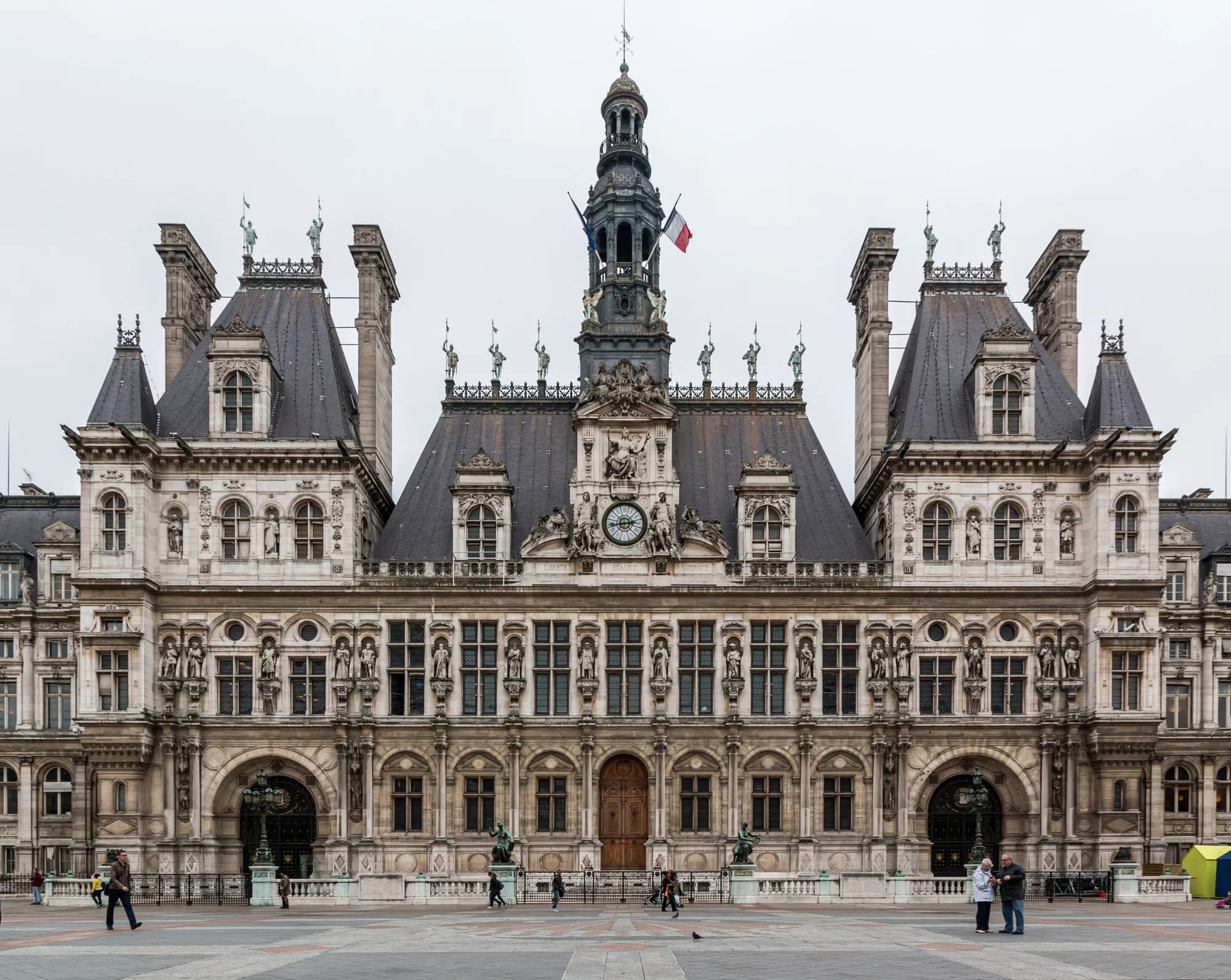
Hôtel de Ville
Step into the heart of Paris with a visit to the Hôtel de Ville, the city's historic seat of government. This grand French Renaissance Revival building, with its 143-meter-long façade adorned with 338 statues of Parisian luminaries, stands as a testament to the city's rich heritage. From its role in pivotal moments of French history to its stunning architecture, the Hôtel de Ville offers a captivating glimpse into the past and present of Paris. Whether you're exploring the intricate sculptures, capturing the perfect photo, or simply soaking in the atmosphere of this monumental landmark, your visit promises to be an unforgettable experience.
Standing majestically on the Right Bank of the Seine in the 4th arrondissement, the Hôtel de Ville de Paris is the monumental seat of the City of Paris's local government and one of the capital's most imposing architectural landmarks. Featuring an expansive 143-meter-long French Renaissance Revival façade, the building is adorned with 338 sculpted statues depicting illustrious Parisian historical figures, scientists, artists, and politicians, alongside a central 50-meter clock tower and allegorical rooftop sculptures. Facing the vast pedestrian Esplanade de la Libération (historically known as the Place de Grève), the site has served as the political, administrative, and revolutionary heart of Paris since the 14th century. An external visit offers travelers sweeping views of the grand civic palace, lively public gatherings, open-air cultural installations, and seasonal city festivals.
History
The municipal history of Paris on this site began in July 1357, when Étienne Marcel, the Provost of the Merchants (Prévôt des Marchands), purchased the 'Maison aux Piliers' (House of Pillars) on the gravelly riverbank square then known as Place de Grève. In 1533, King Francis I decided to endow Paris with a city hall worthy of its prestige, commissioning Italian architect Domenico da Cortona (Boccador) and French master mason Pierre de Chambiges to build a magnificent Renaissance palace, which was completed in 1628 under Louis XIII.\n\nThroughout modern French history, the Hôtel de Ville stood at the epicenter of revolutionary uprisings. During the French Revolution, the Paris Commune of 1792 governed the capital from its halls, and Robespierre was arrested here following the Thermidorian Reaction in 1794. It witnessed the proclamations of the Second Republic in 1848 and the Third Republic in 1870. In May 1871, during the tragic final days of the Paris Commune (the 'Bloody Week'), retreating Communards set the building ablaze, destroying centuries of municipal archives, royal records, and Renaissance artwork.\n\nBetween 1874 and 1882, the City of Paris organized a landmark architectural competition won by architects Théodore Ballu and Édouard Deperthes. They rebuilt the exterior in a faithful, grander Neo-Renaissance style inside a modern stone shell, while creating sumptuously gilded reception salons modeled after the Hall of Mirrors at Versailles. On August 25, 1944, General Charles de Gaulle delivered his legendary 'Paris outragé, Paris brisé, Paris martyrisé, mais Paris libéré' speech from the Hôtel de Ville, cementing its legacy as the enduring symbol of French civic pride and democratic resistance.
Fun Facts
- Gallery of 338 Statues: The exterior façades are adorned with 338 individual stone statues of celebrated Parisian figures, including Voltaire, Molière, Rousseau, Delacroix, and Lavoisier, as well as allegorical statues representing French cities.
- The Great Fire of 1871: During the Bloody Week of the Paris Commune in May 1871, the original Renaissance building was gutted by fire, destroying irreplaceable historical treasures such as the city's parish registers dating back to the 16th century.
- De Gaulle's Liberation Speech: On August 25, 1944, following the Liberation of Paris from Nazi occupation, General Charles de Gaulle stood at the Hôtel de Ville to deliver his immortal proclamation declaring Paris liberated.
- Place de Grève & Modern Events: Historically called Place de Grève—where unemployed workers gathered to look for work (origin of the French phrase 'faire la grève', to go on strike)—the esplanade now hosts major events, open-air concerts, and served as the starting point for the 2024 Olympic marathon.
- Europe's Largest Municipal Hall: The building is the largest municipal government headquarters in Europe, boasting a main hall (Salle des Fêtes) designed as a direct tribute to the Hall of Mirrors at Versailles.
Guide Tips
- Exterior Walking Circuit: Walk the complete perimeter from the Esplanade de la Libération along Rue de Rivoli, Rue de Lobau, and Quai de l'Hôtel de Ville to take in all four distinct sculpted façades and the equestrian statue of Étienne Marcel.
- Best Photo Spots: Stand near the center of the Esplanade de la Libération for a wide-angle shot capturing the entire 143-meter façade, or cross the Pont d'Arcole for a picturesque riverside view framed by the Seine.
- Evening Illumination: Visit after dusk when the grand clock tower, architectural lanterns, and ornate pediments are warmly illuminated against the Parisian sky.
- Marais & River Connection: The stop serves as a natural gateway connecting Île de la Cité (via Pont d'Arcole) to the historic Marais district and BHV Marais department store just across Rue de Rivoli.
Opening Hours
24/7 - External Visit / Esplanade de la Libération Viewing (Town Hall interior exhibitions & tours: Mon-Sat 10:00 - 18:30)