
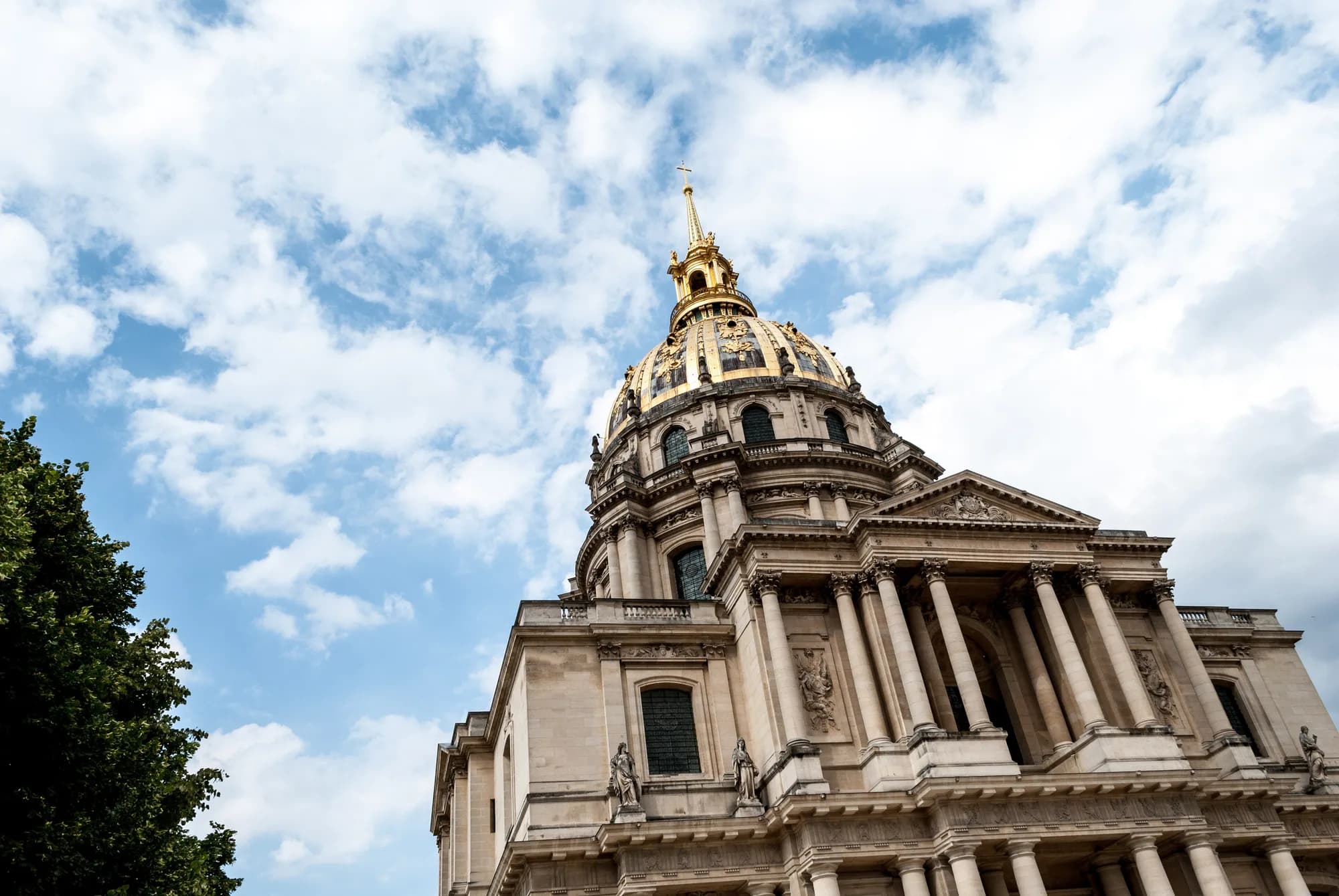
Les Invalides
Imagine standing beneath the awe-inspiring golden dome of Les Invalides, a testament to French Classical architecture that dominates the skyline of Paris's 7th arrondissement. This monumental complex, commissioned by King Louis XIV in 1670 as a royal hospital and retirement home for war veterans, is not just a historical landmark but a living museum. Today, it houses the Musée de l'Armée, one of the largest military history museums in the world, the Musée des Plans-Reliefs, and the Cathédrale Saint-Louis-des-Invalides, the national cathedral of the French military. Beneath the soaring Dôme des Invalides lies the monumental red quartzite crypt and sarcophagus of Napoleon Bonaparte, alongside the resting places of other French military heroes. A stroll from the Esplanade des Invalides to Place Vauban offers one of the most breathtaking architectural vistas in Europe, making Les Invalides a must-visit destination for anyone exploring Paris.
Dominating the skyline of Paris's 7th arrondissement with its glittering 107-metre gilded dome, Les Invalides (officially L'Hôtel National des Invalides) is one of the grandest masterworks of French Classical architecture. Commissioned in 1670 by King Louis XIV as a royal hospital and retirement home for aged and wounded war veterans, the monumental complex spans 13 hectares and combines majestic baroque pavilions, vast arcaded courtyards, and tranquil formal gardens. Today, the complex houses the world-renowned Musée de l'Armée (one of the largest military history museums in the world), the Musée des Plans-Reliefs, the Cathédrale Saint-Louis-des-Invalides (the national cathedral of the French military), and the awe-inspiring Dôme des Invalides. Directly beneath the soaring golden cupola rests the monumental red quartzite crypt and sarcophagus of Napoleon Bonaparte, alongside the resting places of French military heroes such as Marshal Turenne, Vauban, and Marshal Foch. An exterior stroll from the sweeping green lawns of the Esplanade des Invalides on the Seine to the classical southern façade at Place Vauban offers one of the most breathtaking architectural vistas in Europe.
History
In the late 17th century, King Louis XIV recognized that thousands of impoverished veterans disabled in his continental wars roamed the streets of Paris without support. By royal edict in 1670, the Sun King ordered the construction of a monumental residence where retired and wounded soldiers could live with dignity under royal care. Master architect Libéral Bruant was selected to design the expansive classical complex, creating the monumental 196-metre northern façade and the grand central Cour d'Honneur flanked by soldier barracks, refectories, and an infirmary capable of housing up to 4,000 veterans.\n\nBetween 1676 and 1706, royal architect Jules Hardouin-Mansart was commissioned to design a dedicated royal church. Mansart ingeniously divided the sanctuary into two seamlessly connected sections: the soldier's church (Cathédrale Saint-Louis-des-Invalides) and the private Royal Chapel crowned by the spectacular 107-metre triple-shell golden cupola (Dôme des Invalides). During the French Revolution, the site became a pivotal staging ground when insurgents seized artillery from its arsenals on July 14, 1789.\n\nIn 1840, King Louis-Philippe negotiated the repatriation of Napoleon Bonaparte's remains from Saint Helena to France in the historic event known as the 'Retour des Cendres'. Architect Louis Visconti was commissioned to excavate an open circular crypt directly beneath Mansart's dome to receive the Emperor's grand sarcophagus, which was officially entombed there in 1861 under Napoleon III. Today, Les Invalides remains a monumental symbol of French military heritage, national memory, and Classical architectural perfection.
Fun Facts
- Louis XIV's Royal Edict: On February 24, 1670, King Louis XIV issued the royal decree founding Les Invalides to ensure that disabled soldiers who sacrificed for France would never have to beg on the streets.
- ⚔ Spark of the French Revolution: On the morning of July 14, 1789, just hours before storming the Bastille, Parisian revolutionaries broke into the cellars of Les Invalides and seized over 30,000 muskets and 12 cannons used to take the fortress prison.
- ✨ 12 Kilograms of Pure Gold Leaf: The magnificent Dôme des Invalides, designed by premier royal architect Jules Hardouin-Mansart, was regilded in 1989 for the bicentennial of the French Revolution using more than 550,000 sheets of gold leaf weighing a total of 12.65 kilograms.
- ♥ Six Nested Coffins: Napoleon Bonaparte's body rests inside a monumental red quartzite sarcophagus from Russia, enclosed within six concentric nested coffins made of soft iron, mahogany, two of lead, ebony, and oak.
- ✅ Active Veterans' Care: True to its foundational 17th-century mission, the Institution Nationale des Invalides (INI) still operates today within the complex as an active hospital and retirement home for disabled military veterans.
Guide Tips
- Architectural Walk: Walk the monumental axis starting from the Pont Alexandre III across the Esplanade des Invalides to admire the 196-metre classical northern façade, then cross into the two-tiered arcaded Cour d'Honneur before heading around to Place Vauban for the iconic view of the golden dome.
- Best Photography Spots: Place Vauban to the south provides a classic unobstructed framing of the Dôme des Invalides framed by symmetrical clipped trees; early morning or golden hour light makes the gilding shine brilliantly.
- Guard Cannon Firing: The historic bronze cannons lining the northern moat facing the Esplanade were originally seized during foreign campaigns and are still used for ceremonial artillery salutes.
- Combination Tickets: A standard museum ticket grants access to the Dôme (Napoleon's Tomb), the Musée de l'Armée permanent collections, the Historial Charles de Gaulle, and the Musée des Plans-Reliefs on the same day.
Opening Hours
Open daily: 10:00 - 18:00 (Exterior viewing & Esplanade open 24/7)