
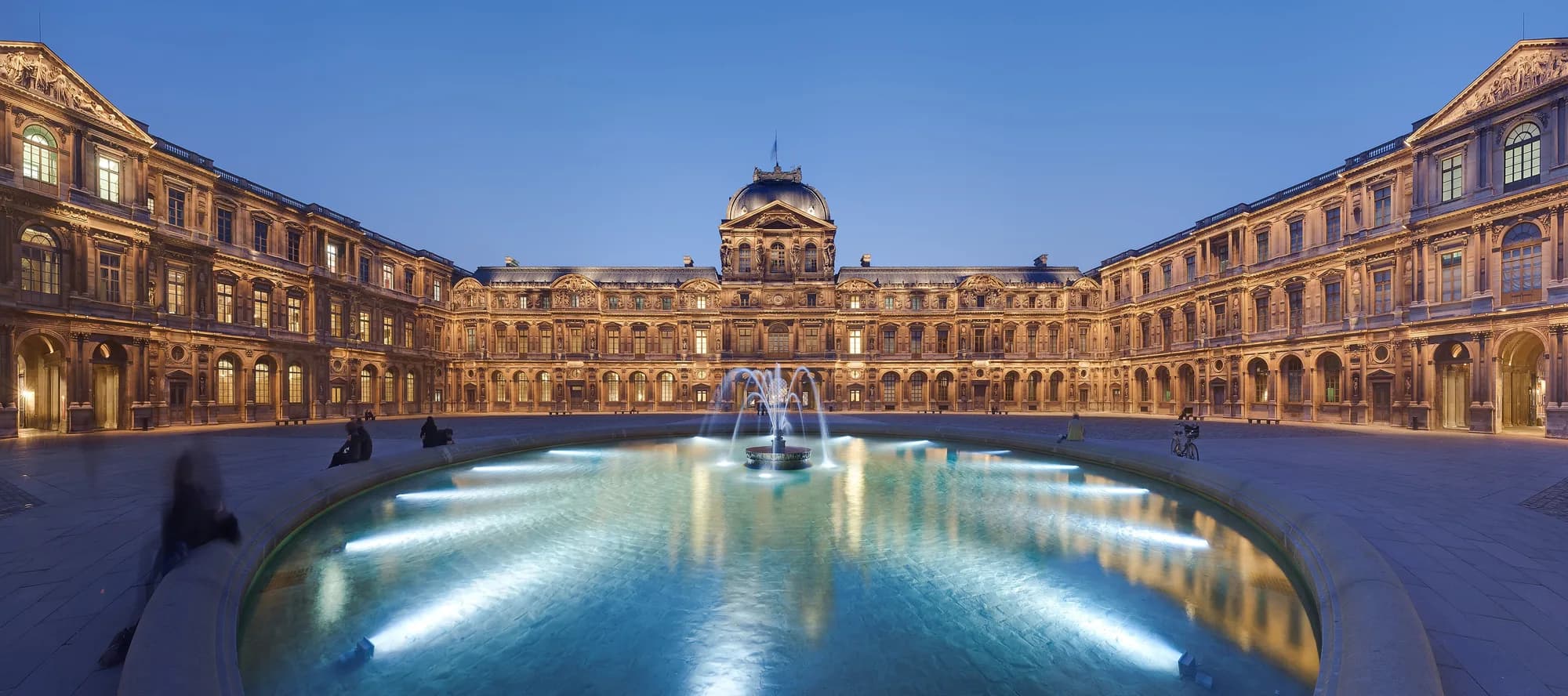
Louvre Palace & Cour Carrée
Step into the heart of Paris at the Louvre Palace, where the Cour Carrée invites you to wander through a tranquil, open-air space steeped in history. This majestic Renaissance quadrangle, surrounded by four architecturally diverse wings, offers a serene escape from the bustling city. As you stroll between the Rue de Rivoli, the Pont des Arts, and the Seine, you'll be captivated by intricate stone carvings, classical friezes, and the central fountain. Whether you're tracing the medieval tower's footprint in the cobblestones or enjoying the acoustic performances by street musicians, the Cour Carrée promises an unforgettable experience of French history and artistry.
The Cour Carrée (Square Court) is the monumental enclosed courtyard and historic architectural heart of the Palais du Louvre in the 1st arrondissement of Paris. Measuring approximately 160 meters on each side, this majestic Renaissance and Classical quadrangle stands on the site of King Philippe Auguste's 12th-century medieval fortress. Today, the courtyard is enclosed by four harmonious wings representing centuries of French royal architectural evolution: the western Renaissance Lescot Wing (Aile Lescot) and Lemercier's Pavillon de l'Horloge, the northern Le Vau wing, the southern riverside wing, and the eastern wing backed by Claude Perrault's world-famous Classical Colonnade. Unlike the bustling Cour Napoléon with its modern glass pyramid, the Cour Carrée offers a remarkably tranquil, atmospheric open-air space where travellers can admire intricate French Renaissance stone carvings, classical friezes, and the central stone fountain while strolling between the Rue de Rivoli, the Pont des Arts, and the Seine.
History
The Cour Carrée represents over 800 years of French monarchical history and architectural transformation. In 1190, King Philippe Auguste constructed a fortified medieval castle on this site to defend Paris from Anglo-Norman incursions along the Seine, centered around a 30-meter circular keep known as the Grosse Tour du Louvre. In 1528, Renaissance monarch King François I decided to modernize the fortification into a luxurious royal palace, ordering the demolition of the medieval keep. In 1546, François I commissioned architect Pierre Lescot and sculptor Jean Goujon to construct the first modern Renaissance wing (the Aile Lescot), establishing a distinct French Classical style inspired by Italian antiquity.\n\nUnder King Louis XIII and his chief minister Cardinal Richelieu in 1624, architect Jacques Lemercier doubled the Lescot Wing's length and erected the monumental Pavillon de l'Horloge (Clock Pavilion). Following the accession of Louis XIV, First Architect Louis Le Vau quadrupled the size of the original courtyard between 1659 and 1664 to create the vast square quadrangle seen today. Between 1667 and 1674, a royal committee comprising Claude Perrault, Louis Le Vau, and painter Charles Le Brun designed the iconic eastern façade—Perrault's Colonnade—cementing the triumph of French Classicism.\n\nWhen Louis XIV permanently moved the French royal court to the Palace of Versailles in 1682, the Louvre was vacated by royalty and became home to royal academies, including the Académie Française and the Académie Royale de Peinture et de Sculpture, as well as artists' lodgings. During the French Revolution in 1793, the revolutionary government transformed the palace into the Muséum Central des Arts, opening royal collections to the public. During the Grand Louvre modernization project in the 1980s under President François Mitterrand, archaeologists excavated the original medieval fortress moat and towers beneath the Cour Carrée, which are now preserved underground while the courtyard paving above commemorates the historic royal fortress.
Fun Facts
- 🏰 Medieval Footprint in the Cobblestones: In the southwest quadrant of the courtyard paving, darker paving stones trace the exact circular footprint of King Philippe Auguste's 1190 medieval keep (Grosse Tour du Louvre).
- 🏛️ Oldest Section of the Louvre: The Lescot Wing (Aile Lescot) on the western side, designed by architect Pierre Lescot with delicate sculptural friezes by Jean Goujon between 1546 and 1556, is the oldest surviving above-ground structure of the entire Louvre complex.
- 🎨 Birthplace of the Paris 'Salons': The grand Salon Carré on the first floor overlooking this courtyard gave its name to the famous official French art exhibitions ('the Salons'), which defined European art criticism and exhibition culture from the 17th to the 19th centuries.
- 🏛️ Masterpiece of French Classicism: The eastern exterior façade facing Place du Louvre is Perrault's Colonnade (1667–1674), celebrated worldwide for its grand paired Corinthian columns and severe classical rhythm.
- 🕊️ Serene Open-Air Sanctuary: While millions gather around the I.M. Pei Pyramid in the adjacent Cour Napoléon, the Cour Carrée remains a peaceful, public pedestrian space renowned for its quiet beauty, acoustic street musicians, and dramatic evening lighting.
Guide Tips
- 🚶 Trace the Medieval Tower: Look down at the paving stones in the southwest corner of the courtyard to spot the dark outline marking the circular perimeter of the 12th-century medieval castle keep.
- 🌅 Golden Hour & Night Illumination: Visit during sunset or late in the evening when warm architectural lighting illuminates the Renaissance façades, reliefs, and central fountain with few tourists around.
- 🌉 Scenic River Route: Walk through the south arched portal (Porte Jean Goujon) to emerge directly onto the Seine quayside and step onto the pedestrian Pont des Arts for panoramic views of Île de la Cité.
- 🔍 Appreciate Goujon's Sculptures: Look up at the Lescot Wing to admire Jean Goujon's masterwork Renaissance reliefs depicting allegorical figures of War, Peace, Victory, and the sciences.
- 🎻 Acoustic Performances: Pause by the central fountain to listen to classical buskers whose strings and flutes resonate beautifully within the enclosed quadrangle.
Opening Hours
24/7 - External Courtyard & Public Thoroughfare (Museum galleries: Mon, Wed, Thu, Sat, Sun 09:00 - 18:00, Fri 09:00 - 21:45, Closed Tue)