
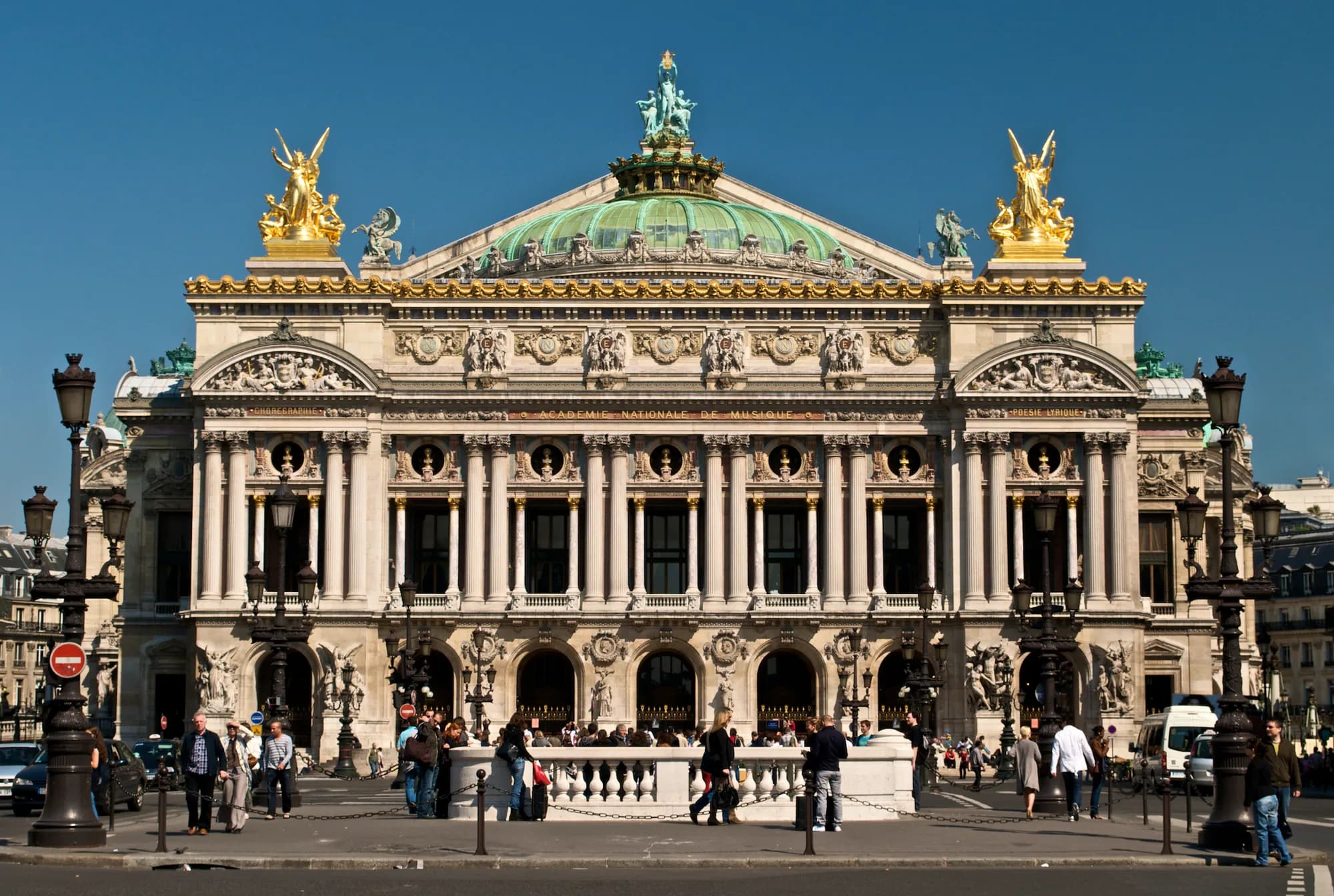
Opéra Garnier
Imagine stepping into a world where every corner whispers tales of grandeur and artistic brilliance. The Opéra Garnier, a beacon of Parisian elegance, invites you to explore its lavish interiors and majestic exteriors. As you wander through its opulent halls, you'll be transported back to the Golden Age of France, where every detail tells a story of creativity and opulence. Whether you're captivated by the architectural marvels or the rich history that permeates its walls, the Opéra Garnier promises an unforgettable experience that will leave you enchanted and inspired.
Standing proudly at the head of Avenue de l'Opéra in the vibrant 9th arrondissement, the Opéra Garnier (Palais Garnier) is one of the world's most opulent and celebrated architectural masterpieces. Commissioned by Emperor Napoleon III and designed by visionary architect Charles Garnier in the lavish Second Empire Beaux-Arts style, this monumental 19th-century opera house was inaugurated in 1875 as the pinnacle of Parisian high society and artistic grandeur. Its exterior façade is a breathtaking symphony of multi-colored marble, Corinthian columns, and sculpted allegorical friezes crowned by Charles Gumery's gilded statues of Harmony and Poetry and Aimé Millet's crowning Apollo with his golden lyre. Inside, visitors are swept into an awe-inspiring world featuring the monumental double-horseshoe Grand Escalier crafted from Swedish, Italian, and French marbles; the dazzling 54-meter Grand Foyer adorned with gilded chandeliers and Paul Baudry's ceiling paintings reminiscent of Versailles; and the 1,979-seat Italian horseshoe auditorium crowned by Marc Chagall's iconic 1964 modern ceiling fresco and an 8-tonne crystal chandelier. An essential Parisian cultural landmark, the Palais Garnier offers an unforgettable journey through France's Golden Age of architecture, ballet, and opera.
History
The Palais Garnier stands as the supreme architectural symbol of Paris's Second Empire and the grand urban transformation orchestrated by Emperor Napoleon III and Baron Georges-Eugène Haussmann. Following an assassination attempt on Napoleon III outside the old Salle Le Peletier opera house in January 1858, the Emperor decreed the construction of a monumental, secure new opera house anchoring the grand avenues of the Right Bank.
An anonymous design competition in 1861 attracted 171 architectural proposals. In a stunning upset, the jury unanimously selected the design of an unknown 35-year-old Grand Prix de Rome winner, Charles Garnier. Construction began in 1861 and took fourteen years to complete, contending with difficult marshy groundwater that required an enormous subterranean reservoir, financial strain, and the interruption of the Franco-Prussian War (1870–1871) and Paris Commune, during which the half-finished building was used as a military warehouse and hospital.
Inaugurated with grand imperial pageantry on January 5, 1875, by French President Patrice de MacMahon, the Palais Garnier immediately captivated the world with its lavish integration of polychrome marble, gilded bronzes, neoclassical sculptures (such as Jean-Baptiste Carpeaux's 'La Danse'), and state-of-the-art iron structural framework. As the primary home of the Paris Opera and its ballet troupe for over a century, the venue became immortalized worldwide through Gaston Leroux's 1910 novel 'The Phantom of the Opera'. Following the opening of the modern Opéra Bastille in 1989, the Palais Garnier became dedicated primarily to ballet productions and chamber opera, standing today as one of the most visited and celebrated architectural masterpieces in Europe.
Fun Facts
- 👻 The Phantom's Underground Lake: Beneath the Palais Garnier lies an enormous subterranean concrete water reservoir (cuve) holding 7,300 cubic metres of water, built to resist hydrostatic groundwater pressure during construction. This underground reservoir inspired Gaston Leroux's legendary 1910 novel 'The Phantom of the Opera' and Box No. 5 reserved for the phantom.
- 👑 The 'Napoleon III Style': When Empress Eugénie famously asked architect Charles Garnier during construction whether the style of the opera was Greek or Roman, Garnier boldly replied: 'It is neither, Madame; it is the Napoleon III style!'—defining the peak of 19th-century Second Empire eclecticism.
- 🎨 Chagall's Revolutionary Ceiling: In 1964, French Minister of Cultural Affairs André Malraux commissioned modernist master Marc Chagall to repaint the auditorium ceiling. Chagall's vibrant 220-square-metre canvas depicts scenes honoring 14 legendary composers including Mozart, Wagner, Berlioz, and Tchaikovsky.
- 💎 The 8-Tonne Bronze Chandelier: Hanging above the auditorium is a colossal 8-tonne bronze and crystal chandelier designed by Charles Garnier. On May 20, 1896, a counterweight fell during a performance of Faust, an accident that Leroux dramatized in his Phantom novel.
- 🐝 Rooftop Beehives: Since 1982, beehives installed on the roof of the Palais Garnier produce renowned Parisian urban honey, harvested annually from flowers in the surrounding Tuileries and Palais-Royal gardens.
Guide Tips
- 🎟️ Book Interior Tickets in Advance: Book your self-guided visit online ahead of time on the Opéra national de Paris official website to guarantee entry, as box office tickets are not sold on-site.
- 🏛️ Grand Staircase & Grand Foyer: Spend extra time exploring the Grand Escalier (crafted with marbles from across Europe) and the 54-metre-long Grand Foyer with its mirrors and gilded chandeliers inspired by the Hall of Mirrors at Versailles.
- 📸 Prime Exterior Photography Spots: Stand at the pedestrian island at the junction of Avenue de l'Opéra and Place de l'Opéra for a magnificent straight-on shot of the Apollo sculpture and gilded statues.
- ☕ Rooftop & Cafe Pairing: Pair your visit with a rooftop panoramic view over the Palais Garnier dome from the top-floor terrace of Galeries Lafayette Haussmann, located just behind the opera house.
Opening Hours
Daily 10:00 - 17:00 (Last admission 16:15; subject to performance schedules). Exterior visible 24/7.