
Palais-Royal
Imagine stepping into a living museum where history and modernity intertwine seamlessly. The Palais-Royal, nestled in the heart of Paris, invites you to explore its grand halls and serene gardens, where every corner whispers tales of the past. From the striking contemporary art of Daniel Buren to the revolutionary fervor that once stirred in its gardens, this landmark is a captivating blend of aristocratic elegance and vibrant cultural heritage. Whether you're tracing the footsteps of literary greats or marveling at the innovative art installations, the Palais-Royal promises an unforgettable journey through time and creativity.
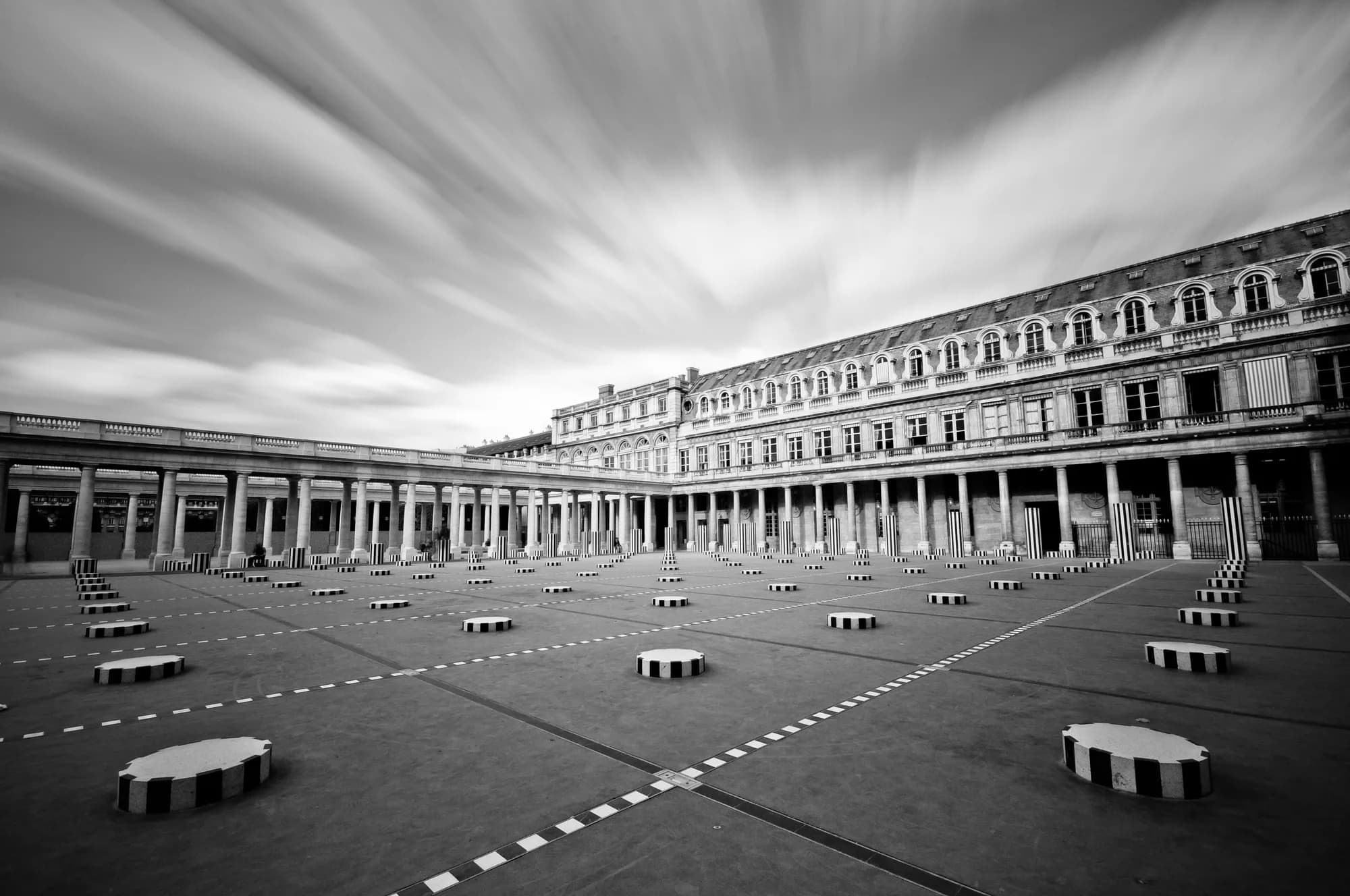
Situated directly north of the Louvre in the 1st arrondissement, the Domaine National du Palais-Royal is one of Paris's most refined and historically significant architectural ensembles. Originally commissioned in 1628 by Cardinal Richelieu as the Palais-Cardinal, the monumental palace became a royal residence upon Richelieu's death, housing the young King Louis XIV and later serving as the primary seat of the illustrious House of Orléans. Today, an external walking visit reveals two contrasting yet seamlessly unified spaces: the grand Cour d'Honneur, transformed in 1986 by contemporary artist Daniel Buren with 'Les Deux Plateaux'—an iconic installation of 260 black-and-white striped octagonal marble columns rising at varying heights alongside kinetic stainless-steel spherical fountains by Pol Bury—and the serene Jardin du Palais-Royal. Enclosed within classical 18th-century colonnaded arcades (Galerie de Montpensier, Galerie de Beaujolais, and Galerie de Valois), the tranquil gravel avenues, double rows of clipped linden trees, and central fountain basin provide a peaceful haven steeped in aristocratic elegance, literary heritage, and revolutionary history.
History
The Palais-Royal's storied history began in 1628 when Cardinal Richelieu, chief minister to King Louis XIII, commissioned royal architect Jacques Lemercier to build a lavish private palace known as the Palais-Cardinal. Richelieu bequeathed the palace to the French Crown upon his death in 1642. The Queen Mother Anne of Austria relocated here with her young sons, including the future Sun King Louis XIV, during the turbulent uprisings of the Fronde (1648–1653)—an experience that shaped Louis XIV's lifelong distrust of Paris and inspired his later move to Versailles.\n\nIn 1692, King Louis XIV granted the Palais-Royal to his younger brother Philippe I, Duke of Orléans, initiating nearly a century of lavish Orléans residency and cultural patronage. In the 1780s, facing heavy debts, Louis-Philippe Joseph d'Orléans (later known as Philippe Égalité) undertook a visionary real estate and urban development project designed by architect Victor Louis. He enclosed the palace gardens with uniform neoclassical buildings featuring 180 grand stone arcades housing shops, gaming halls, theatres, and public cafés. Because the palace remained private property of the Duke, municipal police were barred from entering, turning the arcades into a vibrant sanctuary of free speech, intellectual debate, political radicalism, and lively Parisian night life.\n\nDuring the outbreak of the French Revolution, the gardens served as the primary gathering ground for dissidents. It was here, on July 12, 1789, that Camille Desmoulins rallied the Parisian public to arms, directly precipitating the Storming of the Bastille on July 14. Following the Revolution and the 19th-century Bourbon Restoration, the palace transitioned into key administrative and judicial roles. Classified as a Historical Monument in 1975, the Domaine National du Palais-Royal now houses the Conseil d'État (Council of State), the Conseil Constitutionnel (Constitutional Council), and the French Ministry of Culture, while its historic gardens and contemporary courtyards remain beloved public spaces.
Fun Facts
- From Cardinal's Palace to Royal Seat: Built by architect Jacques Lemercier between 1628 and 1636 as the 'Palais-Cardinal' for Cardinal Richelieu, the complex was bequeathed to King Louis XIII upon Richelieu's death in 1642 and renamed the 'Palais-Royal'.
- Spark of the French Revolution: On July 12, 1789, young revolutionary journalist Camille Desmoulins leaped onto a table at Café de Foy in the Palais-Royal gardens, brandishing a pistol and calling citizens 'To arms!', which directly ignited the insurrection that led to the storming of the Bastille two days later.
- The Controversial Buren Columns: Installed in 1986 in the main courtyard (Cour d'Honneur), Daniel Buren's modern conceptual artwork 'Les Deux Plateaux' features 260 truncated marble columns striped in white and black Carrara marble, creating an open-air interactive sculpture park.
- Birthplace of the Comédie-Française: Molière and his theatrical troupe performed in the Palais-Royal's theatre starting in 1660; today, the historic Salle Richelieu at the palace's southwest wing serves as the permanent home of France's national theatre company, the Comédie-Française.
- The Solar Noon Cannon: From 1786 to 1911, a small brass cannon in the garden was fitted with a magnifying glass that focused the midday sun's rays to ignite gunpowder and fire a shot every day at exactly solar noon, allowing Parisians to calibrate their pocket watches.
Guide Tips
- Interactive Photography: The Cour d'Honneur and Buren columns offer endless perspective lines for architectural and creative street photography; visit in the early morning for soft sunlight and empty courtyards.
- Explore the Historic Arcades: Stroll through the covered Galerie de Valois and Galerie de Montpensier to discover historic cafés, vintage boutiques, niche perfumeries, and antiquarian bookshops.
- Garden Relaxation: Grab an espresso at Café Kitsuné under the arcades and sit by the central garden fountain under the shaded linden tree allées.
- Literary Footsteps: Look for commemorative plaques honoring celebrated French writers Colette and Jean Cocteau, both of whom lived in apartments overlooking the tranquil palace gardens.
Opening Hours
Open daily: 08:30 - 22:30 (May-Aug) / 08:30 - 20:30 (Oct-Mar) / 08:30 - 21:30 (Apr, Sep) - External Courtyard & Garden Visit