
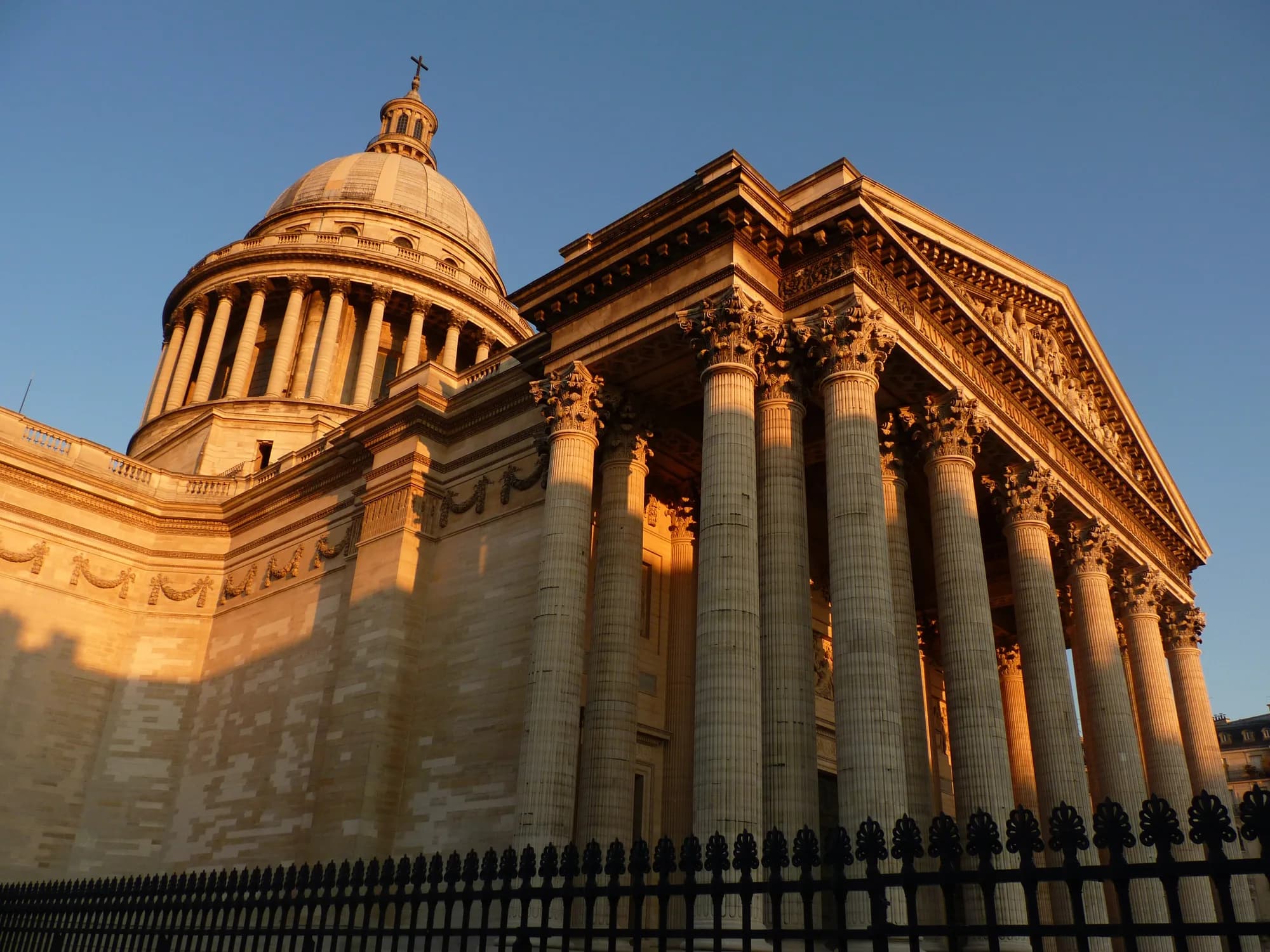
Panthéon
Imagine standing atop Montagne Sainte-Geneviève, gazing upon the Panthéon, a Neoclassical marvel that has stood the test of time. This iconic landmark, originally envisioned as a grand church, now serves as a solemn mausoleum for France's most illustrious figures. As you explore the majestic Corinthian portico and the towering triple-shell dome, you'll be captivated by the rich history and architectural brilliance that define this Parisian gem. Whether you're marveling at the intricate pediment sculptures or pondering the revolutionary transformations that have shaped its legacy, the Panthéon promises an unforgettable journey through the heart of French heritage.
Dominating the summit of Montagne Sainte-Geneviève in the Latin Quarter, the Panthéon is one of Paris's most majestic and monumental Neoclassical masterpieces. Originally commissioned in 1744 by King Louis XV as a grand church dedicated to Saint Genevieve (the patron saint of Paris) and designed by visionary architect Jacques-Germain Soufflot, the building blends the monumental grandeur of Roman antiquity with the structural lightness of Gothic architecture. Following the French Revolution, the National Constituent Assembly transformed the monument into a secular mausoleum to honor France's greatest thinkers, scientists, and national figures under the famous motto inscribed on its pediment: 'Aux grands hommes la patrie reconnaissante' ('To great men, the grateful homeland'). An external exploration around Place du Panthéon offers magnificent views of its monumental Corinthian portico, modeled after the Pantheon in Rome, the sculpted triangular pediment by David d'Angers, and the iconic 83-meter-high triple-shell dome that defines the Left Bank skyline.
History
The origin of the Panthéon dates back to 1744 when King Louis XV fell gravely ill in Metz. Vowing that if he recovered he would replace the dilapidated medieval abbey church of Sainte-Geneviève on Mount Lucotitius with a magnificent new basilica, the King commissioned master architect Jacques-Germain Soufflot upon his recovery. Soufflot sought to achieve a groundbreaking architectural synthesis: combining the purity and grandeur of Greco-Roman classical architecture with the structural daring and luminous lightness of French Gothic cathedrals. Construction began in 1758 and the foundation stone was laid by Louis XV in 1764. After Soufflot died in 1780, his collaborators Jean-Baptiste Rondelet and Maximilien Brébion completed the monument in 1790.\n\nIn April 1791, amidst the upheaval of the French Revolution, the National Constituent Assembly decreed that the newly finished church should become a secular necropolis to house the ashes of great French citizens, renaming it the 'Panthéon Français'. During the 19th century, the building oscillated between religious and secular purposes under successive regimes—serving as a church under Napoleon I, the Bourbon Restoration, and Napoleon III, before being definitively established as a secular republican monument upon the grand state funeral and entombment of Victor Hugo in 1885. Today, managed by the Centre des monuments nationaux, the Panthéon stands as an enduring emblem of French republican ideals, intellectual achievement, and architectural brilliance.
Fun Facts
- Roman & Greek Inspiration: Soufflot modeled the Panthéon's imposing portico of 22 Corinthian columns directly on the Pantheon in Rome, while designing the building's floor plan as a monumental Greek cross.
- Proof of Earth's Rotation: In 1851, French physicist Léon Foucault suspended a 28-kilogram brass pendulum from the central dome ceiling on a 67-meter wire, providing the world's first direct visual proof of the Earth's diurnal rotation.
- Revolutionary Transformation: In 1791, during the French Revolution, architect Quatremère de Quincy bricked up 38 of the original 42 large windows to create a darker, more solemn, and sober mausoleum ambiance suitable for a secular temple of heroes.
- The Legendary Pediment: The sculpted triangular pediment by David d'Angers (1837) portrays France distributing laurels to distinguished civil figures (Voltaire, Rousseau, Lafayette) on the left and military and educational heroes on the right.
- Resting Place of Great Minds: The crypt serves as the national burial place for legendary luminaries including Victor Hugo, Voltaire, Jean-Jacques Rousseau, Émile Zola, Pierre and Marie Curie, Jean Moulin, and Simone Veil.
Guide Tips
- Best Photography Angles: Stand at the corner of Rue Soufflot for the iconic postcard view looking uphill toward the portico and dome, or shoot from Place Sainte-Geneviève next to Église Saint-Étienne-du-Mont for dramatic architectural contrasts.
- Golden Hour Lighting: Visit Place du Panthéon in late afternoon when the setting sun illuminates the golden limestone façade and the Corinthian columns.
- Neighborhood Route: Combine your visit with nearby Latin Quarter landmarks—stroll 3 minutes down Rue Soufflot to the Jardin du Luxembourg or wander east toward Arènes de Lutèce and Rue Mouffetard.
- Pediment Details: Use a zoom lens or binoculars to examine the intricate sculptures on the pediment and spot the depictions of Napoleon Bonaparte, Voltaire, and Rousseau.
Opening Hours
24/7 - External Visit / Place du Panthéon (Monument interior: Apr–Sep daily 10:00 - 18:30, Oct–Mar daily 10:00 - 18:00)