
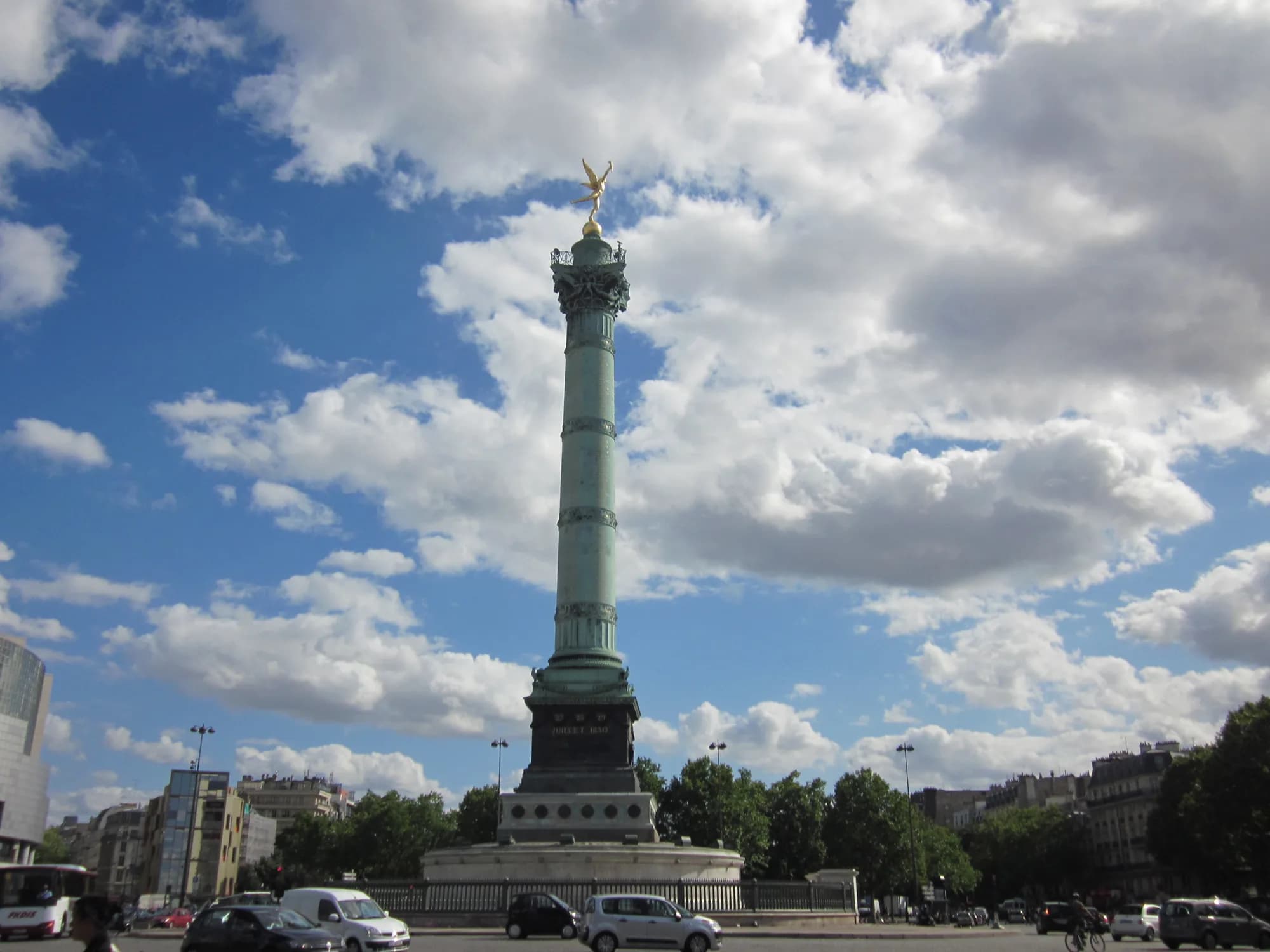
Place de la Bastille
Step into the heart of Paris at Place de la Bastille, where history and modernity intertwine to create an unforgettable experience. This iconic square, steeped in the legacy of the French Revolution, stands as a testament to the enduring spirit of liberty. As you wander through its pedestrian plaza, you'll find yourself surrounded by striking landmarks, from the towering July Column to the modern Opéra Bastille, all while the vibrant energy of Parisian life pulses around you. Whether you're tracing the ancient footprint of the Bastille fortress or enjoying a leisurely stroll along the marina, Place de la Bastille promises a journey through time and culture that's as enriching as it is inspiring.
Spanning the borders of the 4th, 11th, and 12th arrondissements, the Place de la Bastille is one of the most historically symbolic public squares in Paris and a worldwide emblem of freedom and revolution. It occupies the site of the infamous medieval fortress and state prison, the Bastille Saint-Antoine, whose storming by Parisian citizens on July 14, 1789, ignited the French Revolution. At the center of the redesigned pedestrian plaza rises the monumental 50-meter-high Colonne de Juillet (July Column), erected between 1835 and 1840 to commemorate the victims of the Three Glorious Days (Trois Glorieuses) of the July Revolution of 1830. Crowned by Augustin-Alexandre Dumont's iconic gilded bronze sculpture 'Le Génie de la Liberté' (The Genius of Liberty), the square today is a vibrant cultural hub anchored by the modern glass façade of the Opéra Bastille, the scenic marina of Port de l'Arsenal, and lively café terraces.
History
Originally built between 1369 and 1383 under King Charles V during the Hundred Years' War, the Bastille (Bastille Saint-Antoine) began as a formidable four-story, eight-tower stone fortress designed to defend the eastern gates of Paris against English invasion. In the 17th century, under Cardinal Richelieu and King Louis XIV, the stronghold was converted into a state prison primarily used to detain political prisoners, religious dissidents, and banned authors under arbitrary royal arrest warrants (lettres de cachet), making it a detested symbol of royal absolutism.\n\nOn July 14, 1789, seeking gunpowder and weapons to resist royal troops, an armed crowd of Parisian insurgents stormed the fortress—an epochal event that catalyzed the French Revolution and is celebrated annually as France's National Day (Bastille Day). Demolition contractor Pierre-François Palloy organized the prompt dismantling of the prison between 1789 and 1790, turning its stones into carved miniature replicas and paving materials for the Pont de la Concorde.\n\nIn 1792, the open area was officially designated Place de la Bastille. After various interim monuments, King Louis-Philippe commissioned the July Column (Colonne de Juillet), designed by architects Jean-Antoine Alavoine and Joseph-Louis Duc. Inaugurated in 1840, the column commemorates the Three Glorious Days of July 27–29, 1830, that overthrew King Charles X, and its underground vaults contain the tombs of over 800 revolutionaries from both the 1830 and 1848 revolutions. In 1989, to mark the bicentennial of the French Revolution, the modern Opéra Bastille designed by Carlos Ott was inaugurated on the square.
Fun Facts
- Paved Outline of History: Look closely at the ground across the square and adjoining streets—a line of contrasting granite paving stones traces the exact perimeter and tower layout of the demolished medieval Bastille fortress.
- The Gilded Spirit of Liberty: The July Column is crowned by 'Le Génie de la Liberté', a 4-meter-tall gilded bronze statue sculpted in 1833 by Augustin-Alexandre Dumont, depicting the spirit of liberty balancing on one foot with the torch of civilization and broken chains.
- Napoleon's Plaster Elephant: Between 1813 and 1846, a massive 24-meter-tall plaster model of a monumental elephant fountain stood on the square, immortalized in French literature as the shelter of Gavroche in Victor Hugo's 'Les Misérables'.
- Hidden Marina Gateway: Directly south of the square lies the Port de l'Arsenal boat marina, where the Canal Saint-Martin passes beneath the Place de la Bastille through a 2-kilometer underground vaulted tunnel before meeting the Seine.
- Subterranean Medieval Bastille: Inside the Bastille Métro station (Line 5), travelers can view an excavated segment of the fortress's original medieval stone counterscarp wall uncovered during transit construction in 1899.
Guide Tips
- Trace the Fortress Footprint: Follow the contrasting paving stones embedded in the ground along Rue Saint-Antoine and Boulevard Henri IV to visualize the imposing footprint of the Bastille.
- Golden Hour Photography: Capture the July Column and the gilded 'Génie de la Liberté' in late afternoon light when the sun illuminates the gold leaf against the sky.
- Stroll to Port de l'Arsenal: Walk down the southern stone stairs to wander along the tranquil marina quays and connect directly to the elevated parkway Promenade Plantée (Coulée Verte René-Dumont).
- Surrounding Neighborhoods: Stroll down Rue de la Roquette, Rue de Lappe, or Rue de Charonne for authentic Parisian bakeries, bistros, and historic cobblestone passageways.
Opening Hours
24/7 - Public Square & Pedestrian Esplanade