
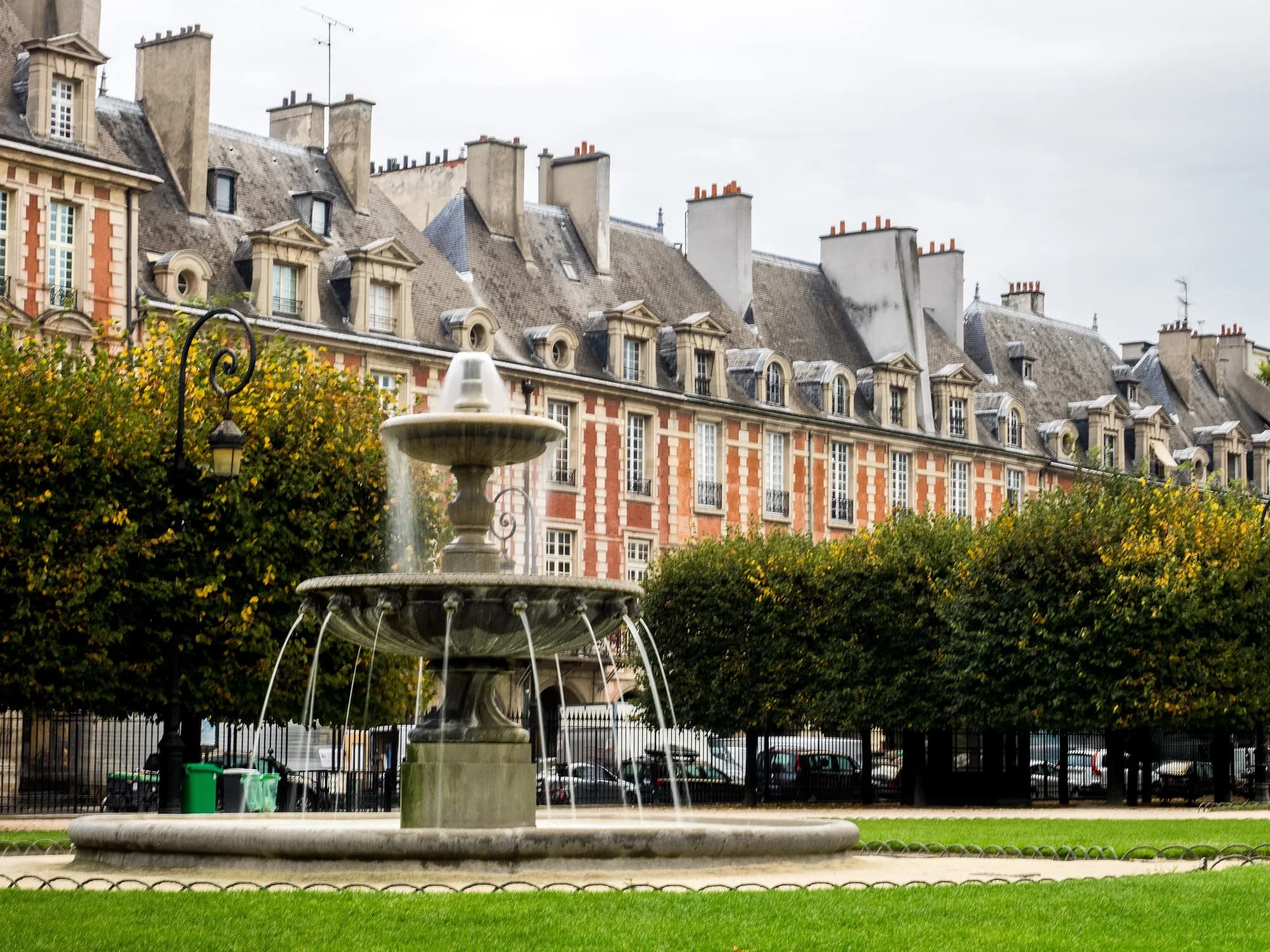
Place des Vosges
Imagine stepping into a living museum where every corner whispers tales of French history and elegance. Place des Vosges, the oldest planned monumental square in Paris, beckons you to explore its meticulously crafted symmetry and storied past. Nestled in the heart of the historic Marais district, this architectural gem offers a serene escape with its manicured lawns, neoclassical fountains, and the imposing statue of King Louis XIII. Whether you're strolling through the Renaissance arcades, discovering the secret gardens, or simply soaking in the timeless beauty, Place des Vosges promises an unforgettable Parisian experience.
Nestled in the heart of the historic Marais district across the 3rd and 4th arrondissements, Place des Vosges is the oldest planned monumental square in Paris and one of the finest urban ensembles in Europe. Designed as a perfect 140-by-140-meter square, it is famed for its strict architectural symmetry comprising 36 harmonious residential pavilions constructed with distinctive red brick, dressed white limestone quoins, steep slate roofs, and continuous vaulted ground-floor arcades. At its core lies the tranquil Square Louis XIII, featuring manicured lawns, leafy rows of clipped linden trees, four neoclassical fountains, and a commanding 19th-century white marble equestrian statue of King Louis XIII. An external exploration allows visitors to stroll beneath the shaded Renaissance arcades lined with art galleries, antique shops, and historic cafes, pass beneath the monumental Pavillon du Roi and Pavillon de la Reine gateways, and admire the exquisite façades of private mansions that once housed celebrated French luminaries such as Victor Hugo, Madame de Sévigné, and Cardinal Richelieu.
History
Before the construction of Place des Vosges, the site was occupied by the sprawling Hôtel des Tournelles, a Gothic royal estate frequented by the Valois monarchy. In July 1559, during a celebratory tournament commemorating the Peace of Cateau-Cambrésis, King Henri II was mortally wounded when the shattered lance of Gabriel de Montgomery pierced his eye. Grief-stricken, Queen Catherine de' Medici abandoned the estate, ordered its demolition, and relocated the royal court to the Louvre and the Tuileries Palace.\n\nIn 1605, King Henri IV initiated an ambitious royal urban master plan to revitalize Paris and establish a vibrant silk manufacturing hub and aristocratic residential center. He commissioned the construction of a grand square, originally named 'Place Royale', framed by 36 uniform pavilions built of red brick, white limestone, and slate. The square was officially inaugurated in April 1612 with a three-day Carrousel equestrian festival celebrating the double royal engagement of the young King Louis XIII to Anne of Austria, and Princess Élisabeth of France to Philip IV of Spain.\n\nThroughout the 17th and 18th centuries, Place Royale became the epitome of high-society Parisian life, attracting nobility, intellectuals, and artists. Following the French Revolution, the square was stripped of royal symbols and briefly renamed Place des Fédérés and Place de l'Indivisibilité, before being officially named Place des Vosges in 1800 to honor the Vosges department. Classified as a Historical Monument in 1954 and restored under the Malraux Law preservation program for the Marais, Place des Vosges remains one of the world's finest architectural gems.
Fun Facts
- First Planned Residential Square: Commissioned in 1605 by King Henri IV, Place des Vosges (originally named Place Royale) established the prototype for grand residential square design across Europe, including London's Covent Garden and Charleville-Mézières' Place Ducale.
- Renamed for Paying Taxes: Originally called Place Royale, the square was renamed 'Place des Vosges' in 1800 by Napoleon Bonaparte in honor of the northeastern Vosges department, which was the very first in France to pay its revolutionary taxes in full.
- Royal Pavilions Never Slept a Monarch: The taller central pavilions on the south (Pavillon du Roi) and north (Pavillon de la Reine) sides were reserved for the Crown and feature grand carriage archways, yet no French king or queen ever actually resided there.
- Victor Hugo's Creative Haven: Renowned author Victor Hugo lived at No. 6 (the Hôtel de Rohan-Guémené) on the second floor from 1832 to 1848, where he penned a major portion of his masterpiece novel 'Les Misérables'.
- Infamous Duelling Ground: Despite strict royal edicts banning duels issued by King Henri IV and Cardinal Richelieu, the secluded square served as Paris's most notorious aristocratic duelling hotspot during the 17th century.
Guide Tips
- Secret Garden Passage to Hôtel de Sully: Walk to the southwest corner at No. 7 and pass through the discreet open doorway to discover the magnificent gardens and Renaissance courtyard of the 17th-century Hôtel de Sully leading directly to Rue Saint-Antoine.
- Admire the Royal Pavilions: Stand at the center of Square Louis XIII to compare the elevated three-arch gateways of the Pavillon du Roi (south) and Pavillon de la Reine (north), perfectly aligned along a north-south urban axis.
- Arcades & Contemporary Art: Take a sheltered stroll under the vaulted ground-floor arcades to explore contemporary art galleries, sculpture showrooms, and historic tearooms like Carette.
- Best Photography Angle: Capture the square from the corner diagonals during late afternoon 'golden hour' when warm sunlight highlights the red brick and limestone contrast against lush green linden foliage.
Opening Hours
24/7 - External Visit / Arcades (Square Louis XIII central garden: daily 08:00 - 19:30 Winter / 21:30 Summer)