
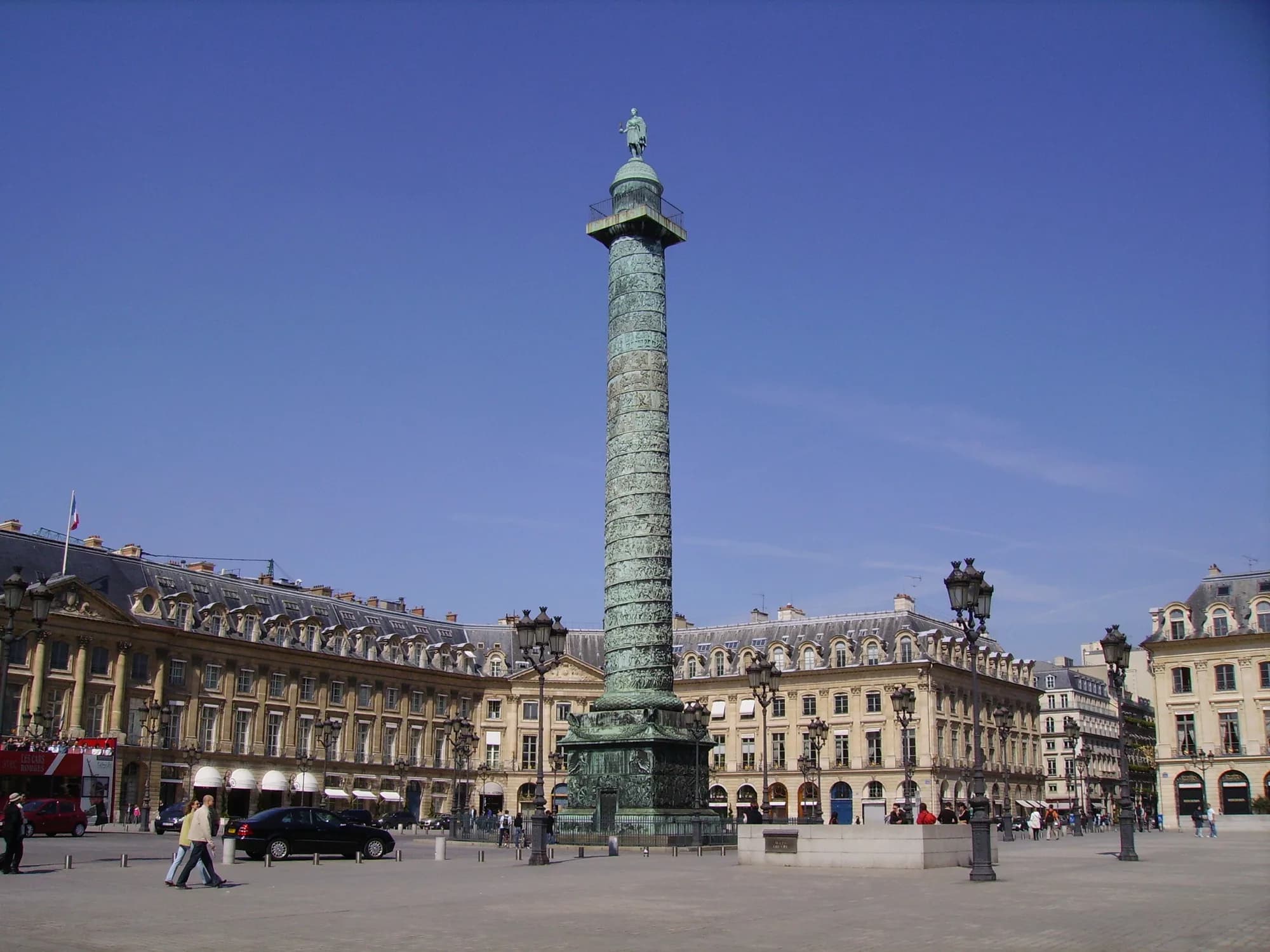
Place Vendôme & Vendôme Column
Step into the heart of Paris and experience the timeless elegance of Place Vendôme, a masterpiece of French Classical architecture that has stood the test of time since its creation in 1699. This grand octagonal square, with its uniform façades and rhythmic arcades, is not only a visual feast but also a place steeped in history, from the Vendôme Column commemorating Napoleon's victory to the prestigious luxury brands that call it home. As you wander through this iconic landmark, you'll find yourself immersed in a world where history, art, and luxury converge, making it an unmissable stop on your Parisian adventure.
Located in the 1st arrondissement just north of the Tuileries Garden, Place Vendôme is one of the world's most magnificent and harmonious expressions of French Classical urban architecture. Commissioned in 1699 under King Louis XIV and masterfully designed by premier royal architect Jules Hardouin-Mansart, the grand octagonal royal square is celebrated for its monumental uniform façades, Corinthian pilasters, high-pitched slate mansard roofs, and rhythmic arched arcades. Rising 44 metres at the exact center of the square is the monumental Vendôme Column (Colonne Vendôme), erected in 1810 by Napoleon Bonaparte to commemorate his triumph at the Battle of Austerlitz. Modeled after Trajan's Column in Rome, the column features a 280-metre spiraling continuous bronze bas-relief crafted from the melted bronze of 1,200 cannons captured from Austrian and Russian armies, capped by a commanding statue of Napoleon depicted as a Roman Emperor. Today, Place Vendôme stands as a legendary global epicenter of high jewelry, luxury fashion houses, and historic grand residences including the famed Ritz Paris and the French Ministry of Justice.
History
Originally conceived by King Louis XIV's minister Louvois in 1685 as the Place des Conquêtes, the square was initially intended to house royal academies and embassies surrounding an equestrian statue of the Sun King sculpted by François Girardon. After financial setbacks halted the initial project, King Louis XIV transferred the land to the City of Paris in 1699. Jules Hardouin-Mansart, the visionary architect of the Palace of Versailles and Les Invalides, redesigned the square into a majestic octagonal royal plaza renamed Place Louis-le-Grand. To fund the enterprise, uniform classical façades were erected first, and the parcels behind them were subsequently sold to private aristocrats and royal financiers, giving birth to iconic Parisian hôtels particuliers like the Hôtel de Bourvallais (now France's Ministry of Justice).\\\\n\\\\nDuring the French Revolution, the equestrian bronze statue of Louis XIV was toppled and destroyed on August 10, 1792, and the site was briefly rechristened Place des Piques. In 1806, Napoleon Bonaparte decreed the creation of a monumental victory column—the Colonne de la Grande Armée—to honor the French soldiers of the 1805 campaign. Designed by Jacques Gondouin and Jean-Baptiste Lepère and inaugurated on August 15, 1810, the column was wrapped in 425 spiraling bronze bas-reliefs sculpted by a team led by Pierre-Nolasque Bergeret and surmounted by Antoine-Denis Chaudet's statue of Napoleon in Roman imperial regalia.\\\\n\\\\nThroughout the 19th century, the statue atop the column changed several times with the fluctuating political regimes: removed during the Bourbon Restoration in 1814, replaced by Louis-Philippe in 1833 with Napoleon in a military overcoat and bicorne hat, and restored to the imperial Roman guise under Napoleon III in 1863. During the 1871 Paris Commune, the entire column was toppled into a bed of sand and manure before being painstakingly reconstructed in 1875 by architect Alfred-Nicolas Normand. Over the late 19th and 20th centuries, with the opening of the Ritz Hotel in 1898 and the arrival of premier luxury jewelers (Boucheron, Cartier, Chaumet, Van Cleef & Arpels), Place Vendôme cemented its international legacy as the world's preeminent showcase of timeless elegance, history, and craftsmanship.
Fun Facts
- Classical Symmetry: Jules Hardouin-Mansart designed the uniform façades of the octagonal square before any of the buildings behind them were even constructed, selling off empty lots behind the pre-built royal facades to wealthy aristocrats and financiers.
- Cast from 1,200 Cannons: The 425 spiraling bronze plates wrapping the 44-metre Vendôme Column were cast from approximately 1,200 enemy artillery pieces captured by Napoleon's Grand Army at the decisive Battle of Austerlitz in 1805.
- Toppled During the Paris Commune: On May 16, 1871, the revolutionary Paris Commune pulled down the Vendôme Column as a symbol of imperialism, an action spearheaded by painter Gustave Courbet, who was later ordered to pay for its entire reconstruction in 1875.
- Chopin's Final Days: Celebrated Polish composer Frédéric Chopin spent his final months and passed away at No. 12 Place Vendôme on October 17, 1849, in an apartment now marked with a memorial plaque.
- Birthplace of Haute Joaillerie: In 1893, Frédéric Boucheron became the first high jeweler to establish a boutique on Place Vendôme (at No. 26), chosen for its exceptional natural sunlight that made diamonds and gems sparkle brilliantly.
Guide Tips
- Best Angles for Photos: Stand at the southern entrance of the square on Rue de la Paix or from the corner of Rue Saint-Honoré for dramatic perspectives looking up along the spiraling bronze column framed by classical façades.
- Look for the Standard Metre: Embedded in the exterior arcade wall beneath No. 36 Place Vendôme is one of only two surviving original marble 'Mètres Étalons' installed in 1795 to introduce the metric system to Parisian citizens.
- Magic at Dusk: Visit around sunset or nightfall when architectural floodlights illuminate the bronze relief panels and warm lamplight casts golden glows across the classical Mansart arcades.
- Historic Walking Connection: Combine your stop with a leisurely stroll linking the Palais-Royal and Tuileries Garden to the south, and the Palais Garnier Opera House to the north via Rue de la Paix.
Opening Hours
24/7 - Public Square & Monument Viewing