
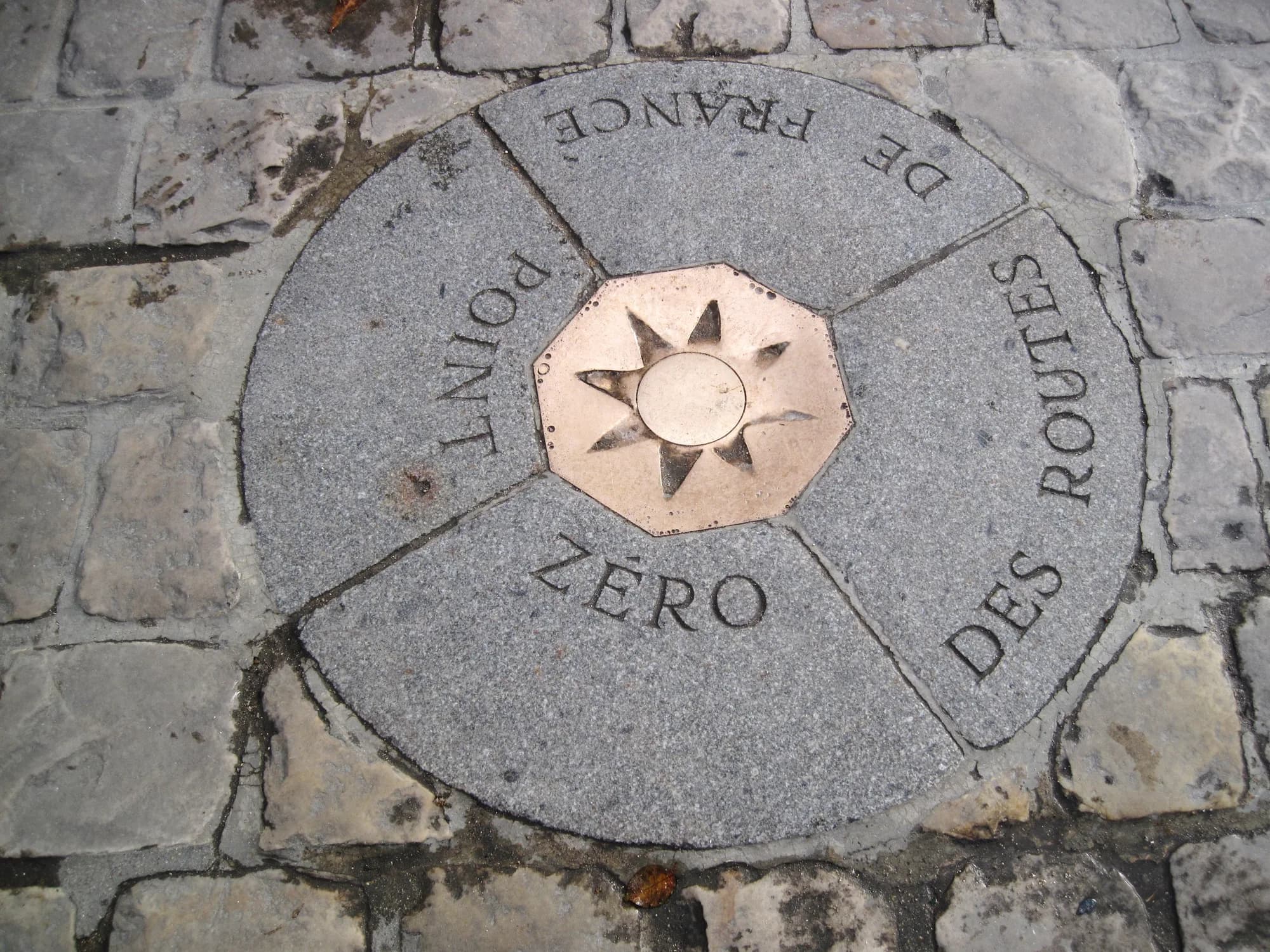
Point Zéro des Routes de France
Imagine standing at the very heart of France, where all roads truly begin. Nestled in the historic Parvis Notre-Dame, directly in front of the majestic Cathédrale Notre-Dame de Paris, lies Point Zéro des Routes de France. This unassuming yet significant landmark marks the official Kilometre Zero, from which all highway distances across the nation are measured. As you step or spin on the bronze medallion, you're not just marking a spot on the map; you're participating in a centuries-old tradition that connects you to the very soul of Paris. Whether you're a history buff, a traveler, or simply a curious soul, Point Zéro offers a unique glimpse into the rich tapestry of French heritage and a chance to make a wish for your future Parisian adventures.
Embedded in the cobblestones of the Parvis Notre-Dame (Place Jean-Paul II) directly in front of Cathédrale Notre-Dame de Paris, Point Zéro des Routes de France is the official Kilometre Zero marker of France. Marked by an octagonal bronze compass rose medallion surrounded by a circular stone slab divided into four quarters—inscribed 'POINT', 'ZÉRO', 'DES ROUTES', and 'DE FRANCE'—this modest landmark serves as the national geographic reference point from which all highway distances radiating from Paris across the French road network are measured. A popular tradition among travelers and Parisians holds that stepping or turning on the bronze medallion guarantees a future return to Paris.
History
The concept of measuring distances from the heart of Paris dates back to the Ancien Régime. In medieval times, an 'échelle de justice' (ladder of justice / pillory) stood near the cathedral portal, where condemned individuals did public penance. By letters patent issued by King Louis XV on April 22, 1769, and a royal letter by Louis XVI on April 22, 1786, the parvis of Notre-Dame was formally designated as the starting benchmark for all royal roads leaving the capital.
Between 1912 and 1924, the Paris City Council and the Commission du Vieux Paris deliberated on the physical monumentation of this point, culminating in the solemn installation of the current bronze medallion and four-quadrant stone slab on October 10, 1924. The marker was temporarily removed in 1966 during excavations for an underground car park beneath the parvis; when extensive Gallo-Roman and medieval ruins were uncovered, the car park plan was abandoned in favor of creating the Crypte Archéologique de l'Île de la Cité, after which the Point Zéro medallion was carefully reinstalled in 1972.
Fun Facts
- All highway and national road distances across France (such as the A1, A6, and N7) are officially calculated starting from this exact bronze point.
- According to local Parisian folklore and superstition, spinning on one foot atop the bronze compass rose medallion ensures that you will return to Paris, while others make a wish or toss a coin onto it.
- During underground excavations beneath Point Zéro in the 1960s, workers unearthed ancient Roman baths, medieval street walls, and 18th-century hospital foundations, leading to the creation of the Crypte Archéologique.
- Point Zéro is a geographic and road distance datum, whereas historical French geodetic survey reference points (triangulation markers) were based on the cathedral spire and the Paris Observatory Meridian.
- The marker was officially inaugurated on October 10, 1924, formalizing a tradition of measuring royal roads established under King Louis XV in 1769.
Guide Tips
- Location: Look for the medallion roughly 50 meters directly in front of Notre-Dame's main western portal on the open stone square.
- Finding it: Because it is embedded flat into the ground, it can easily be overlooked or obscured when the parvis is bustling with visitors—look for small clusters of people gazing down at the ground or taking photos of their shoes.
- Photography: Capture a classic overhead shot of your feet on the bronze wind rose with the twin towers of Notre-Dame soaring in the background.
- Timing: Visit early in the morning before tourist crowds gather on the parvis to have clear, unobstructed access to the plaque.
Opening Hours
24/7 - External Visit (Public square / Parvis Notre-Dame)