
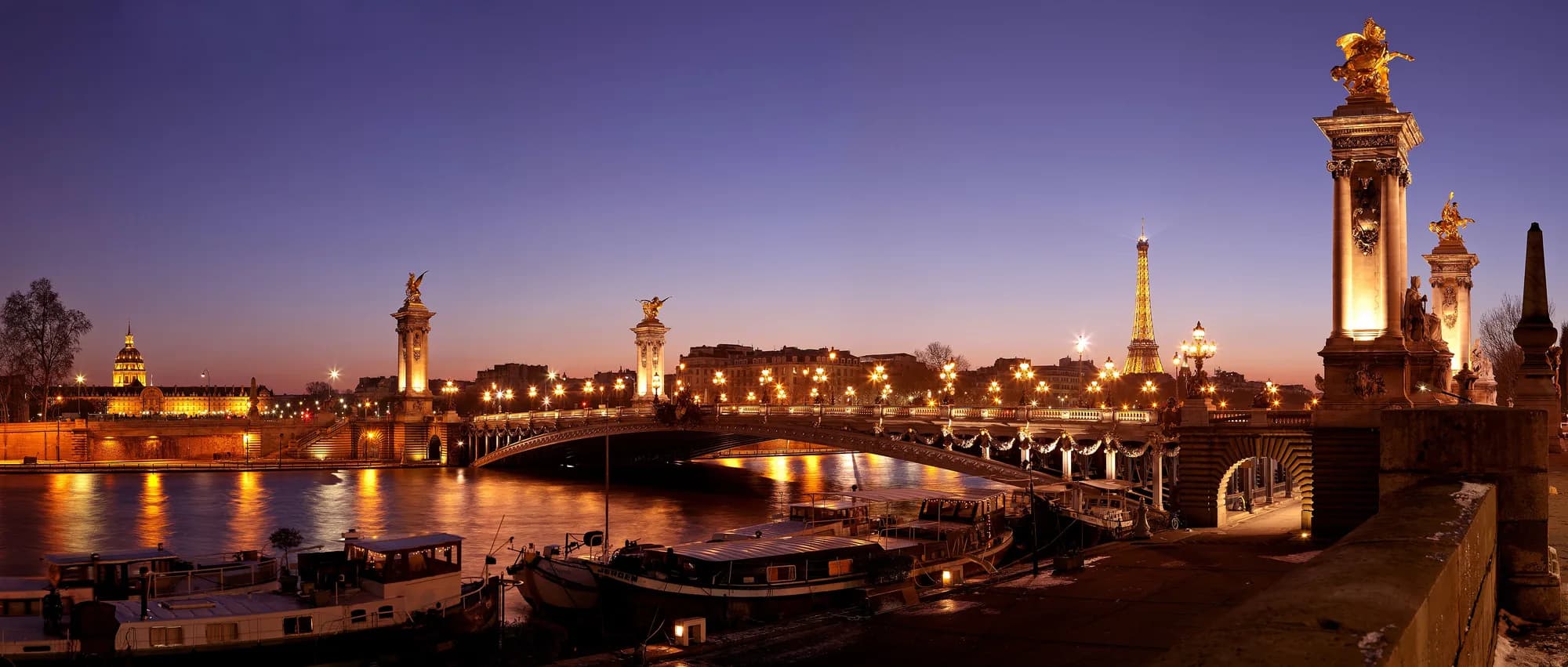
Pont Alexandre III
Imagine yourself walking across the Pont Alexandre III, a bridge that not only connects two sides of Paris but also bridges the past and present with its timeless elegance. Spanning the River Seine between the 7th and 8th arrondissements, this Beaux-Arts masterpiece is a testament to the grandeur of Belle Époque Paris. As you stroll across its broad sidewalks, you'll be treated to panoramic views of the Eiffel Tower, the Grand Palais, and the historic Les Invalides, all framed by the bridge's stunning Art Nouveau details and gilded bronze sculptures. Whether you're here to soak in the history, capture the perfect photo, or simply enjoy the serene river life, Pont Alexandre III promises an unforgettable experience that captures the essence of Paris at its most enchanting.
Spanning the River Seine between the 7th and 8th arrondissements, the Pont Alexandre III is widely celebrated as the most elegant, sumptuous, and ornate bridge in Paris. Designed in the opulent Beaux-Arts style by architects Joseph Cassien-Bernard and Gaston Cousin alongside engineers Jean Résal and Amédée Alby, the bridge was constructed between 1896 and 1900 for the Exposition Universelle (1900 World's Fair). Connecting the monumental esplanade of Les Invalides on the Left Bank with the Grand Palais and Petit Palais on the Right Bank, the bridge was engineered with an innovative 107.5-meter (353 ft) single-span steel arch with an exceptionally low 6-meter profile, deliberately designed not to obstruct panoramic vistas of the Invalides dome or the Champs-Élysées. The bridge is an open-air sculpture museum adorned with four monumental 17-meter (56 ft) stone pylons crowned with gilded bronze sculptures of the Fames (Renommées), allegorical bas-reliefs representing the French periods of Charlemagne, Francis I, Louis XIV, and the modern era, thirty-two ornate Art Nouveau candelabras, and sculpted copper Nymphs symbolizing the Seine and Neva rivers. A stroll across its broad sidewalks offers breathtaking panoramic vistas of the Eiffel Tower, the Grand Palais glass dome, and river traffic cruising along the Seine.
History
The construction of the Pont Alexandre III is inextricably linked to the geopolitical diplomacy of late 19th-century Europe and the celebration of the 1900 Paris Exposition Universelle. In 1891, the French Third Republic and the Russian Empire signed the Franco-Russian Alliance (l'Alliance Franco-Russe), ending France's diplomatic isolation and establishing close military, cultural, and economic ties between the two nations. To symbolize this enduring friendship, Russian Emperor Alexander III sponsored the project, and in October 1896 his son, Tsar Nicholas II, laid the foundation stone in a lavish state ceremony with French President Félix Faure. In reciprocity, the French Republic funded the Trinity Bridge (Troitsky Bridge) across the Neva River in Saint Petersburg, designed by the French firm Gustave Eiffel & Cie and laid by President Faure in 1897.
Constructed in just four years under the direction of engineers Jean Résal and Amédée Alby and architects Joseph Cassien-Bernard and Gaston Cousin, the bridge was officially inaugurated on April 14, 1900, by French President Émile Loubet for the opening of the Exposition Universelle. It formed a vital ceremonial axis connecting the newly erected Grand Palais and Petit Palais on the Right Bank with the monumental Esplanade des Invalides on the Left Bank.
Throughout the 20th and 21st centuries, the bridge has stood as one of the quintessential emblems of Belle Époque Paris. It was officially classified as a French Monument Historique in 1975 and included in the UNESCO World Heritage listing for the 'Paris, Banks of the Seine' in 1991. In 2024, the bridge took center stage on the global athletic stage as a key competition venue and finish line for the Paris 2024 Olympic and Paralympic Games.
Fun Facts
- Imperial Cornerstone: The bridge's foundation stone was laid on October 7, 1896, by Russian Tsar Nicholas II and Empress Alexandra Feodorovna alongside French President Félix Faure, commemorating the Franco-Russian Alliance of 1891 and honoring Nicholas's father, Emperor Alexander III.
- Nymphs of Two Great Rivers: At the center of the bridge's arch over the Seine, ornate hammered-copper reliefs represent the Nymphs of the Seine (holding the coat of arms of Paris) on one side and the Nymphs of the Neva (holding the imperial coat of arms of Russia) on the other.
- Masterwork of Low-Profile Engineering: To preserve sightlines to Les Invalides and the Champs-Élysées, engineers Jean Résal and Amédée Alby built the bridge as a single low-slung steel arch only 6 meters high at its center, resisting massive lateral thrusts with colossal 17-meter stone counterweight pylons.
- The Four Gilded Fames: The towering masonry pylons serve both as essential structural ballast against horizontal thrust and as pedestals for four magnificent gilded bronze statues representing the Fame of the Arts, Sciences, Commerce, and Industry.
- Legendary Cinematic Backdrop: The bridge is one of global cinema's most famous filming locations, appearing in classics and modern hits such as Woody Allen's 'Midnight in Paris', the James Bond film 'A View to a Kill', 'Anastasia', and 'John Wick: Chapter 4'.
- Olympic Grandeur: During the Paris 2024 Olympic Games, Pont Alexandre III served as a dramatic centerpiece for the Opening Ceremony and hosted the finish line for triathlon, marathon swimming, and road cycling time trials.
Guide Tips
- Best Eiffel Tower Photo Spot: Stand on the eastern (downstream) sidewalk facing west during golden hour or twilight to frame the ornate Art Nouveau lamp posts, gilded statues, and the Eiffel Tower sparkling in the background.
- Riverfront Walk Below: Take the stone staircases at either end down to the Parc Rives de Seine promenade (Port des Invalides) for an incredible low-angle view of the bridge's steel arch and river nymphs.
- Twilight and Night Illumination: Visit after dusk when the 32 three-branch bronze candelabras are lit and the four gilded Fame statues are floodlit against the night sky.
- Floating Cafes & River Life: In the warmer months, the quays directly underneath and adjacent to the bridge host popular open-air terrace bars, floating restaurant barges, and cultural venues.
Opening Hours
24/7 - External Public Bridge & Promenade