
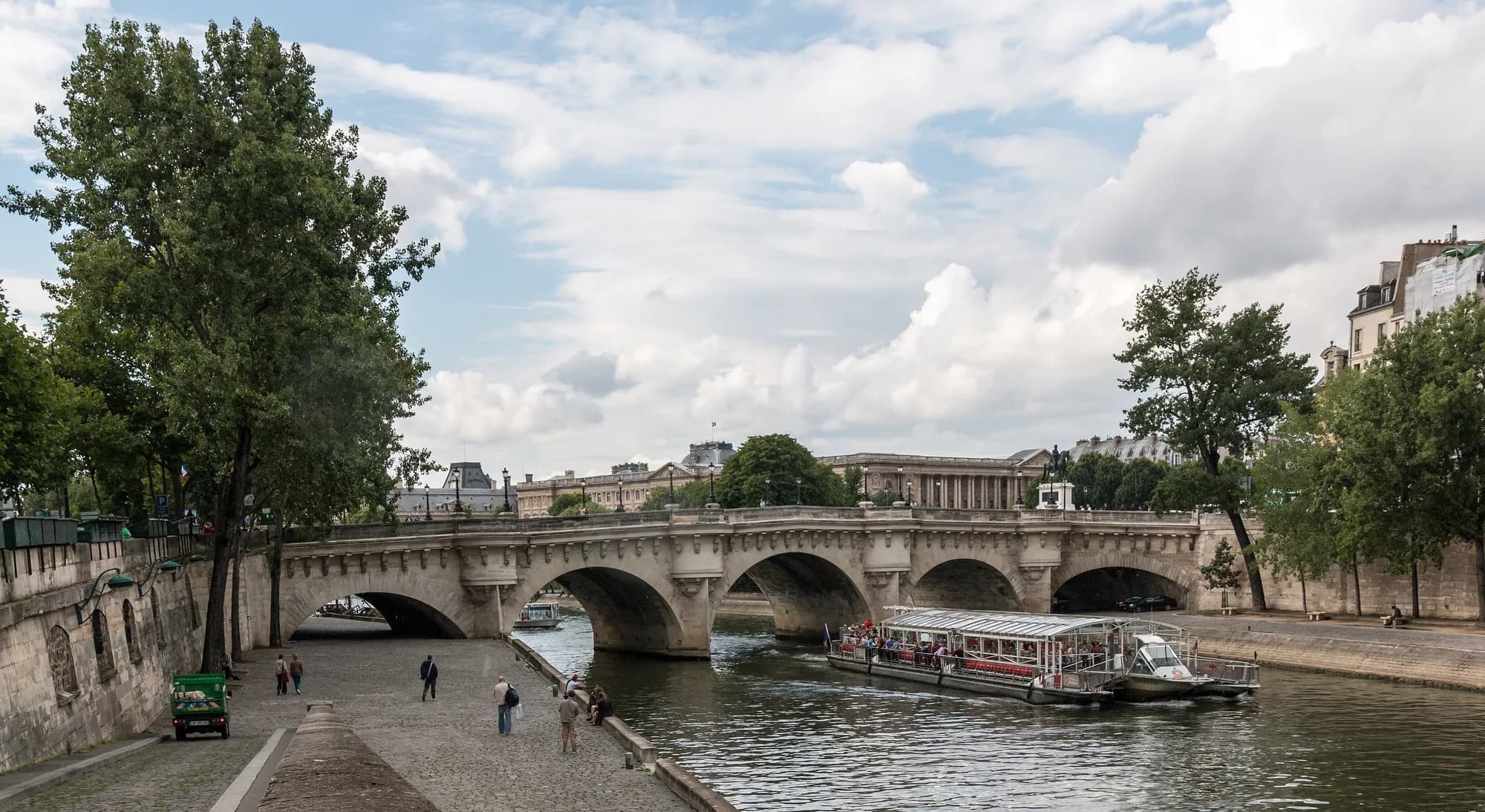
Pont Neuf
Imagine stepping back in time as you cross the Pont Neuf, Paris' oldest standing stone bridge, a masterpiece of Renaissance engineering. Commissioned by King Henry III and completed under King Henry IV, this iconic landmark not only offers a fascinating glimpse into the past but also provides stunning panoramic views of the Seine and the city's most celebrated landmarks. Whether you're marveling at the 381 unique stone mascarons, strolling along the first pedestrian sidewalks in Europe, or admiring the equestrian statue of Henri IV, the Pont Neuf promises an unforgettable journey through history and art. Plan your visit to experience the charm and beauty of this timeless Parisian treasure.
Spanning the River Seine at the western tip of the Île de la Cité, the Pont Neuf is the oldest standing bridge in Paris and one of the French capital's most celebrated engineering and architectural marvels. Commissioned in 1578 by King Henry III and completed in 1607 under King Henry IV, the bridge was revolutionary for its era: unlike medieval predecessors, it was constructed entirely of stone without houses encumbering its decks and was the very first bridge in Paris fitted with raised pedestrian sidewalks (trottoirs) to protect strollers from street mud and carriage wheels. Built in two distinct spans totaling 232 meters across 12 semicircular arches (seven on the Right Bank arm and five on the Left Bank arm), the bridge is adorned with 381 distinctive carved stone mascarons and semicircular projecting bastions (demi-lunes) resting upon each pier. An external stroll across the bridge connects the 1st and 6th arrondissements, offering breathtaking panoramic vistas of the Seine, the Louvre Palace, the Pont des Arts, and the romantic weeping willows of Square du Vert-Galant.
History
In the 16th century, Paris possessed only two heavily congested wooden bridges connecting Île de la Cité to the riverbanks—both lined with crowded timber houses that posed severe fire and collapse hazards. In 1577, King Henry III approved plans for a modern stone bridge across the western tip of the island, laying the foundation stone on May 31, 1578, with master mason Guillaume Marchant and architect Jean-Baptiste Androuet du Cerceau guiding construction.\n\nWork was halted for over a decade during the French Wars of Religion (1588–1598) and resumed in 1599 under King Henry IV ('Le Bon Roi Henri'). Henry IV made the radical decision to ban the construction of houses upon the bridge, ensuring unobstructed views of the river and royal palaces while creating public pedestrian sidewalks—a pioneering urban planning innovation in Europe. In 1607, Henry IV formally inaugurated the bridge by riding across it on a white charger.\n\nIn 1614, four years after Henry IV's assassination, Queen Marie de' Medici commissioned an equestrian statue of the king sculpted by Giambologna and Pietro Tacca, placed on the central terre-plein. During the French Revolution in 1792, the original statue was melted down for artillery bronze, but in 1818 King Louis XVIII commissioned a faithful replica by sculptor François-Frédéric Lemot, cleverly cast using bronze melted from statues of Napoleon Bonaparte. Designated a Historical Monument in 1889 and later recognized within the UNESCO World Heritage listing for the Banks of the Seine, Pont Neuf underwent a comprehensive 13-year restoration completed in 2007. In September 2025, the City of Paris officially named the central bridge esplanade 'Place du Pont-Neuf - Christo et Jeanne-Claude' in honor of the artist duo who enveloped the monument in 1985.
Fun Facts
- Oldest Bridge with the 'New' Name: Although 'Pont Neuf' literally translates to 'New Bridge,' it is ironically the oldest standing stone bridge in Paris, having survived intact for over four centuries.
- Birthplace of Parisian Sidewalks: Pont Neuf was the first bridge in Paris built without residential houses and shops lining its roadway, and the very first civic thoroughfare to feature raised pavements (trottoirs) dedicated solely to pedestrian walking.
- 381 Grotesque Mascarons: The bridge's stone cornices are embellished with 381 individually sculpted stone masks (mascarons), designed in the late 16th century by royal sculptor Germain Pilon to depict expressive heads of mythological satyrs, river deities, and Parisian sylvans.
- France's First Public Royal Effigy: The bronze equestrian statue of King Henri IV, erected on the bridge's central platform in 1614, was the first statue of a French monarch displayed on an open public road rather than inside a royal palace or private courtyard.
- The Pont-Neuf Wrapped (1985): In September 1985, the iconic environmental artist duo Christo and Jeanne-Claude wrapped the entire bridge, including its arches, 44 streetlamps, and bastions, in 41,800 square meters of shimmering sandstone-colored woven fabric for a world-renowned art installation.
Guide Tips
- Walk Both River Spans: Stroll the entire 232-meter length across both sections of the bridge—the 7-arch span connecting to the Right Bank (near the Samaritaine) and the 5-arch span connecting to the Left Bank (near Rue Dauphine and Monnaie de Paris).
- Postcard View from Square du Vert-Galant: Take the central stone staircase down behind the statue of Henri IV to the westernmost tip of Île de la Cité for a tranquil water-level view of the Seine and the bridge arches framed by weeping willows.
- River Cruise Gateway: At the foot of the bridge on the Île de la Cité quay sits the embarkation dock for the historic Vedettes du Pont Neuf riverboats, offering scenic sightseeing cruises along the Seine.
- Sunset & Twilight Illumination: Visit around dusk when the evening golden light warms the historic limestone stonework and the charming vintage street lanterns cast romantic reflections across the Seine.
Opening Hours
24/7 - External Visit / Scenic Bridge & Quayside Viewing