
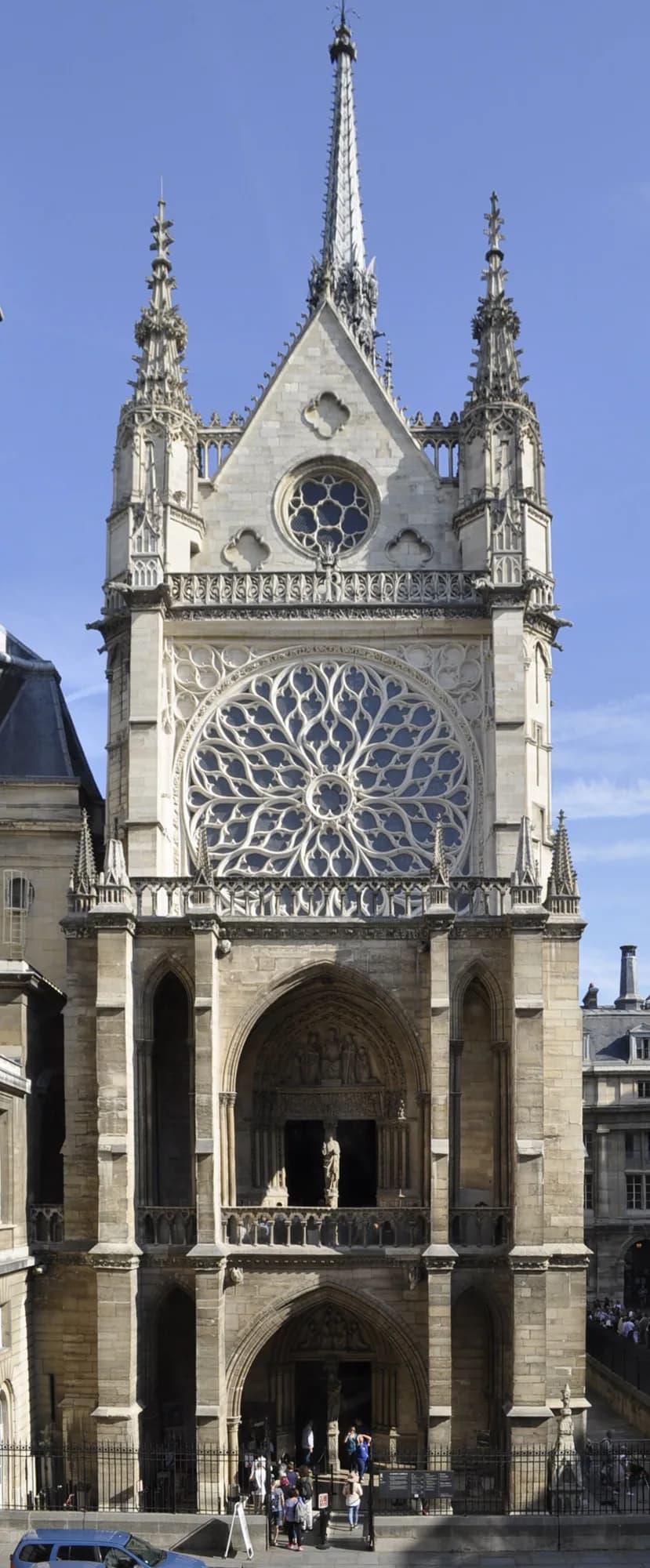
Sainte-Chapelle
Imagine stepping back in time to the heart of medieval Paris, where the Sainte-Chapelle stands as a testament to the grandeur of High Gothic architecture. This iconic landmark, nestled within the Palais de Justice on the Île de la Cité, is not just a building but a treasure trove of history and artistry. Commissioned by King Louis IX to house the Crown of Thorns, the chapel's radiant design and intricate details invite you to explore its storied past and bask in its timeless beauty. Whether you're admiring the chapel's soaring spire from a nearby street or stepping inside to witness the illuminated relics, Sainte-Chapelle promises an unforgettable journey through history and light.
Tucked within the monumental courtyard of the Palais de la Cité (now the Palais de Justice) on the Île de la Cité, the Sainte-Chapelle is widely considered the quintessential gem of High Gothic (Rayonnant) architecture in Europe. Commissioned in the 1240s by King Louis IX (Saint Louis) to house the Crown of Thorns and other priceless Passion relics, this jewel-like royal palatine chapel was engineered to dissolve the physical boundaries of stone walls into pure, incandescent light. An exterior visit reveals its soaring 33-metre cedar spire, dramatic exterior buttresses topped with pinnacles and gargoyles, the intricately sculpted two-tier western portal, and the flamboyant Gothic rose window gifted by King Charles VIII. Framed by the historic 18th-century Cour du Mai and the gilded wrought-iron gates of the Palais de Justice, Sainte-Chapelle stands as one of the most sublime architectural achievements of medieval Christendom.
History
Commissioned by King Louis IX (later canonized as Saint Louis) in 1242 and consecrated on April 26, 1248, the Sainte-Chapelle was conceived as a monumental architectural reliquary. In 1239, Louis IX purchased the Crown of Thorns from Baldwin II, the Latin Emperor of Constantinople, for an astronomical sum of 135,000 livres tournois—over three times the entire construction cost of the chapel itself (around 40,000 livres). Designed in the radiant Rayonnant Gothic style, possibly by master mason Pierre de Montreuil or Jean de Chelles, the structure was built with exceptional speed in just six years.\n\nThe building was ingeniously organized on two levels: a lower chapel dedicated to the Virgin Mary for palace servants and court staff, and a luminous upper chapel accessible directly from the royal apartments via a covered passageway, reserved exclusively for the King, the royal family, and display of the holy relics. Surviving major palace fires in 1630 and 1776, the chapel suffered severe desecration during the French Revolution when its reliquaries were melted down, the original spire dismantled, and the building repurposed as a flour warehouse, judicial archives storage, and club meeting hall. In 1837, galvanized by popular outcry and Romantic historic preservationists, the French government initiated a monumental 26-year restoration led by architects Félix Duban, Jean-Baptiste Lassus, and Eugène Viollet-le-Duc, who faithfully reconstructed the ornate 33-metre spire in 1853 and returned the masterpiece to its medieval glory.
Fun Facts
- Relics Worth More Than the Building: King Louis IX paid 135,000 livres tournois in 1239 to acquire the Crown of Thorns from the Latin Emperor of Constantinople—more than three times the total cost of constructing the entire chapel itself (40,000 livres).
- Blazing Speed of Medieval Engineering: While medieval cathedrals often took centuries to finish, Sainte-Chapelle was designed, engineered, and completed in only six years (1242–1248).
- The Fifth Spire in History: The current 33-metre Gothic spire, constructed from durable cedar wood in 1853 by architect Jean-Baptiste Lassus, is actually the fifth spire to crown the chapel since the 13th century, replacing predecessors destroyed by lightning and fire.
- Two Distinct Chapels in One: The building is a two-story royal structure: the lower chapel with low vaulted ceilings was used by palace staff and servants, while the breathtaking 20-metre-high upper chapel was reserved exclusively for the French monarch and royal court.
- Saved by Flour and Paper: During the French Revolution, the chapel avoided total demolition because revolutionary authorities repurposed the sacred building first as a grain and flour storage warehouse, and later as the central archive depository for the neighboring courts of justice.
Guide Tips
- Best Exterior Viewing Spots: Admire the chapel's soaring spire and roofline from Boulevard du Palais through the monumental gilded gates of the Cour du Mai, or capture the dramatic upper spire against the sky from Pont Saint-Michel and Quai des Grands-Augustins.
- Island Walking Loop: Pair your exterior viewing with a walk around Île de la Cité—visit the neighboring Conciergerie and Clock Tower (Tour de l'Horloge), stroll through Place Dauphine, and finish at Notre-Dame Cathedral.
- Golden Hour & Evening Illumination: In the late afternoon, the setting sun casts a golden glow across the limestone buttresses and western rose window, and subtle floodlighting illuminates the spire after dusk.
- Security & Courtyard Access: Because Sainte-Chapelle is situated inside the active Paris Court of Justice (Palais de Justice) complex, all visitors entering the Cour du Mai courtyard must pass through standard airport-style security scanners.
Opening Hours
24/7 - External Courtyard & Exterior Viewing (Chapel interior visit: Apr–Sep daily 09:00 - 19:00, Oct–Mar daily 09:00 - 17:00)