
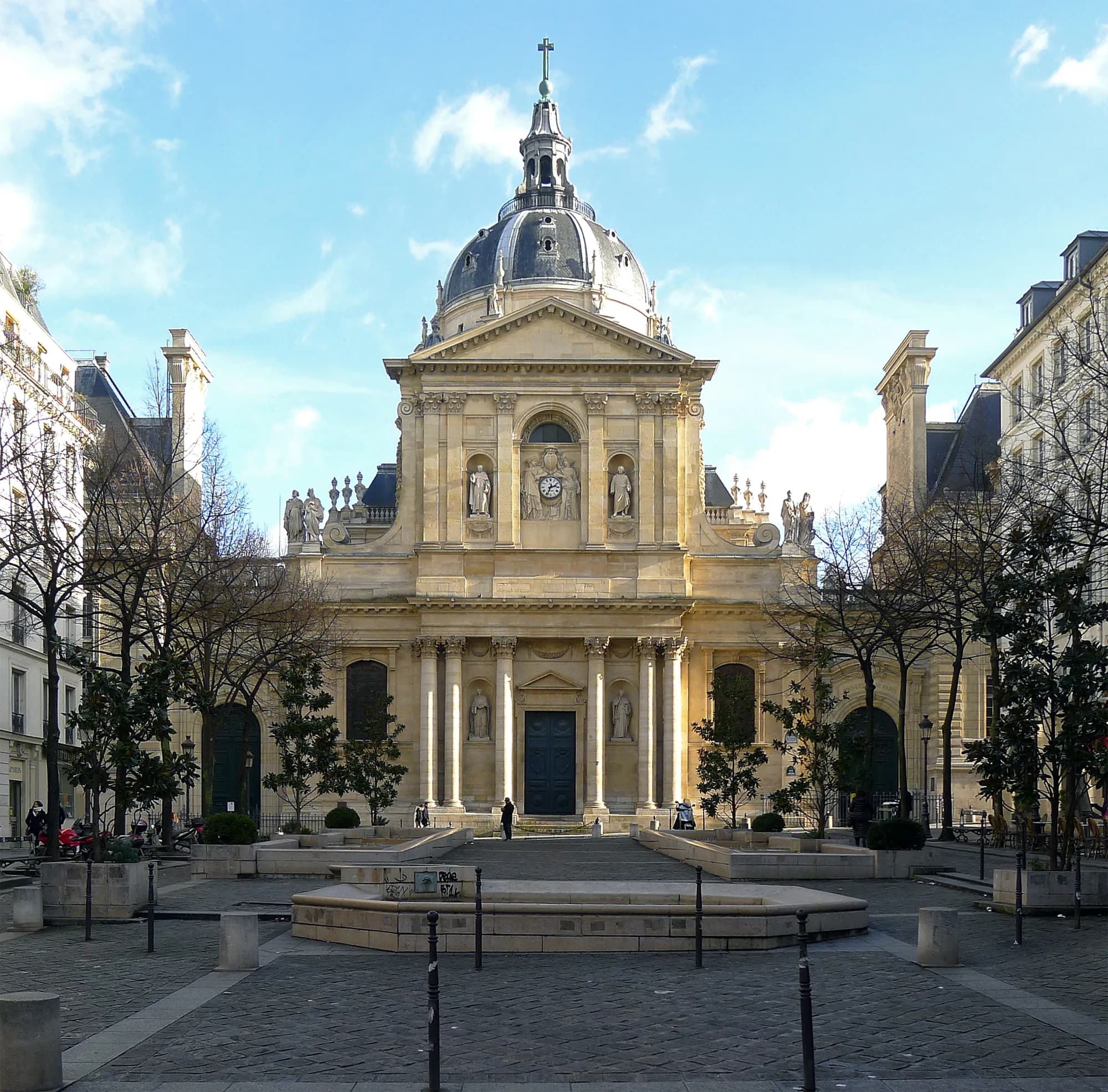
Sorbonne
Step into the hallowed halls of history at the Sorbonne, Paris' venerable institution of higher learning. Nestled in the heart of the Latin Quarter, this iconic landmark has been a beacon of intellectual pursuit since its founding in 1253 by Robert de Sorbon. As you wander through the picturesque Place de la Sorbonne, lined with charming café terraces and historic plane trees, you'll be captivated by the majestic classical façade of the Chapelle Sainte-Ursule de la Sorbonne. This architectural gem, reconstructed under the patronage of Cardinal Richelieu, stands as a testament to the enduring legacy of the University of Paris. Whether you're soaking in the scholarly atmosphere, marveling at the intricate details of the chapel's Baroque dome, or simply enjoying a moment of reflection, the Sorbonne promises an unforgettable journey through time.
At the intellectual heart of the Latin Quarter on the Montagne Sainte-Geneviève, La Sorbonne is one of the world's oldest and most prestigious institutions of higher learning. Founded in 1253 by theologian Robert de Sorbon as a college for students of modest means and chartered with the patronage of King Louis IX (Saint Louis), it grew into the defining historical symbol of the University of Paris. An external walking exploration centers on the picturesque pedestrian expanse of Place de la Sorbonne, lined with classic Parisian café terraces, plane trees, and stone fountains, leading directly to the monumental classical façade of the Chapelle Sainte-Ursule de la Sorbonne. Reconstructed between 1635 and 1642 by master royal architect Jacques Lemercier under Cardinal Richelieu, the chapel’s Corinthian portico, sculpted pediments, and majestic Baroque dome remain an architectural landmark of the 5th arrondissement.
History
The origins of La Sorbonne trace back to 1253 when Robert de Sorbon, confessor and chaplain to King Louis IX, established a college designed to provide lodging and theological instruction to scholars of modest means. Over the Middle Ages, the Collège de Sorbonne evolved into the intellectual nerve center of the University of Paris, attracting leading thinkers, theologians, and humanists from across Europe. In 1470, the college hosted the installation of France's first printing press, cementing its role at the vanguard of European scholarship.\n\nIn 1622, Armand Jean du Plessis, Cardinal de Richelieu, became the college's headmaster. Seeking to restore its crumbling medieval buildings, Richelieu commissioned premier royal architect Jacques Lemercier in 1626 to design a grand classical complex. The centerpiece of this grand design was the Chapelle Sainte-Ursule de la Sorbonne, built between 1635 and 1642, which remains the sole surviving structure of the Richelieu era. Following the French Revolution—during which the university was suppressed and the chapel briefly converted into a Temple of Reason—Napoleon Bonaparte revived the complex in 1808 as the seat of the Académie de Paris. Between 1885 and 1901, architect Henri-Paul Nénot reconstructed the surrounding university palace in the grand Neo-Renaissance style seen today, harmonizing modern academic halls with Lemercier's historic 17th-century chapel.
Fun Facts
- Richelieu's Mausoleum: Cardinal Richelieu, who served as proviseur (headmaster) and funded the 17th-century reconstruction, was entombed within the Chapelle de la Sorbonne. His white marble tomb, sculpted by François Girardon, survived the French Revolution despite the looting and later recovery of the cardinal's remains.
- Birthplace of French Printing: In 1470, the Sorbonne welcomed the first printing press ever established in France, installed by Ulrich Gering, Michael Friburger, and Martin Crantz to print humanist academic texts.
- Origin of the 'Latin Quarter': The surrounding Quartier Latin received its centuries-old moniker because scholars, professors, and international students from across Europe conversed exclusively in Latin inside the Sorbonne and along nearby streets.
- Sculptural Facade Details: The chapel façade features an ornate 19th-century clock crowned by Richelieu's coat of arms and two sculpted muses, alongside stone niche statues of scholastic philosophers Saint Thomas Aquinas and Peter Lombard.
- Historical Crucible: The Sorbonne's lecture halls and courtyards stood at the center of momentous French historical events, serving as a primary stage during the May 1968 student demonstrations that transformed modern French society.
Guide Tips
- Café Culture on Place de la Sorbonne: Take a relaxing seat at one of the lively open-air café terraces lining Place de la Sorbonne (such as Le Rostand or Café de la Sorbonne) for prime views of the chapel dome amidst student life.
- Complete Exterior Circuit: Walk from Boulevard Saint-Michel through Place de la Sorbonne to the chapel gates, then follow Rue Victor Cousin around to Rue des Écoles to take in the monumental 19th-century Neo-Renaissance university façades.
- Photography Angle: Stand near the central reflecting fountains on Place de la Sorbonne for a wide symmetrical shot framing the trees, cobblestones, and the soaring Baroque dome.
- Neighborhood Pairing: Cross Rue des Écoles to rub the foot of the bronze Michel de Montaigne statue for good luck (a long-standing student tradition), or combine with the nearby Panthéon and Musée de Cluny.
Opening Hours
24/7 - External Visit (Place de la Sorbonne public plaza)