
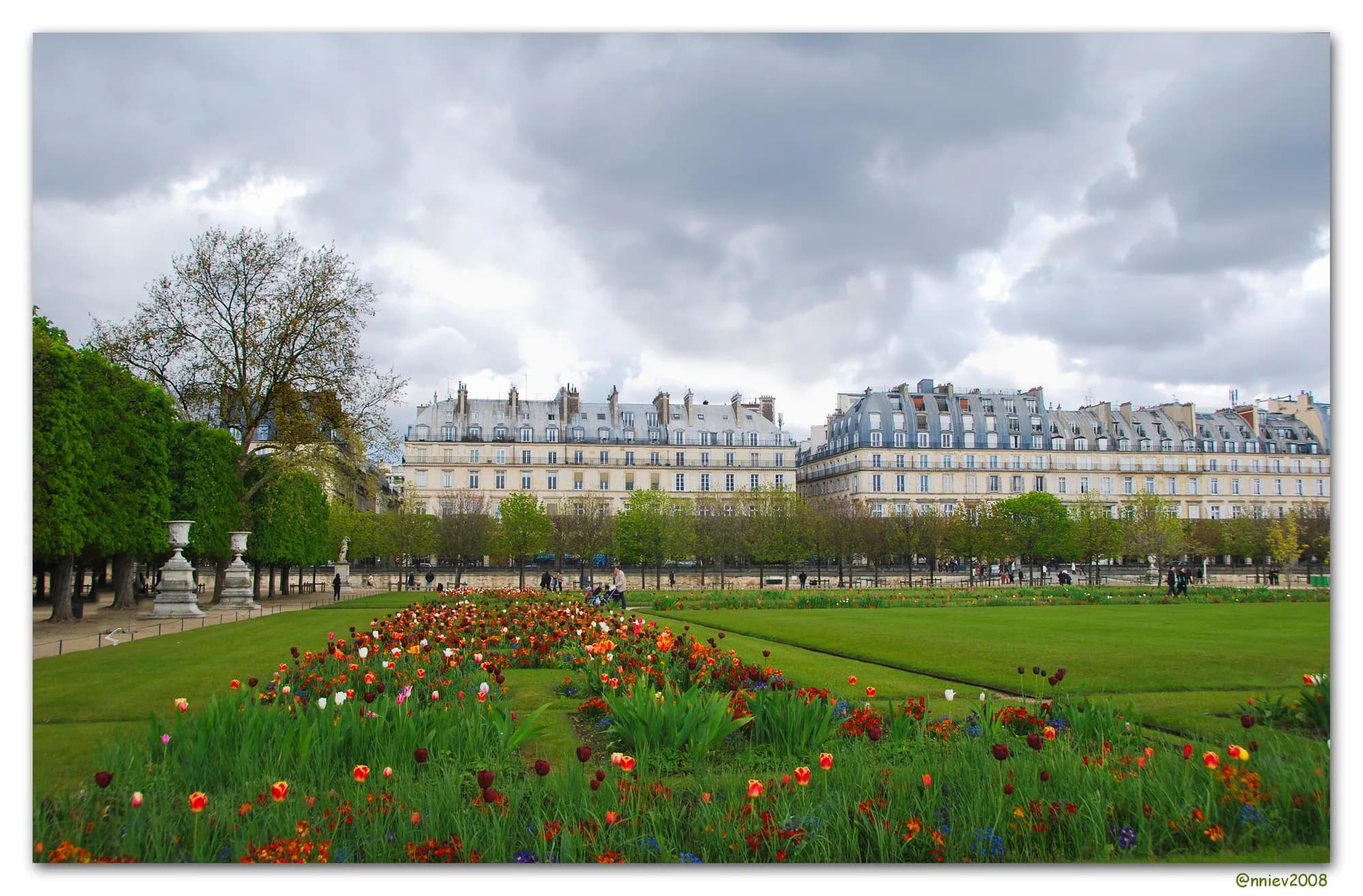
Tuileries Garden
Step into the heart of Paris with a visit to the Tuileries Garden, an enchanting oasis nestled between the Louvre Palace and the Place de la Concorde. This historic gem, originally commissioned by Queen Catherine de' Medici in 1564, has evolved into a celebrated public French formal garden, offering a perfect blend of natural beauty and artistic splendor. As you stroll through the meticulously manicured landscapes, you'll discover the iconic Grand Allée, lined with majestic chestnut and linden trees, and the serene ponds where you can rent a vintage wooden sailboat and glide across the water. Whether you're admiring the open-air sculptures by renowned artists or simply soaking in the tranquil atmosphere, the Tuileries Garden promises an unforgettable Parisian experience.
Stretching gracefully between the Louvre Palace and the Place de la Concorde in the 1st arrondissement, the Tuileries Garden (Jardin des Tuileries) is Paris's oldest, largest, and most celebrated public French formal garden. Spanning over 25 hectares along the Right Bank of the Seine, the park was originally commissioned in 1564 by Queen Catherine de' Medici as the private pleasure gardens of the Tuileries Palace, and later masterfully redesigned in 1664 by André Le Nôtre, the legendary landscape architect of Versailles. Today, the garden forms a central centerpiece of Paris's iconic Axe Historique (Historical Axis), featuring the majestic Grand Allée lined with sculpted chestnut and linden trees, two magnificent ornamental ponds (Grand Bassin Rond and Grand Bassin Octogonal) where Parisians sail vintage miniature wooden toy boats, and famous sage-green reclining chairs. Beyond its manicured greenery, the garden serves as a world-class open-air sculpture museum adorned with works by Auguste Rodin, Aristide Maillol, and Henry Moore, and is home to both the Musée de l'Orangerie and the Jeu de Paume.
History
In 1564, following the tragic death of King Henri II at the Place des Vosges tournament, Queen Catherine de' Medici acquired the suburban land west of Paris—historically occupied by tile factories (tuileries)—to construct the Tuileries Palace and design an Italian Renaissance garden. In 1664, King Louis XIV and his chief minister Jean-Baptiste Colbert commissioned royal landscape master André Le Nôtre to completely transform the gardens into the quintessential 'jardin à la française'. Le Nôtre introduced strict geometric symmetry, terraced perspectives along the Seine (Terrasse du Bord de l'Eau and Terrasse des Feuillants), and opened the central grand vista extending westward toward the future Champs-Élysées, giving birth to Paris's renowned Axe Historique.
In 1667, King Louis XIV opened the Tuileries to the public, creating one of Europe's very first royal gardens accessible to common citizens. The park was at the heart of pivotal historical moments during the French Revolution, including the fateful storming of the Tuileries Palace on August 10, 1792, which toppled the French monarchy. Although the Tuileries Palace was destroyed during the Paris Commune in 1871, the gardens endured as one of Paris's grandest urban sanctuaries, eventually designated a UNESCO World Heritage Site as part of the Banks of the Seine in 1991.
Fun Facts
- Origin of the Name: The garden gets its name from the tile-making kilns and factories ('tuileries') that occupied the clay-rich soil on this site before Queen Catherine de' Medici purchased the land in 1564.
- Classic Toy Sailboats: Since the 1850s, Parisian children and visitors have rented vintage wooden miniature sailboats to push across the Grand Bassin Octogonal using long wooden sticks—a beloved Parisian tradition that continues today.
- Iconic Green Garden Chairs: The famous sage-green metal chairs (known as the 'Sénat' chairs, designed by Frédéric Sofia) scattered freely throughout the garden have been a staple of Parisian leisure since 1923.
- Anchor of the Axe Historique: The Tuileries Garden forms the eastern foundation of the 8-kilometer Axe Historique, aligning in a perfect straight line from the Louvre Pyramid and Arc de Triomphe du Carrousel through Place de la Concorde to the Arc de Triomphe and Grande Arche de la Défense.
- Outdoor Sculpture Masterpieces: The garden functions as an open-air museum housing more than 20 bronze statues by Aristide Maillol, alongside monumental sculptures by Auguste Rodin, Jean Dubuffet, and Alberto Giacometti.
Guide Tips
- Grab a Green Chair: Pull one of the classic green recliners up to the edge of the Grand Bassin Octogonal or under the shaded linden tree allées for the ultimate Parisian relaxation experience.
- Sunset along the Seine Terrace: Walk along the elevated Terrasse du Bord de l'Eau overlooking Quai Aimé Césaire and the Seine for sweeping sunset views across to the Musée d'Orsay.
- Art Museum Pairings: Visit the Musée de l'Orangerie at the southwest corner to see Claude Monet's monumental Water Lilies (Nymphéas), or explore contemporary photography at the Jeu de Paume on the northwest terrace.
- Café Stops: Stop for a refreshment or pastry at Café Diane or Paul kiosk nestled under the garden trees between the ponds.
Opening Hours
Open daily: 07:00 - 23:00 (Jun-Aug) / 07:00 - 21:00 (Apr-May, Sep) / 07:30 - 19:30 (Oct-Mar)