
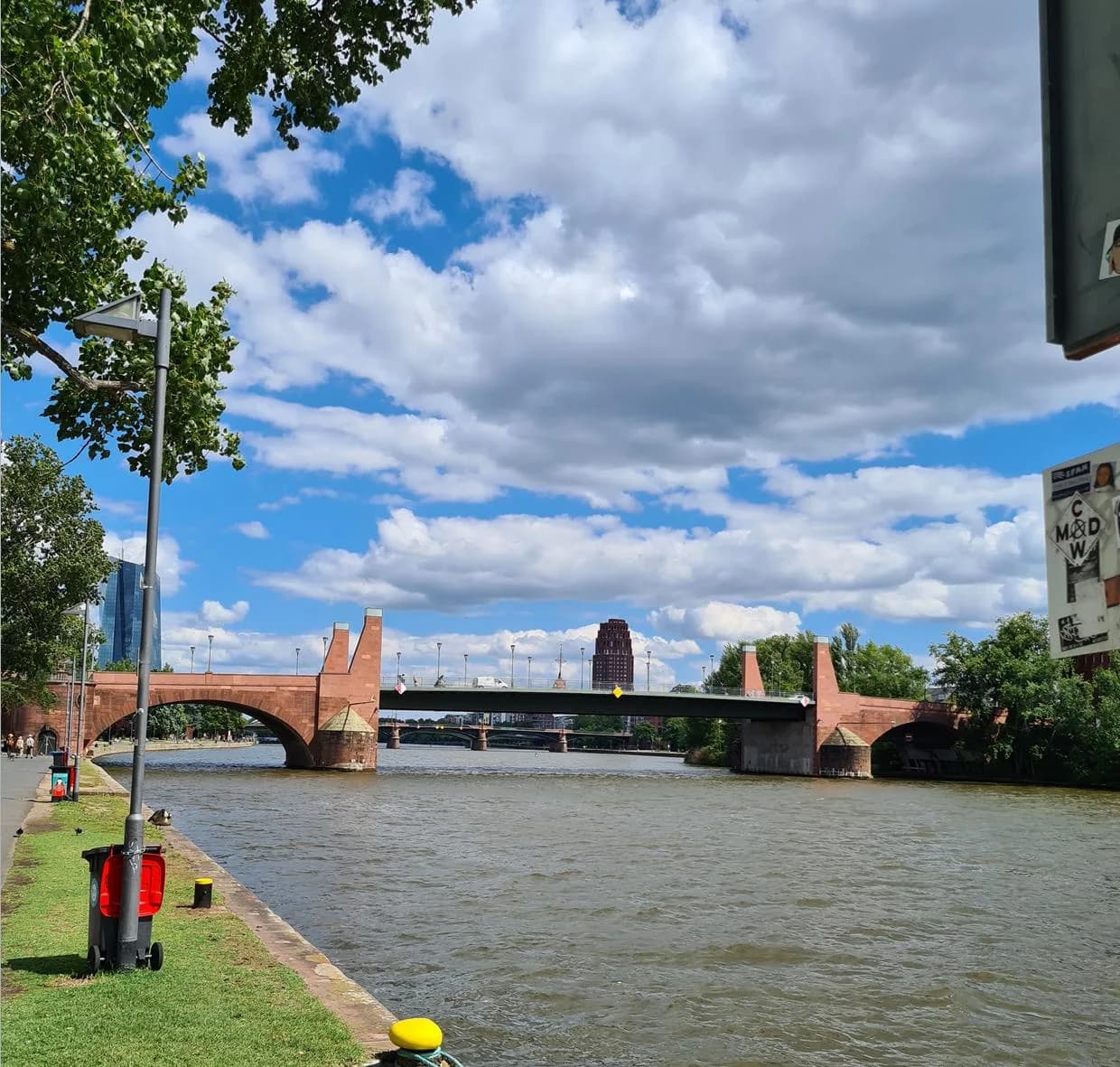
Alte Brücke (The Oldest Bridge)
A Alte Brücke, a ponte mais antiga de Frankfurt, é um testemunho da rica história e evolução da cidade. Construída em 1222, esta ponte de pedra substituiu o antigo vau natural do rio Main, que desempenhou um papel crucial na fundação de Frankfurt. Caminhe sobre suas pedras e sinta a história pulsando sob seus pés, enquanto desfruta da vista panorâmica do rio e da cidade. A Alte Brücke não é apenas uma passagem; é um portal para o passado, onde cada detalhe conta uma história de comércio, defesa e transformação.
A ponte mais antiga e a mais antiga documentada (1222) sobre o rio Main na cidade. A ponte mais antiga provavelmente era de madeira, a atual foi construída e expandida posteriormente.
História
**Frankfurt:** Born at the Ford.
**Ford**= Shallow part of a river where people could cross on foot or on horseback.)
Frankfurt grew around a natural ford in the Main River, somewhere in the area of today's Alte Brücke (Old Bridge). We don't know the exact position of the original ford, but historians generally place the historic crossing somewhere in this part of the river.
Before there was a bridge, this shallow section of the Main allowed people, horses, and carts to cross the river. The crossing was important because Frankfurt stood at the intersection of long-distance routes connecting different parts of Central Europe. Travelers and merchants could cross the Main here and continue their journeys in different directions.
The location also had another major advantage: the Domhügel (Cathedral Hill), just north of the river, provided higher and safer ground for settlement. Over time, the combination of a useful river crossing, important routes, and protected high ground attracted people, trade, and eventually political power.
From Ford to Bridge
For centuries, the river was crossed using the natural ford. But as Frankfurt grew, relying on a shallow crossing was no longer enough. A permanent bridge made it possible to cross the Main more reliably, especially for the growing movement of merchants, goods, and people.
The Alte Brücke is Frankfurt's oldest bridge and the oldest documented bridge across the Main in the city. It is first mentioned in a document from 1222. The earliest bridge was probably wooden, while the stone bridge that we associate with the Alte Brücke today developed through later rebuilding and expansion.
The bridge connected the historic center on the northern bank with Sachsenhausen on the southern bank. For centuries, it was the city's most important connection across the Main and one of the major routes through Frankfurt.
**This was a major transformation:**
**Before the bridge:**
People had to find and use the natural ford.
**After the bridge:**
People could cross at a fixed, controlled point.
That made movement more predictable and helped Frankfurt strengthen its position as a commercial and strategic center. The bridge also became important for controlling traffic into the city and collecting tolls from people and goods crossing it.
**Why “Frankfurt”?**
The name Frankfurt itself preserves the memory of the original crossing.
The earliest recorded form of the name, Franconofurd, appears in 794 AD. It is generally understood as “the ford of the Franks.”
Franco → the Franks, the Germanic people who controlled the region
furd → an old Germanic word meaning ford, a place where a river could be crossed
So:
Franconofurd → Frankfurt
“The Franks' ford.”
The name therefore describes the geographical feature that helped make the settlement important in the first place.
And the bridge came much later. When the Alte Brücke was first documented in 1222, Frankfurt had already existed for centuries. The bridge did not create Frankfurt — it replaced the natural crossing that had helped create the city.
So Frankfurt's story can be understood as a simple evolution:
natural ford → settlement → Frankish royal center → medieval bridge → trading city → financial center
Frankfurt was, quite literally, a city born from a river crossing.
Curiosidades
- Historicamente, uma torre de ponte ficava do lado de Frankfurt.
- A ponte já foi cercada por estruturas defensivas e portões.
- O famoso Galo de Tijolos (Brickegickel) de Frankfurt está associado à ponte há séculos.
- A travessia do rio Main foi uma das razões pelas quais Frankfurt se tornou estrategicamente importante.
Dicas do guia
- Visite a torre de ponte histórica do lado de Frankfurt para uma vista panorâmica.
- Explore as estruturas defensivas e portões ao longo da ponte.
- Preste atenção ao famoso Galo de Tijolos, um símbolo da ponte há séculos.
- Aprecie a arquitetura histórica da ponte e imagine a vida cotidiana em tempos antigos.
Horário de funcionamento
24/7 - External Visit