
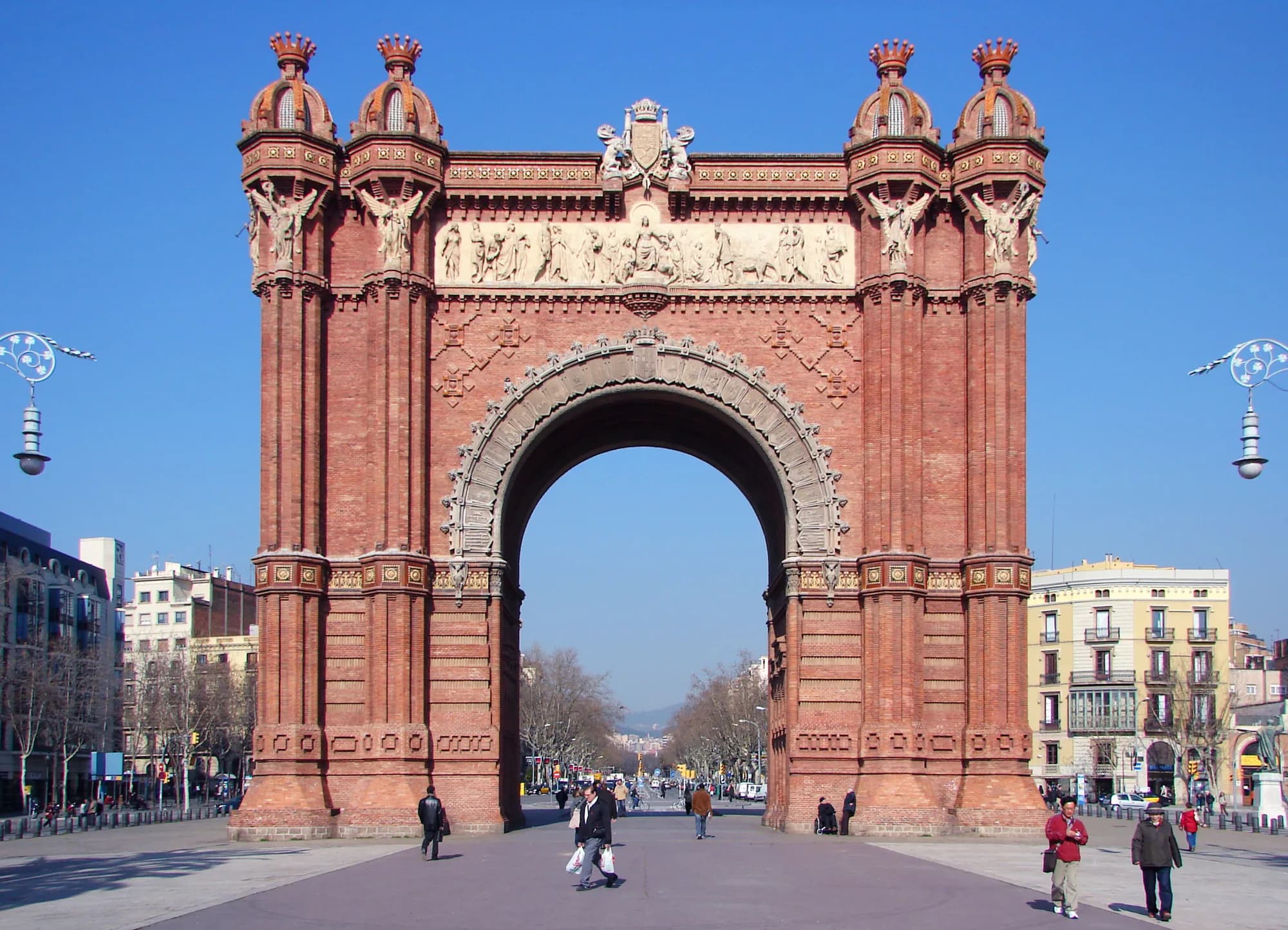
Arc de Triomf
Imagine standing at the gateway to a celebration of artistic and scientific progress, where every brick and tile tells a story of Barcelona's rich heritage. The Arc de Triomf, an iconic landmark in the heart of the city, invites you to explore its unique Neo-Mudéjar architecture and the fascinating history behind its creation. As you stroll along the palm-lined promenade leading to Parc de la Ciutadella, you'll find yourself immersed in a world where every detail, from the intricate stone carvings to the vibrant ceramic tiles, reflects the spirit of a city that embraces innovation and culture.
The Arc de Triomf is one of Barcelona's most iconic monuments, located at the head of the wide, palm-lined promenade of Passeig de Lluís Companys leading toward Parc de la Ciutadella.
History
Erected in 1888 for the Barcelona Universal Exposition, the Arc de Triomf marked a milestone in Barcelona's urban transformation following the demolition of the old defensive walls and the fortress of the Ciutadella in the mid-19th century. Architect Josep Vilaseca i Casanovas drew inspiration from Moorish and Mudéjar brick architecture, creating an innovative structure that departed from neoclassical Roman triumphal monuments. The arch's sculptural program was crafted by leading Catalan artists: the north-facing frieze by Josep Reynés welcomes participating nations, the south-facing frieze by Josep Llimona illustrates awards and honors, and the lateral reliefs by Antoni Vilanova and Torquat Tassó symbolize Industry, Agriculture, Science, and the Arts. The top of the arch is crowned with the coats of arms of Barcelona and Spain's provinces.
Fun Facts
- Civil, Not Military: Unlike Paris's Arc de Triomphe or Rome's Arch of Constantine, Barcelona's Arc de Triomf was built to celebrate civilian, artistic, and scientific progress rather than a military conquest.
- Neo-Mudéjar Red Brick: The structure is constructed primarily of red brick combined with decorative ceramic tiles, reflecting the 19th-century Catalan appreciation for Mudéjar and Moorish architectural traditions.
- Universal Exposition Gateway: During the 1888 World Fair, the arch served as the official main entrance leading visitors along the grand promenade directly into the fairgrounds in Parc de la Ciutadella.
- City Crest Details: If you look closely at the upper friezes, you can spot the bat crest, a historic heraldic symbol of King James I of Aragon and medieval Barcelona.
Guide Tips
- Classic Framing Shot: Stand in the center of Passeig de Lluís Companys to frame the monument with the two rows of date palms and modernist lampposts designed by Pere Falqués.
- Lively Promenade Stroll: The pedestrian promenade between the Arch and Parc de la Ciutadella is great for people-watching, street performers, rollerblading, and relaxed walks.
- Combine with the Park: Walk directly through the arch down the boulevard into Parc de la Ciutadella to visit the Cascada Monumental fountain and lake.
Opening Hours
24/7 - Public Monument & Promenade