
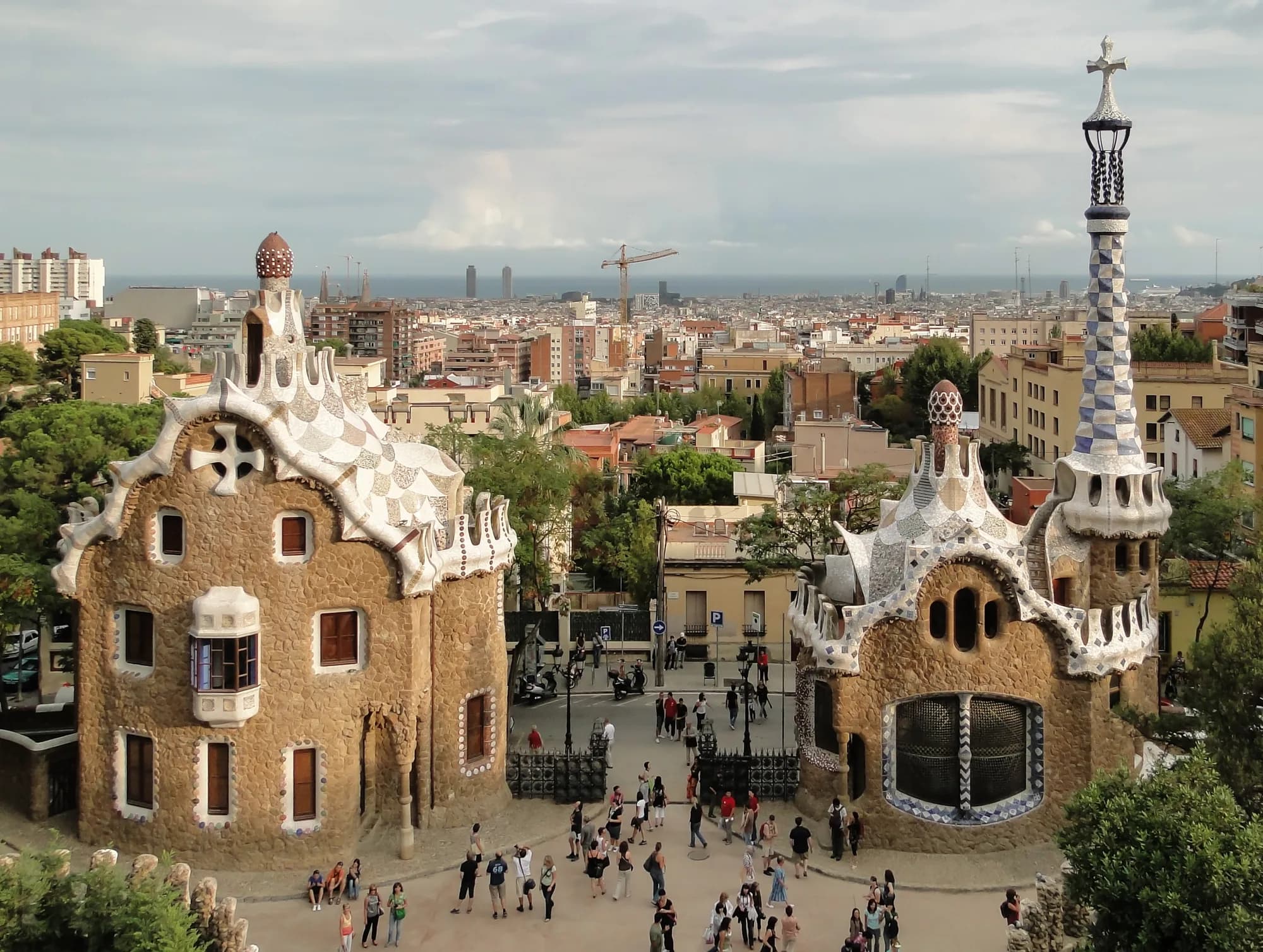
Park Güell
Imagine a place where nature and architecture dance together in a symphony of colors and forms. Welcome to Park Güell, a masterpiece crafted by the visionary Antoni Gaudí, nestled on the slopes of Carmel Hill in Barcelona's Gràcia district. This public park, commissioned by Count Eusebi Güell in 1900, is a testament to Gaudí's organic architectural philosophy, seamlessly blending with the natural landscape. As you wander through its winding paths, you'll encounter the iconic dragon staircase, the majestic Hypostyle Room, and the enchanting Nature Square, each element a testament to Gaudí's genius. Park Güell is not just a park; it's a journey through time, a celebration of creativity, and a must-visit landmark in Barcelona.
Park Güell is one of Antoni Gaudí's most visionary, fantastical, and world-renowned public park creations, situated on the slopes of Carmel Hill (Turó del Carmel) in Barcelona's Gràcia district. Commissioned in 1900 by wealthy industrialist Count Eusebi Güell as an upscale residential garden city, Gaudí integrated his organic architectural vision seamlessly into the natural topography of the Mediterranean hillside. Highlights of the park's Monumental Zone include the iconic dragon staircase (Escalinata del Drac) guarded by 'El Drac'—the celebrated multicolored mosaic salamander—the majestic Hypostyle Room (Sala Hipòstila) featuring 86 fluted Doric-inspired columns, and the sprawling Nature Square (Plaça de la Natura) surrounded by the famous serpentine bench lined with vibrant trencadís ceramic tile mosaics. In 1984, UNESCO inscribed Park Güell as a World Heritage Site under 'Works of Antoni Gaudí'.
History
Conceived in 1900 by wealthy Catalan industrialist Count Eusebi Güell as an exclusive garden city residential development for Barcelona's bourgeoisie, inspired by the British garden city movement. Eusebi Güell commissioned his close friend and visionary architect Antoni Gaudí to design the estate on Muntanya Pelada (Carmel Hill). The ambitious master plan called for 60 individual triangular residential plots, but the project struggled commercially and only two houses were ever built. Gaudí purchased one of the model homes and resided there with his family from 1906 to 1925. Following Eusebi Güell's death in 1918, his heirs offered the complex to the City of Barcelona, which officially opened it as a public municipal park in 1926. In 1984, UNESCO declared Park Güell a World Heritage Site as part of the 'Works of Antoni Gaudí'.
Fun Facts
- 🦎 'El Drac' Mosaic Icon: The colorful trencadís mosaic salamander on the monumental staircase, nicknamed 'El Drac', has become one of Barcelona's most recognizable global symbols.
- 🌧️ Ancient Water Reservoir: The 86 fluted columns in the Hypostyle Room act as drainage conduits: rainwater collected on the upper sand terrace filters down through the columns into a massive underground cistern designed to irrigate the gardens.
- 🪑 Ergonomic Serpentine Bench: The curving trencadís mosaic bench encircling the Plaça de la Natura was designed collaboratively by Gaudí and Josep Maria Jujol using human body molds to ensure ergonomic comfort.
- 🇬🇧 English 'Park' Spelling: Count Eusebi Güell admired the English garden city model so much that he insisted on naming the estate 'Park Güell' using the English spelling rather than the Catalan 'Parc' or Spanish 'Parque'.
- 🏡 Gaudí's Former Residence: Gaudí lived in the pink house inside the park with his father and niece from 1906 until 1925, shortly before his death. Today it operates as the Casa Museu Gaudí.
Guide Tips
- 🎟️ Book Monumental Zone Tickets in Advance: Timed-entry tickets must be purchased online prior to your visit, as daily visitor capacity is strictly capped and slots sell out quickly.
- 👟 Wear Comfortable Walking Shoes: The park is built on a steep hillside with gravel paths, incline ramps, and stone stairs.
- 🛗 Use the Escalators on Baixada de la Glòria: If arriving via Vallcarca Metro (L3), follow the signs to the outdoor public escalators that carry you up the steepest incline.
- 🌅 Golden Hour Light: Visit during late afternoon to catch warm golden sunlight illuminating the colorful mosaic benches with panoramic views stretching out to the Mediterranean Sea.
Opening Hours
Mon-Sun: 09:30 - 19:30