
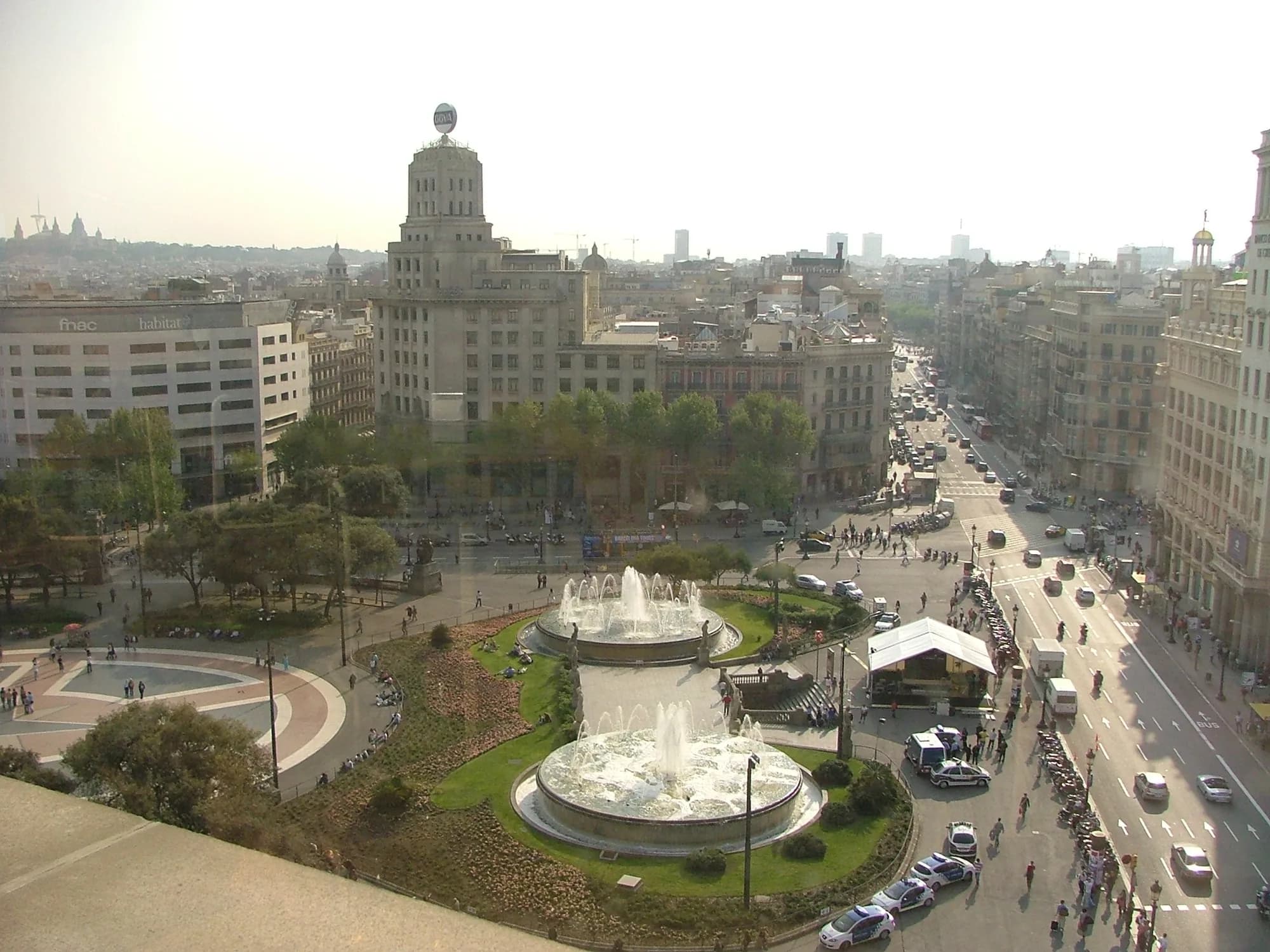
Plaça de Catalunya
Imagine stepping into the heart of Barcelona, where history, art, and modern life converge in a grand spectacle. Plaça de Catalunya, the city's grand central plaza, is not just a meeting point but a vibrant tapestry of Barcelona's rich heritage and dynamic present. As you wander through this expansive square, you'll find yourself surrounded by monumental fountains, manicured gardens, and an open-air gallery of early 20th-century sculptures that tell the story of Catalonia's artistic legacy. Whether you're here to marvel at the architectural beauty, feed the friendly pigeons, or simply soak in the atmosphere, Plaça de Catalunya promises an unforgettable experience.
Plaça de Catalunya is Barcelona's grand central plaza and beating heart, serving as the pivotal junction where the historic Ciutat Vella (Old City) meets the 19th-century grid of the Eixample district. Covering approximately 50,000 square meters, it is one of the largest public squares in Spain. The plaza is framed by monumental twin fountains, manicured gardens, expansive stone promenades, and an extraordinary open-air collection of early 20th-century neoclassical and Noucentista stone and bronze sculptures by leading Catalan artists including Josep Clarà, Josep Llimona, and Pau Gargallo, as well as Josep Maria Subirachs's monument to President Francesc Macià. As Barcelona's primary transport and commercial hub, Plaça de Catalunya acts as the meeting point for famous thoroughfares including La Rambla, Passeig de Gràcia, Rambla de Catalunya, and Portal de l'Àngel, surrounded by major flagship stores, historic cafes, and lively open-air terraces.
History
Before the mid-19th century, the land occupied by Plaça de Catalunya was an open esplanade situated just outside the Portal de l'Àngel gate of Barcelona's medieval defensive walls. When the city walls were demolished in 1854, the expanding city needed a dignified gateway between the crowded medieval center and the emerging Eixample district. Although urban planner Ildefons Cerdà's initial 1859 plan did not include a grand plaza here, local merchants and citizens naturally congregated at the crossroads. In 1889, the municipality officially designated the space as a public plaza. In preparation for the 1929 Barcelona International Exposition, the square underwent a complete architectural overhaul designed by Francesc de Paula Nebot and was officially inaugurated on November 2, 1927, by King Alfonso XIII, featuring grand promenades, underground railway connections, twin illuminated fountains, and 28 commissioned monumental sculptures representing Catalonia's four provinces, commerce, agriculture, and industry.
Fun Facts
- The Pigeon Plaza: Plaça de Catalunya is internationally known for the flocks of friendly pigeons gathering on its central paved esplanade, where generations of locals and visitors have paused to feed them.
- Epicenter of Transit: Beneath the square lies Catalonia's busiest underground transport junction, where four metro lines, regional commuter trains (Rodalies), and FGC rail networks converge.
- Open-Air Noucentista Sculpture Gallery: The square showcases 28 master sculptures by acclaimed Catalan artists of the Noucentisme movement, including Josep Clarà's celebrated statue 'La Deessa' (The Goddess).
- The Planned Center That Moved: When urban planner Ildefons Cerdà designed the 1859 Eixample grid, he envisioned Plaça de les Glòries as the city's true geometric center, but organic civic life firmly established Plaça de Catalunya as the authentic heart of Barcelona.
Guide Tips
- Gateway Orientation Point: Use the plaza as your orientation starting point—head south along La Rambla to enter the Gothic Quarter, north up Passeig de Gràcia for Gaudí's modernist masterpieces, or east into Portal de l'Àngel for pedestrian shopping.
- Panoramic Department Store Cafe: Take the elevator to the 9th-floor cafeteria of El Corte Inglés on the northeast corner of the square for a morning coffee with a panoramic bird's-eye view across the entire plaza and Montjuïc.
- Twin Fountain Illumination: In the evenings, the monumental fountains on the upper terrace are illuminated with colorful lights and choreographed water jets.
Opening Hours
24/7 - Public Central Square