
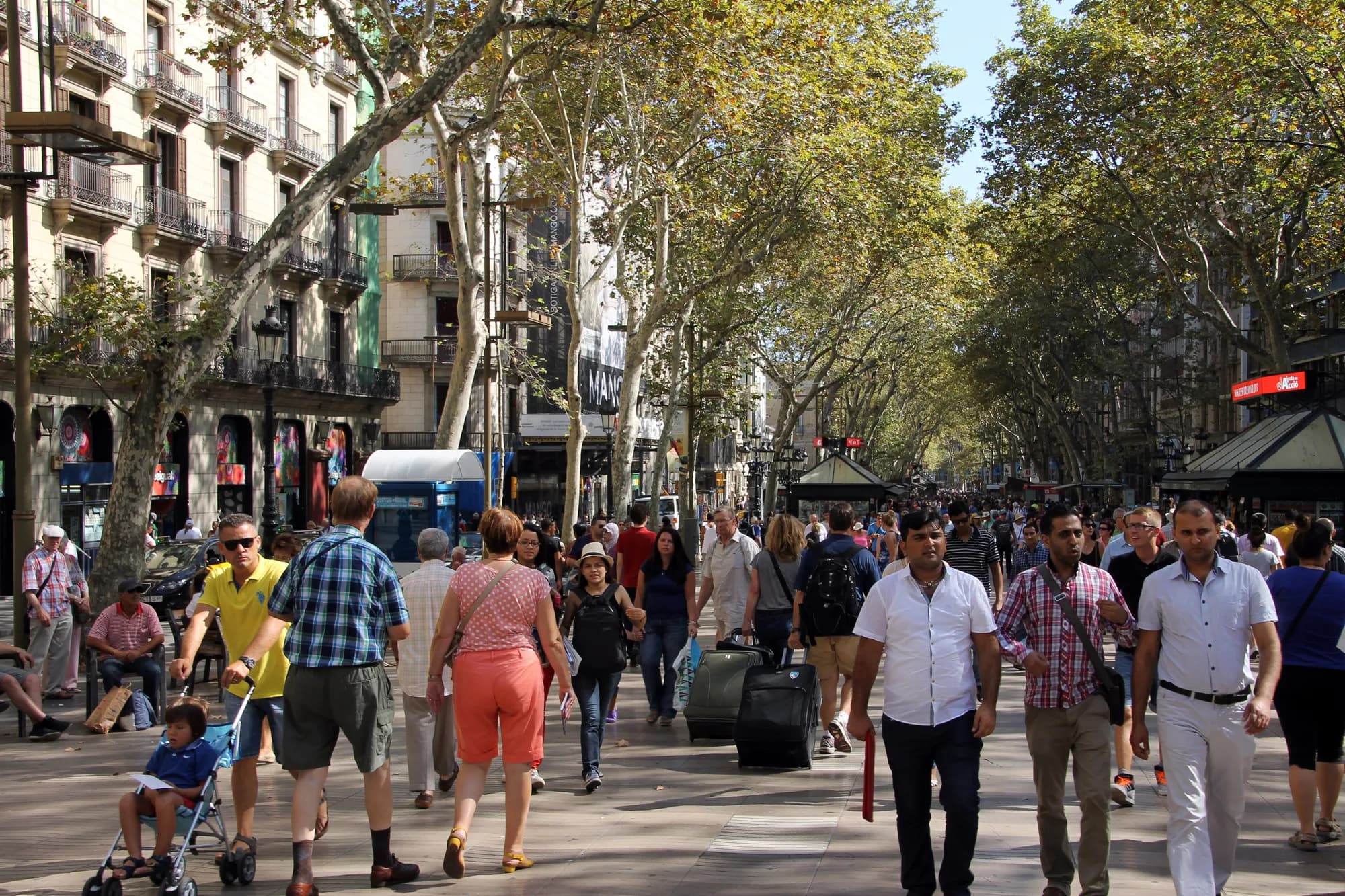
La Rambla
Imagine a place where every step you take is a journey through time and culture, where the air is filled with the scent of blooming flowers and the sounds of street artists captivating passersby. Welcome to La Rambla, Barcelona's most iconic pedestrian boulevard, a 1.2-kilometer stretch that pulses with life from Plaça de Catalunya to the Mediterranean waterfront. This legendary promenade, shaded by majestic plane trees, is not just a walk but an experience, a vibrant tapestry of history, art, and everyday moments that unfold before your eyes. Whether you're admiring the historic facades, stopping to marvel at the colorful flower kiosks, or simply soaking in the atmosphere of this celebrated boulevard, La Rambla promises an unforgettable encounter with the heart of Barcelona.
La Rambla is Barcelona's most legendary and celebrated pedestrian boulevard, stretching 1.2 kilometers (0.75 miles) through the heart of Ciutat Vella from Plaça de Catalunya down to the Mediterranean waterfront at the Christopher Columbus Monument (Mirador de Colom). Shaded by a continuous canopy of majestic plane trees, this bustling promenade divides the Gothic Quarter to the east from El Raval to the west. La Rambla is traditionally divided into five distinct contiguous sections—Rambla de Canaletes, Rambla dels Estudis, Rambla de Sant Josep (or Rambla de les Flors), Rambla dels Caputxins, and Rambla de Santa Mònica—giving rise to its popular plural name, 'Les Rambles'. Along the promenade, visitors encounter iconic cultural landmarks including the historic Font de Canaletes fountain, the historic flower kiosks, the pavement mosaic by Catalan surrealist master Joan Miró (Pla de l'Os), the Gran Teatre del Liceu opera house, and the bustling entrance to Mercat de la Boqueria. Day and night, La Rambla pulses with life, street artists, human statues, open-air cafes, and travelers from around the world.
History
The origin of La Rambla dates back to the Middle Ages when the area was a seasonal watercourse and sandy riverbed ('ramla' in Arabic) running outside Barcelona's 13th-century city walls that channeled rainwater runoff from the Collserola mountains to the Mediterranean Sea. When the Raval defensive wall was built in the 14th century, the stream was diverted and the open path began to develop into a central thoroughfare. During the 16th to 18th centuries, numerous religious convents, monasteries, and colleges were constructed along its margins. In the late 18th century (circa 1766), the inner medieval walls were dismantled and the municipality transformed the space into a grand tree-lined pedestrian boulevard modeled on French boulevards. Following the 1835 confiscation and secularization of church properties (Desamortización de Mendizábal), former monastic sites were repurposed for public markets, grand squares (Plaça Reial), and cultural venues like the Gran Teatre del Liceu, cementing La Rambla as Barcelona's civic and social spine.
Fun Facts
- Legend holds that anyone who drinks from the 19th-century Font de Canaletes at the upper end of La Rambla will fall in love with Barcelona and inevitably return to the city.
- Since the 1930s, fans of FC Barcelona have gathered around Font de Canaletes to celebrate major league titles and trophy victories, a tradition born when the sports newspaper 'La Rambla' posted real-time match results on blackboards outside its offices.
- Outside the Liceu Opera House, pedestrians walk directly over a vibrant circular pavement tile mosaic (Pla de l'Os) created in 1976 by Catalan master Joan Miró.
- The singular avenue comprises five named segments: Canaletes (fountain), Estudis (former university site), Sant Josep/Flors (flower market), Caputxins (Liceu and former monastery), and Santa Mònica (art center and port approach).
Guide Tips
- Walk from north to south, beginning at the bustling fountains of Plaça de Catalunya and descending toward Port Vell to take in the architecture and maritime breeze.
- Stop to admire the colorful floral kiosks near Rambla de les Flors, where florists have traded since the 19th century.
- Look up to admire historic facades like Casa Bruno Cuadros (the Umbrella House) decorated with Japanese umbrellas and a Chinese dragon, and the neoclassical Gran Teatre del Liceu.
Opening Hours
24/7 - Public Pedestrian Boulevard