
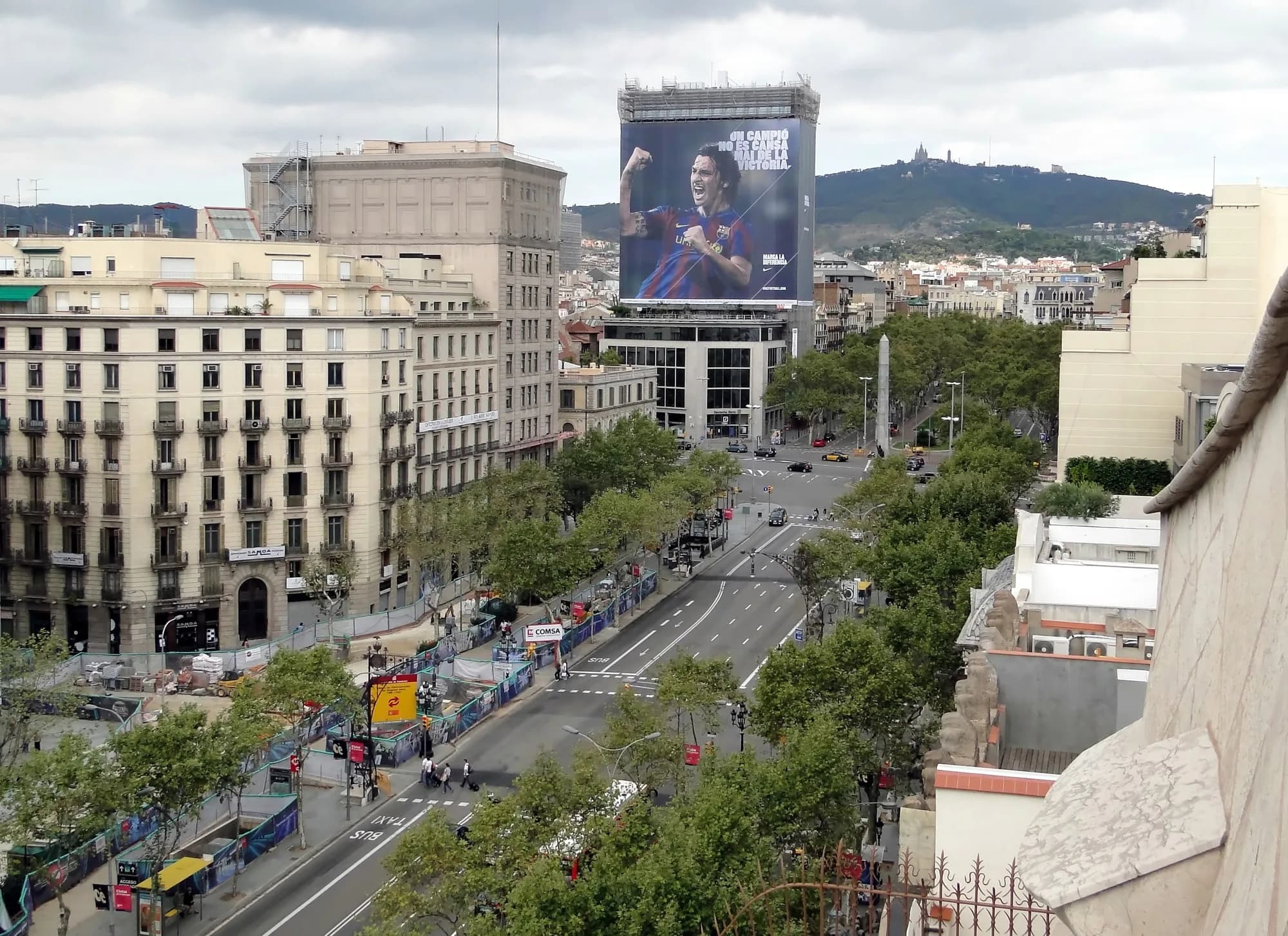
Passeig de Gràcia
Imagine walking down a boulevard where every turn reveals a new architectural marvel, a place where the past and present blend seamlessly in a symphony of design and luxury. Welcome to Passeig de Gràcia, Barcelona's most prestigious grand boulevard, a veritable open-air museum of Modernisme architecture. Stretching from Plaça de Catalunya to the heart of Vila de Gràcia, this elegant avenue is not just a street but a journey through time, showcasing the city's rich history and artistic spirit. With its iconic Gaudí hexagonal paving stones, the 'Block of Discord', and a host of luxury shops and fine dining, Passeig de Gràcia promises an unforgettable experience for every visitor.
Passeig de Gràcia is Barcelona's most prestigious, elegant, and architecturally renowned grand boulevard, stretching approximately 1.3 kilometers (0.8 miles) through the Eixample district from Plaça de Catalunya to the bohemian neighborhood of Vila de Gràcia. Conceived during the 19th-century expansion of Barcelona planned by Ildefons Cerdà, the avenue developed into the favored residential showcase for wealthy Catalan industrialists and bourgeoisie during the Modernisme (Catalan Art Nouveau) golden age. Today, Passeig de Gràcia is celebrated worldwide for its extraordinary concentration of architectural masterpieces, most notably the 'Illa de la Discòrdia' (Block of Discord) featuring Antoni Gaudí's Casa Batlló, Josep Puig i Cadafalch's Casa Amatller, and Lluís Domènech i Montaner's Casa Lleó Morera, as well as Gaudí's Casa Milà (La Pedrera) further up the avenue. Shaded by stately plane trees, the boulevard is also distinguished by Pere Falqués' iconic 1906 wrought-iron lampposts with integrated trencadís mosaic benches and hexagonal paving tiles originally designed by Gaudí, while serving as Spain's premier luxury shopping and fine-dining promenade.
History
Originally known as the Camí de Jesús, Passeig de Gràcia was an ancient rural trail linking the medieval city gates of Barcelona to the historic hilltop village of Gràcia. In 1821, municipal authorities initiated plans to transform the path into a wide, tree-lined promenade for public recreation, inaugurating the avenue in 1827. When Barcelona's medieval fortifications were demolished in 1854 and Ildefons Cerdà's revolutionary Eixample expansion plan took shape, Passeig de Gràcia was designated as the central spine and most prestigious artery of the new city. During the late 19th and early 20th centuries, Catalonia's industrial, financial, and textile elite competed to construct the most opulent and inventive private residences, hiring visionary Modernista architects who turned the avenue into an open-air museum of modern architecture.
Fun Facts
- Gaudí Hexagonal Paving Tiles: The distinct hexagonal blue-green paving stones ('Panot Gaudí') lining the sidewalks of Passeig de Gràcia were designed by Antoni Gaudí in 1904, depicting marine motifs including starfish, sea snails, and octopus tentacles.
- Falqués Lamppost Benches: The 32 sculptural benches along the avenue were designed in 1906 by municipal architect Pere Falqués, ingeniously combining white ceramic mosaic seating with soaring wrought-iron streetlights.
- The Block of Discord: The segment between Carrer del Consell de Cent and Carrer d'Aragó earned the nickname 'Manzana de la Discordia' because three of Catalonia's greatest rival modernist architects built starkly contrasting masterpieces side-by-side.
- Royal Carriage Promenade: Before the demolition of Barcelona's medieval walls in 1854, Passeig de Gràcia was an unpaved rural path connecting the walled city to the independent village of Gràcia, popularized by aristocrats riding carriages and riding horses.
Guide Tips
- Northbound Stroll: Walk from Plaça de Catalunya north towards Avinguda Diagonal to take in the full architectural progression and landmark facades in natural light.
- Look Down at the Sidewalks: Don't forget to look down at your feet to admire the iconic Gaudí hexagonal paving stones, one of Barcelona's most celebrated industrial design icons.
- Terrace Break at El Nacional: Step into El Nacional (Passeig de Gràcia, 24 Bis), a stunning multi-space culinary venue housed in a restored 19th-century industrial hall, for a drink or tapas.
Opening Hours
24/7 - Public Boulevard & Promenade