
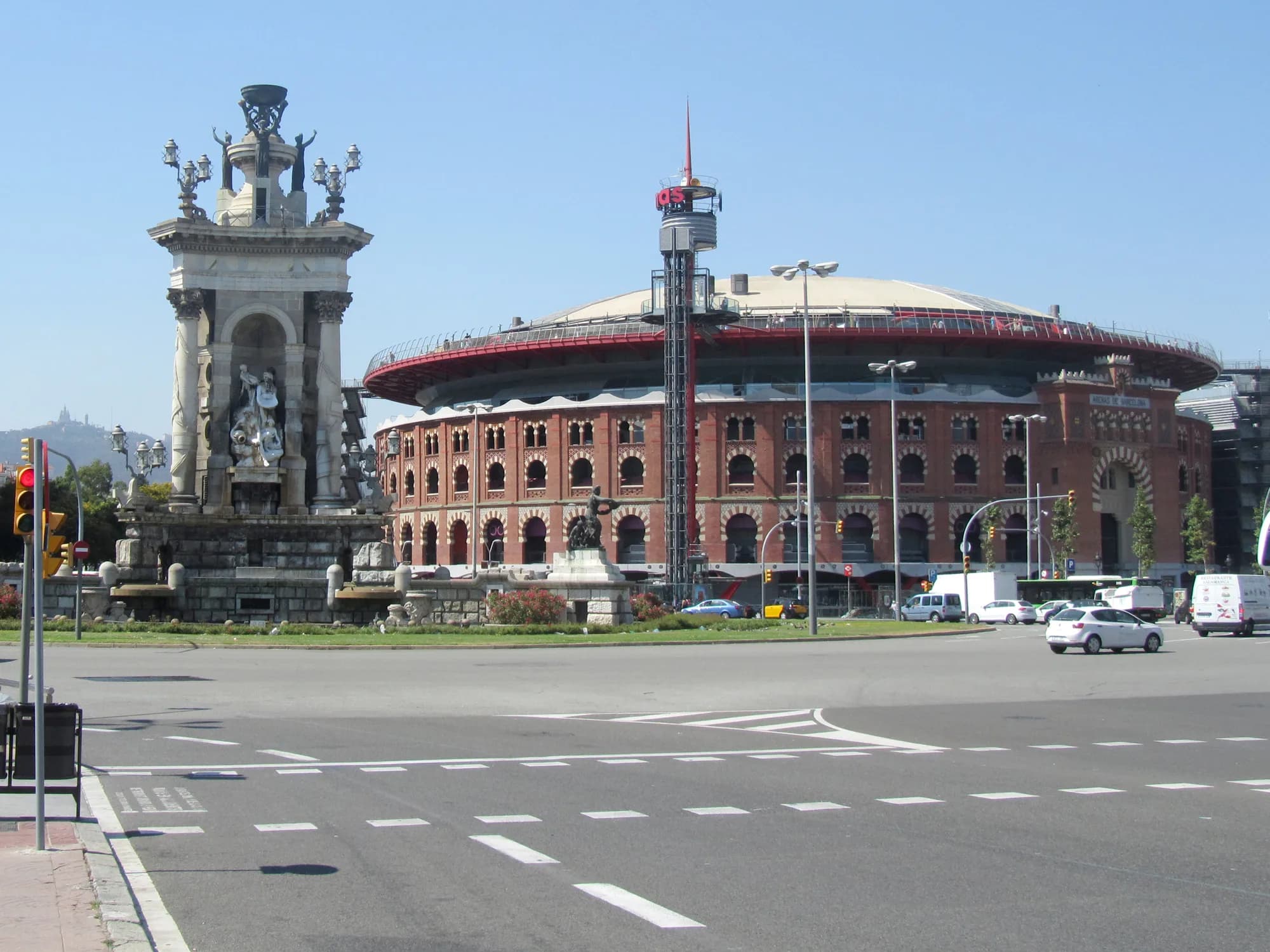
Plaça d'Espanya
Imagine stepping into a living piece of history, where the grandeur of the past meets the pulse of modern life. Plaça d'Espanya, Barcelona's grand square, is a captivating blend of architectural marvels and vibrant culture. At its heart, the monumental fountain tells tales of Spain's rivers and seas, while the Venetian Towers stand as a testament to the city's rich history. Whether you're exploring the rooftop views of the Arenas shopping center or strolling through the bustling square, Plaça d'Espanya promises an unforgettable experience that captures the essence of Barcelona.
Plaça d'Espanya (Plaza de España) is one of Barcelona's grandest, most iconic, and bustling public squares, situated at the junction of Gran Via de les Corts Catalanes, Avinguda del Paral·lel, and Carrer de la Creu Coberta at the foot of Montjuïc hill. Designed by architect Josep Amargós and completed for the 1929 Barcelona International Exposition, the circular square spans over 34,000 square meters. The center of the plaza is crowned by a monumental classical fountain designed by Josep Maria Jujol with sculptural allegories by Miquel Blay representing the seas and rivers of Spain. Facing Montjuïc along Avinguda de la Reina Maria Cristina stand the twin 47-meter-tall Venetian Towers (Torres Venecianes), modeled after the St Mark's Campanile in Venice. The square is also bordered by the historic neo-Mudéjar Arenas de Barcelona former bullring, now converted into a premier shopping and dining complex featuring a 360-degree rooftop viewpoint.
History
Before the 20th century, the site was a semi-rural crossroads known as the Plaça del Cremador, where public executions and gallows were located until 1715. In anticipation of the 1929 Barcelona International Exposition, the municipal government undertook an ambitious urban renewal plan to create a monumental southern entrance to the exposition grounds on Montjuïc. Architect Josep Amargós drew up the urban layout, while Gaudí's close collaborator Josep Maria Jujol designed the central monumental fountain honoring the waters and seas of Spain. Twin Venetian towers were erected by architect Ramon Reventós in 1928 as the ceremonial gateway to the fairgrounds. In 1900, the Las Arenas bullring was constructed on the plaza by August Font i Carreras; after bullfighting ceased, architect Richard Rogers transformed it in 2011 into a shopping complex while preserving its historic neo-Mudéjar facade.
Fun Facts
- The two 47-meter red-brick towers flanking Avinguda de la Reina Maria Cristina were directly modeled after the Campanile of St Mark's Basilica in Venice.
- Josep Maria Jujol's monumental central fountain features allegorical sculptures representing the three bodies of water surrounding Spain: the Mediterranean Sea, the Atlantic Ocean, and the Bay of Biscay, along with the Ebro, Tagus, and Guadalquivir rivers.
- The Arenas de Barcelona building on the north side was originally a 1900 bullring with 15,000 seats. In 2011, Pritzker Prize-winning architect Richard Rogers converted it into a shopping center, elevating the historic brick facade on massive hydraulic jacks.
- Plaça d'Espanya served as the grand entrance to the 1929 World's Fair, leading visitors up Avinguda de la Reina Maria Cristina toward the Magic Fountain and Palau Nacional.
- At 34,000 square meters, it is one of the largest public squares and key transit hubs in Catalonia, connecting six major avenues.
Guide Tips
- Enter the Arenas shopping mall and take the internal escalators up to the top floor for a free 360-degree panoramic terrace view overlooking Plaça d'Espanya and Montjuïc (avoiding the paid exterior elevator fee).
- From Plaça d'Espanya, walk between the Venetian Towers along Avinguda de la Reina Maria Cristina toward the Magic Fountain and the grand steps of the Palau Nacional.
- The Plaça d'Espanya metro station provides easy connections via Metro Lines L1 (Red), L3 (Green), FGC regional trains, and direct express buses (Aerobús) to Barcelona-El Prat Airport.
Opening Hours
24/7 - Public Square & Monument