
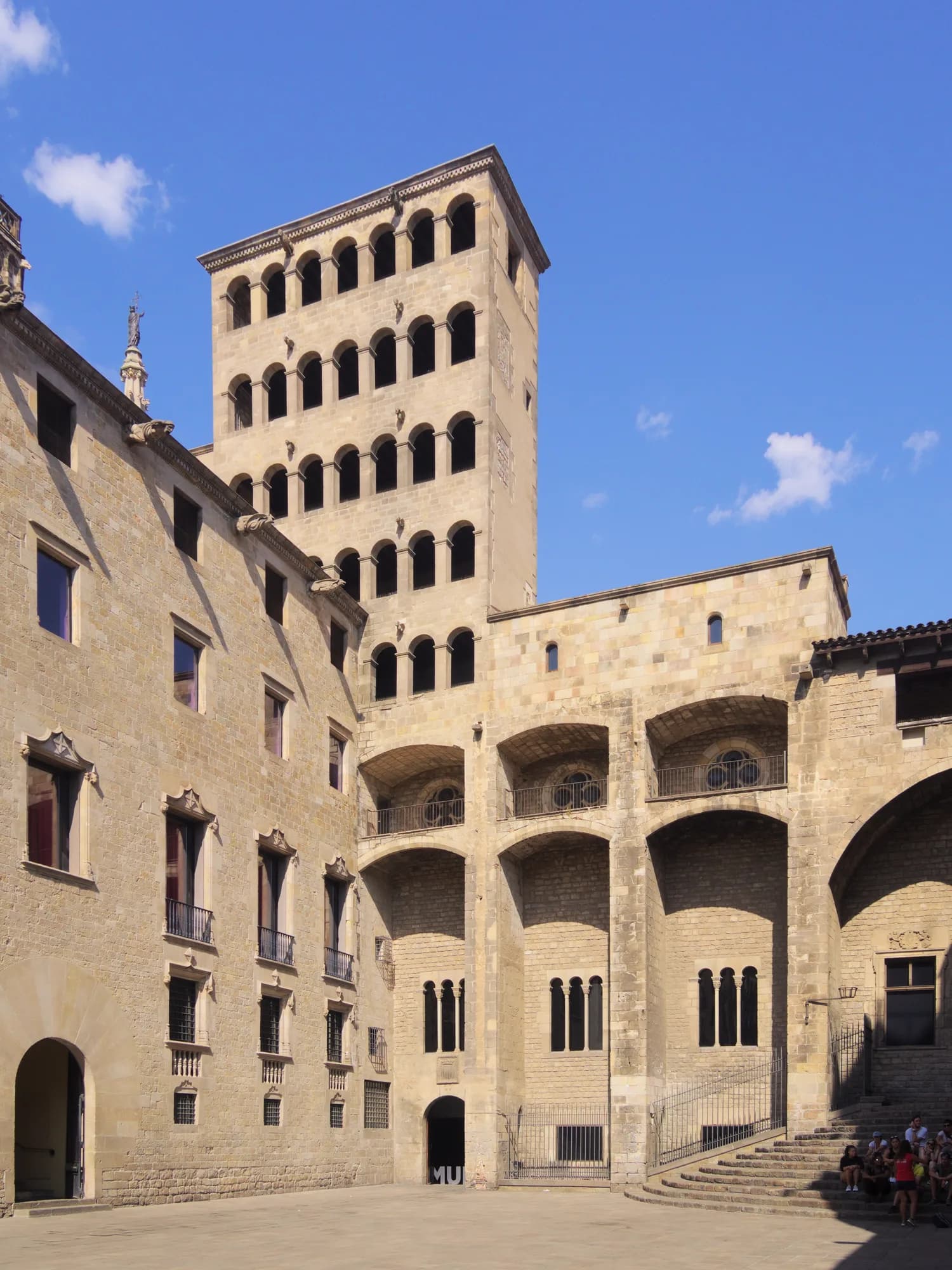
Plaça del Rei
Imagine stepping back in time to the heart of medieval Barcelona, where history breathes through every stone and whispers of ancient rulers echo in the air. Plaça del Rei, a meticulously preserved 14th-century square, invites you to explore its Gothic splendor and the secrets hidden beneath its surface. As you wander through the Gothic Quarter, the majestic Palau Reial Major stands as a testament to the grandeur of the Counts of Barcelona and the Kings of Aragon. Whether you're marveling at the intricate arches of the Saló del Tinell or discovering the subterranean Roman streets at the Museu d'Història de Barcelona, Plaça del Rei promises an unforgettable journey through time.
Plaça del Rei ('King's Square') is a remarkably preserved 14th-century medieval public square in the Gothic Quarter of Barcelona, celebrated as one of the finest Gothic monumental ensembles in Europe. Enclosed on all sides by historic stone structures, the square was the royal seat of the Counts of Barcelona and the Kings of Aragon. Dominating the plaza is the Palau Reial Major (Grand Royal Palace) with its magnificent 14th-century banqueting hall, the Saló del Tinell, featuring six soaring diaphragm arches. To its right rises the slender five-story Mirador del Rei Martí (King Martí's Watchtower), built in 1555, and the 14th-century Gothic royal chapel of Santa Àgata, featuring an exquisite 15th-century altarpiece by Jaume Huguet. Beneath the stones of the square lies the extensive underground archaeological site of the Museu d'Història de Barcelona (MUHBA), where visitors can walk through 4,000 square meters of excavated Roman Barcino streets, wine-making workshops, and Visigothic ruins.
History
Plaça del Rei developed as the political and administrative nucleus of the Crown of Aragon during the High Middle Ages. The site incorporates the 11th-century Romanesque fortress of the Counts of Barcelona, which was comprehensively transformed into a monumental Gothic palace complex under King Peter IV of Aragon ('the Ceremonious') between 1359 and 1370. Master builder Guillem Carbonell designed the majestic Saló del Tinell, capable of hosting grand royal receptions, parliamentary sessions, and trials of the Inquisition. In 1931, the 15th-century Gothic Casa Padellàs palace was dismantled stone by stone from Carrer de Mercaders to make way for the opening of Via Laietana and reassembled in Plaça del Rei, uncovering the astonishing underground Roman ruins that formed the Barcelona History Museum (MUHBA) in 1943.
Fun Facts
- Meeting of Columbus and Monarchs: According to popular historical tradition, Catholic Monarchs Ferdinand and Isabella received Christopher Columbus on the sweeping semicircular stairs of the Palau Reial Major in April 1493 upon his triumphant return from his first voyage to the Americas.
- Subterranean Ancient City: Directly beneath the square's stones lies one of the largest subterranean Roman archaeological excavations in Europe, spanning over 4,000 square meters of preserved Roman streets, laundry factories, and garum fish-sauce vats.
- The 1555 Watchtower: The slender rectangular tower overlooking the plaza, known as 'Mirador del Rei Martí', was constructed in 1555 and offered royal lookouts a sweeping strategic view over Barcelona's medieval harbor.
- Natural Acoustic Amphitheater: The enclosed stone walls and semicircular staircase create pristine acoustic resonance, making Plaça del Rei a premier venue for classical guitar recitals, medieval concerts, and the Grec Arts Festival.
Guide Tips
- Explore Under the Square: Enter MUHBA in Casa Padellàs on the corner of the plaza and take the elevator down to walk the subterranean streets of Roman Barcino.
- Dramatic Corner Angle: Stand on the south corner near Carrer dels Comtes to capture the full dramatic diagonal of the Saló del Tinell, King Martí's watchtower, and the Santa Àgata chapel.
- Evening Atmosphere: Visit after twilight when architectural spotlights illuminate the golden Montjuïc sandstone walls and the square empties of daytime crowds.
Opening Hours
24/7 - Public Historic Square (MUHBA Museum: Tue-Sat 10:00 - 19:00, Sun 10:00 - 20:00, Mon Closed)