
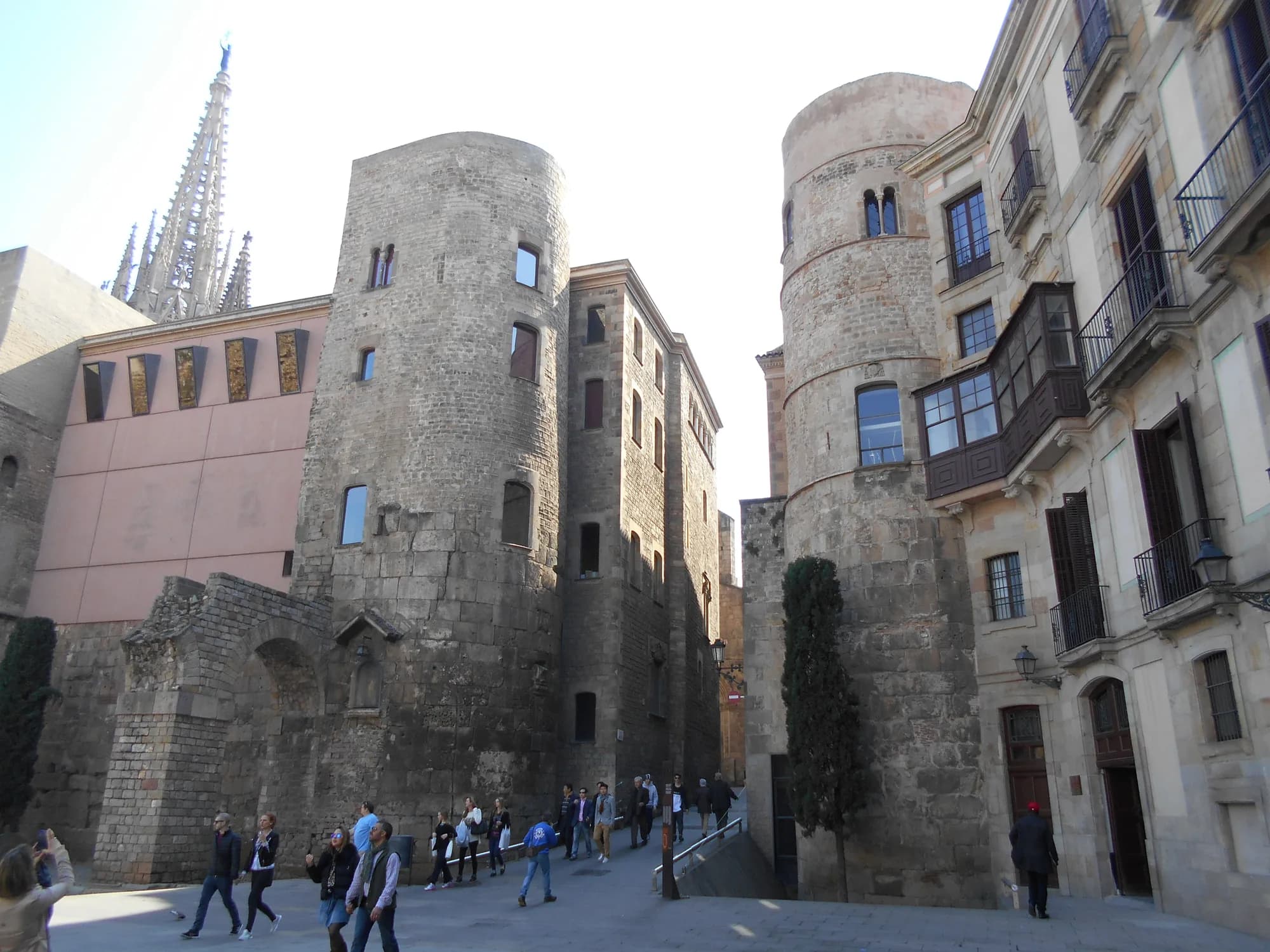
Roman Walls of Barcelona
Step back in time as you wander through the ancient streets of Barcelona, where the imposing Roman Walls stand as a testament to the city's rich history. These formidable fortifications, originally built in the late 1st century BC, have withstood the test of time and continue to guard the secrets of Barcino. As you explore the Gothic Quarter, you'll find yourself surrounded by the echoes of the past, with medieval palaces built atop the sturdy Roman ramparts and reconstructed aqueducts telling tales of a bygone era. Prepare to be captivated by the sheer scale and historical significance of these ancient walls, a must-visit for any history enthusiast.
The Roman Walls of Barcelona (Muralles Romanes de Barcelona) are the imposing archaeological remains of the ancient defensive fortifications that encircled the Roman colony of Barcino. Originally erected in the late 1st century BC and massively reinforced in the late 3rd and early 4th centuries AD to withstand Germanic invasions, the defensive perimeter stretched 1.5 kilometers with 76 towering stone bastions rising over 9 meters high and walls up to 3.5 meters thick. Today, exceptional, well-preserved sections of the Roman wall and watchtowers are visible throughout the Gothic Quarter, most notably at Plaça Nova—where two massive cylindrical gate towers flank the ancient decumanus maximus entrance (Portal del Bisbe) alongside a reconstructed Roman aqueduct section—and along Carrer de la Tapineria, Carrer de la Palla, and Plaça de Ramon Berenguer el Gran, where medieval palaces were built directly atop the Roman ramparts.
History
When Emperor Augustus founded the Roman colony of Julia Augusta Faventia Paterna Barcino around 15–10 BC, a modest initial perimeter wall was built around the Mons Taber hill. Following barbarian incursions in the late 3rd century AD (around 260–275 AD), Roman engineers undertook a monumental reconstruction, encasing the older wall in a much thicker, higher stone rampart reinforced with 76 polygonal and semicircular bastions. The fortified perimeter allowed Barcino to survive Visigothic, Muslim, and Frankish incursions during the early Middle Ages. As Barcelona expanded beyond its Roman boundaries in the 13th and 14th centuries, the Roman walls were incorporated into residential dwellings, monasteries, and royal palaces, preserving significant portions that were rediscovered and restored in the 19th and 20th centuries.
Fun Facts
- The 76 Bastion Stronghold: In the 4th century AD, Barcino was one of the most heavily fortified cities in the entire Western Roman Empire, boasting 76 watchtowers spaced every 6 to 8 meters along its 1.5-kilometer perimeter wall.
- Reconstructed Roman Aqueduct: In Plaça Nova, adjacent to the surviving Roman gate towers, visitors can admire an arched section of the ancient aqueduct that channeled freshwater into Barcino from the Montcada springs.
- Medieval Palaces Built on Roman Stone: During the Middle Ages, Catalan nobles and counts built their palaces—including the Chapel of Santa Àgata and Palau Reial Major—directly on top of the sturdy Roman masonry, creating a dramatic architectural layering visible today at Plaça Ramon Berenguer.
- Barcino Typography Sculpture: In 1994, Catalan artist Joan Brossa installed his celebrated bronze and aluminum visual poetry sculpture spelling out 'BARCINO' directly across from the Roman wall towers in Plaça Nova.
Guide Tips
- Roman Perimeter Walking Loop: Trace the ancient wall circuit by walking from Plaça Nova along Carrer de la Palla, Carrer dels Banys Nous, Carrer del Correu Vell, and Plaça Ramon Berenguer.
- Best Photo Spot: Plaça Ramon Berenguer el Gran offers the most dramatic perspective, showing the equestrian statue of Count Ramon Berenguer III against the towering Roman wall and Gothic arches.
- Spot Recycled Roman Inscriptions: Examine the lower stone courses at Plaça Nova to spot carved funerary stones, friezes, and column drums that Roman builders hastily reused ('spolia') during the 4th-century wall fortification.
Opening Hours
24/7 - External Archaeological Monument & Public Streets