
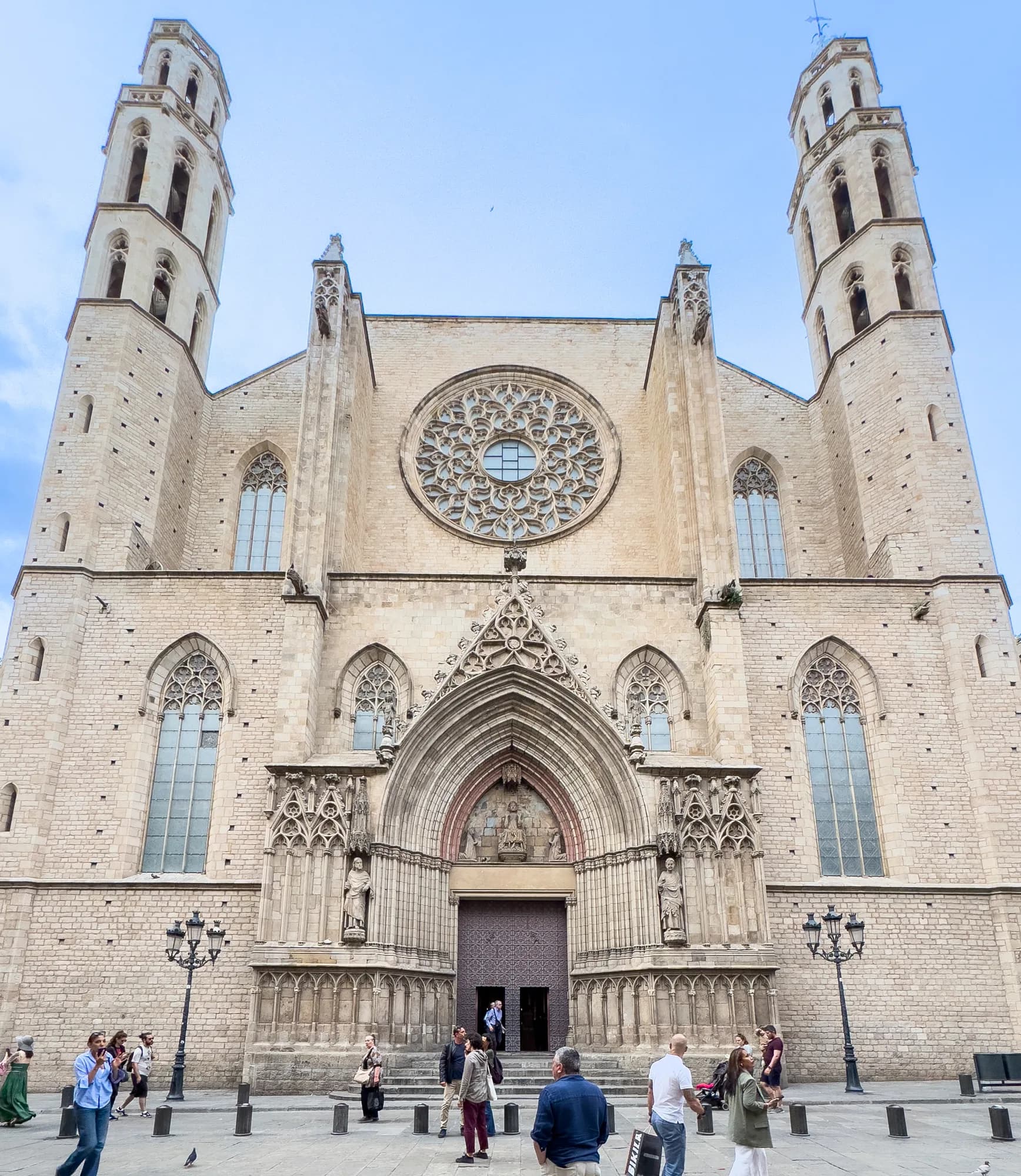
Santa Maria del Mar
Imagine standing in the heart of Barcelona, where the past whispers through the arches of a 14th-century Gothic basilica. Santa Maria del Mar, a testament to the city's maritime glory, invites you to explore its soaring columns and luminous interiors. Built by the hands of local dockworkers and guild merchants, this architectural marvel is not just a place of worship but a living history book. As you wander through its hallowed halls, you'll find yourself immersed in the stories of a city that once ruled the Mediterranean waves, each stone echoing tales of devotion and resilience.
The Basilica of Santa Maria del Mar ('Saint Mary of the Sea') is a breathtaking 14th-century Gothic basilica situated in the vibrant Ribera (El Born) district of Barcelona. Widely regarded as the purest and finest surviving masterpiece of Catalan Gothic architecture, the church stands as a testament to the maritime and mercantile golden age of Catalonia. Designed by master architects Berenguer de Montagut and Ramon Despuig, the basilica was built between 1329 and 1383 in a record 54 years, resulting in a rare, unified architectural harmony. The interior is renowned for its soaring proportions, expansive open layout, and striking octagonal columns spaced thirteen meters apart, creating a luminous, column-free sense of boundless space and acoustic resonance. Built by the devotion and hard labor of local guild workers and dock porters (bastaixos), Santa Maria del Mar remains one of Barcelona's most beloved and spiritually resonant landmarks.
History
Santa Maria del Mar stands on the ancient site of a 4th-century Paleo-Christian necropolis and early maritime sanctuary known as Santa Maria de les Arenes ('Saint Mary of the Sands'), where the relics of Saint Eulalia were once venerated. During the 14th century, as Barcelona emerged as a dominant Mediterranean maritime power, the maritime merchants and shipbuilders of the La Ribera district desired a grand temple that belonged to the people rather than the monarchy or high nobility. King Alfonso IV laid the foundation stone on March 25, 1329. Local guild laborers and dock porters, known as 'Bastaixos', transported thousands of heavy stone blocks on foot from the Montjuïc royal quarries to the building site. Although severely damaged by fire during the Spanish Civil War in July 1936, which destroyed the baroque high altar and wooden furnishings, the resilient stone structure survived and was meticulously restored to reveal its bare Gothic majesty.
Fun Facts
- Built by the Working People (Bastaixos): Unlike royal or bishop-funded cathedrals, Santa Maria del Mar was financed and built entirely by local dockworkers, fishermen, and guild merchants of La Ribera. The 'Bastaixos' (harbor porters) carried massive stone blocks on their bare backs all the way from the royal Montjuïc quarries.
- ✅ Rapid Gothic Construction: The entire basilica was erected in just 54 years (1329–1383)—an astonishingly fast timeframe for a medieval monument—giving it an unparalleled stylistic purity and architectural harmony unmatched in European Gothic architecture.
- ⚽ The FC Barcelona Stained Glass: In the late 1960s, during the restoration of stained glass windows destroyed in the 1936 Spanish Civil War, FC Barcelona sponsored a replacement window that still proudly displays the official Barça club crest in colored glass.
- ⚡ The Cathedral of the Sea: Santa Maria del Mar is the central protagonist of Ildefonso Falcones' internationally bestselling historical novel 'La catedral del mar' ('Cathedral of the Sea') and its acclaimed Netflix television adaptation.
Guide Tips
- Rooftop Terrace Tour: Book the guided rooftop tour for an unforgettable 360-degree vista across the terracotta rooftops of El Born, the Gothic Quarter, and the Mediterranean coastline.
- Morning Stained Glass Glow: Visit between 10:00 and 12:00 when morning sunlight floods through the eastern apse stained glass windows, illuminating the soaring octagonal pillars in vibrant amber and blue.
- Explore El Born: After your visit, take time to explore the atmospheric medieval alleys of the surrounding Born neighborhood, packed with artisan workshops, tapas bars, and vermouth taverns.
Opening Hours
Mon-Sat: 10:00 - 18:00, Sun: 13:00 - 18:00