
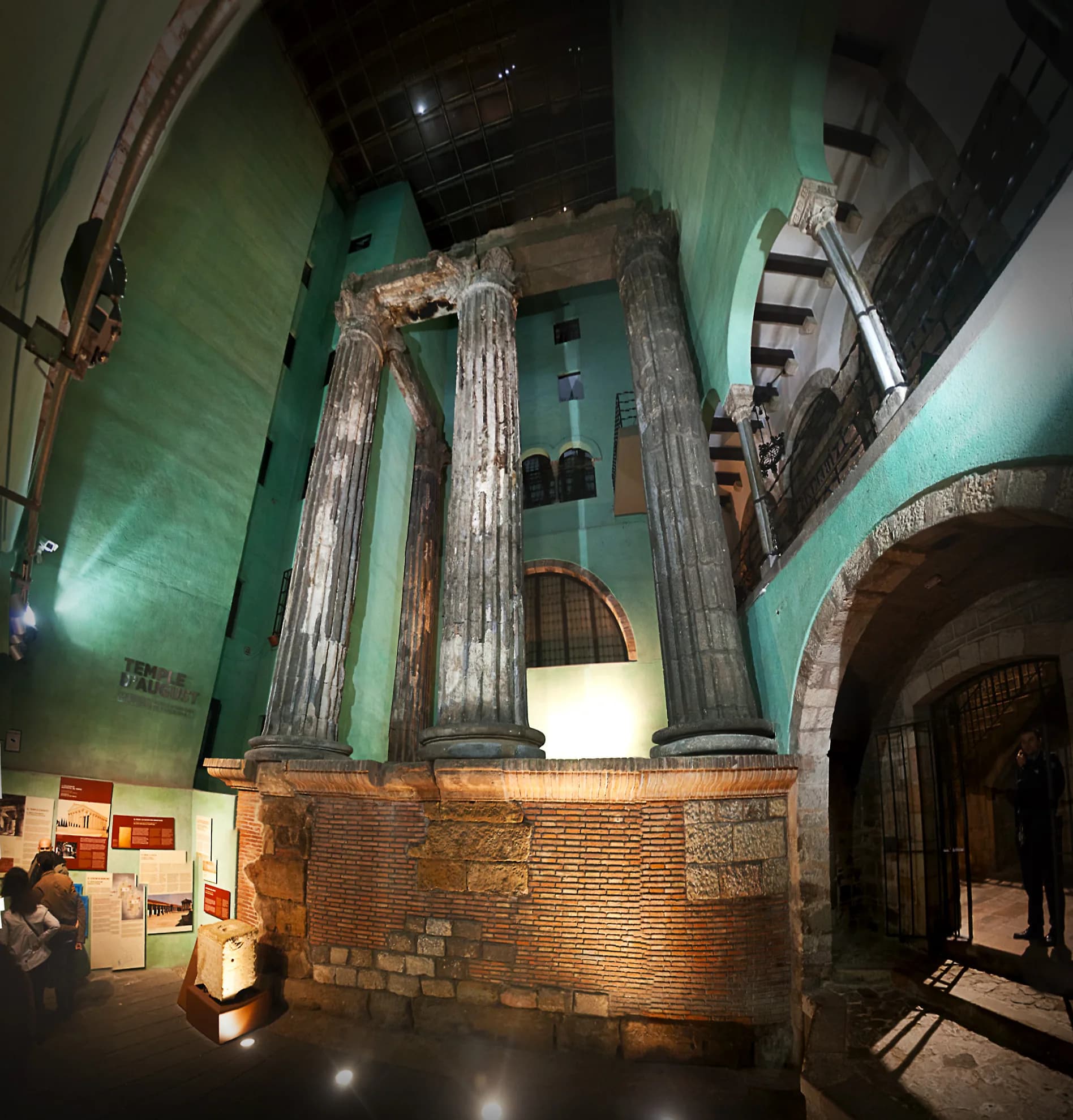
Temple of Augustus
Imagine stepping back in time to the heart of ancient Barcelona, where the whispers of history echo through the quiet courtyard of the Temple of Augustus. Nestled atop Mont Tàber, this hidden gem offers a rare glimpse into the grandeur of the Roman era, with its colossal columns and serene ambiance inviting you to reflect on the city's rich past. As you wander through the intimate space, you'll find yourself standing at the birthplace of Barcelona, a tranquil retreat from the bustling streets below.
The Temple of Augustus (Temple d'August) is one of Barcelona's most astonishing hidden archaeological treasures, tucked away inside a quiet medieval courtyard on the highest point of the historic Roman city, Mont Tàber (Mount Taber). Built in the late 1st century BC during the reign of Emperor Augustus, this hexastyle pseudoperipteral Roman temple was the monumental centerpiece of the Roman forum of Barcino, dedicated to the imperial cult. Although the temple fell into ruin during the Middle Ages and was largely swallowed by surrounding residential buildings, four colossal fluted stone columns with ornate Corinthian capitals and a fragment of the original architrave survive in pristine condition, soaring over nine meters (30 feet) high. Managed as a free heritage site by the Barcelona History Museum (MUHBA), the intimate space allows visitors to stand at the exact historic altitude and birthplace of ancient Barcelona.
History
The Temple of Augustus was erected between 15 BC and the early 1st century AD to anchor the civic, administrative, and religious forum of Colonia Faventia Julia Augusta Pia Barcino. As the western Roman Empire declined and Christianity spread, the pagan temple fell into disuse and was gradually dismantled for building materials or incorporated into private medieval mansions. In the late 19th century, during restoration work on the Centre Excursionista de Catalunya building on Carrer del Paradís, Catalan architect Lluís Domènech i Montaner recognized that the massive stone pillars embedded in the courtyard walls were the monumental columns of Barcino's Roman imperial temple. Domènech i Montaner preserved the courtyard and designed a dedicated skylit viewing space, which was later integrated into MUHBA's municipal archaeological network.
Fun Facts
- 🏔️ Highest Point of Roman Barcino: The temple sits atop Mont Tàber at 16.9 meters (55 feet) above sea level—the highest elevation of the ancient Roman colony, marked today by a historic millstone embedded in the pavement outside the doorway.
- 🏛️ Reunited Fourth Column: For centuries, only three columns stood together in the courtyard. The fourth column had fallen, broken into pieces, and was displayed in Plaça del Rei until Catalan architect Lluís Domènech i Montaner and historians reassembled and reunited it with the other three columns in 1956.
- 📐 Monumental Forum Centerpiece: In Roman times, the complete temple stood atop a high podium measuring 37 meters long by 17.5 meters wide, commanding the intersection of the Cardo Maximus and Decumanus Maximus.
- 🏢 Hidden Inside a Hiking Club: The ruins are housed inside the headquarters of the Centre Excursionista de Catalunya, Catalonia's oldest mountaineering and hiking association founded in 1876.
Guide Tips
- 🚪 Finding the Hidden Entrance: From Plaça de Sant Jaume, walk behind the Palau de la Generalitat up the tiny Carrer del Paradís and enter through the stone carriage arch at No. 10.
- 🪨 Spot the Mont Tàber Millstone: Before entering, look down at the street pavement right in front of the doorway to see the circular stone marker denoting the geographic summit of ancient Roman Barcelona.
- 🤫 Peaceful Quiet Oasis: Because it is enclosed indoors away from street noise, this is one of the most serene and reflective historical stops in the entire Gothic Quarter.
Opening Hours
Mon: 10:00 - 14:00, Tue-Sat: 10:00 - 19:00, Sun: 10:00 - 20:00