
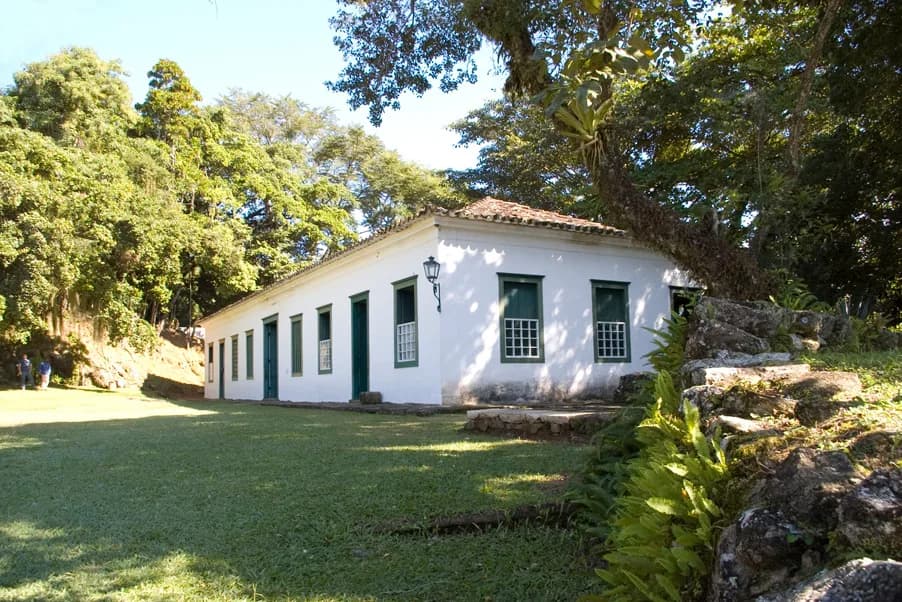
Forte Defensor Perpétuo
Nestled atop the green Morro da Vila Velha, the Forte Defensor Perpétuo offers a captivating glimpse into Paraty's storied past. This historical fort, rebuilt in 1822 to honor Emperor Dom Pedro I, stands as a testament to Brazil's independence. Today, it serves as a small, free museum where you can wander among ancient cannons, explore the former commander's house, and immerse yourself in exhibitions showcasing the region's traditional culture. But it's not just the history that draws visitors; the panoramic views of Paraty Bay and the historic center from the fort's vantage point are simply breathtaking. Whether you're a history buff or simply seeking a unique perspective of Paraty, the Forte Defensor Perpétuo promises an unforgettable experience.
On top of the green hill of Morro da Vila Velha, just past Praia do Pontal, stands Paraty's old fort, the Forte Defensor Perpétuo. Originally built in the early 1700s to guard the gold passing through Paraty's port, the fort you see today was rebuilt in 1822, the year of Brazil's independence, and named in honour of Emperor Dom Pedro I, the 'Perpetual Defender of Brazil'. Today it's a small free museum run by Ibram, Brazil's national museums institute. Walk among the old cannons on the parade ground, see the former commander's house and troop barracks, and visit exhibitions on the traditional culture of the region: caiçara fishing life, crafts and objects from the area's old farms. Many visitors find the view from the top, overlooking Paraty Bay and the historic centre, to be the real highlight. It's about a 20-minute walk from the old town, crossing the Pontal bridge and following the shore.
History
The Morro da Vila Velha is where Paraty's first settlement grew up, before the town moved to the site of today's historic centre. A fortification was raised on the hill from 1703 to protect the port, which shipped gold from Minas Gerais along the Estrada Real, as well as the region's sugar, from pirate raids.
After falling into ruin during Paraty's economic decline, the fort was rebuilt in 1822 and named in honour of Dom Pedro I, who received the title "Perpetual Defender of Brazil" that year. With open artillery positions and no full walls, it is technically a battery rather than a fort.
In 1957 it passed from the War Ministry to the Ministry of Education and Culture. It was restored by the heritage institute IPHAN and opened to visitors. Since 2009 it has been run by Ibram, and it houses Paraty's Centre for Arts and Popular Traditions.
Fun Facts
- It's named after Dom Pedro I, who received the title 'Perpetual Defender of Brazil' in 1822, the year of independence.
- Strictly speaking it isn't a fort but a battery: an open artillery position without full defensive walls.
- Some of its cannons were made in Britain. One, marked with a crown and the letter 'P', was cast at the Carron ironworks in Scotland in 1796.
- The hill it stands on, Morro da Vila Velha ('Old Town Hill'), is where Paraty's first settlement began.
Guide Tips
- Come for the view as much as the museum: the cannons on the parade ground frame Paraty Bay.
- Go in the morning on weekends, since it closes at 14:00.
- Walking from the old town takes about 20 minutes: cross the Pontal bridge and follow the beach to the foot of the hill, then take the short path up.
Opening Hours
Mon: Closed, Tue: Closed, Wed-Fri: 10:00 AM - 5:00 AM, Sat-Sun: 10:00 AM - 2:00 PM