
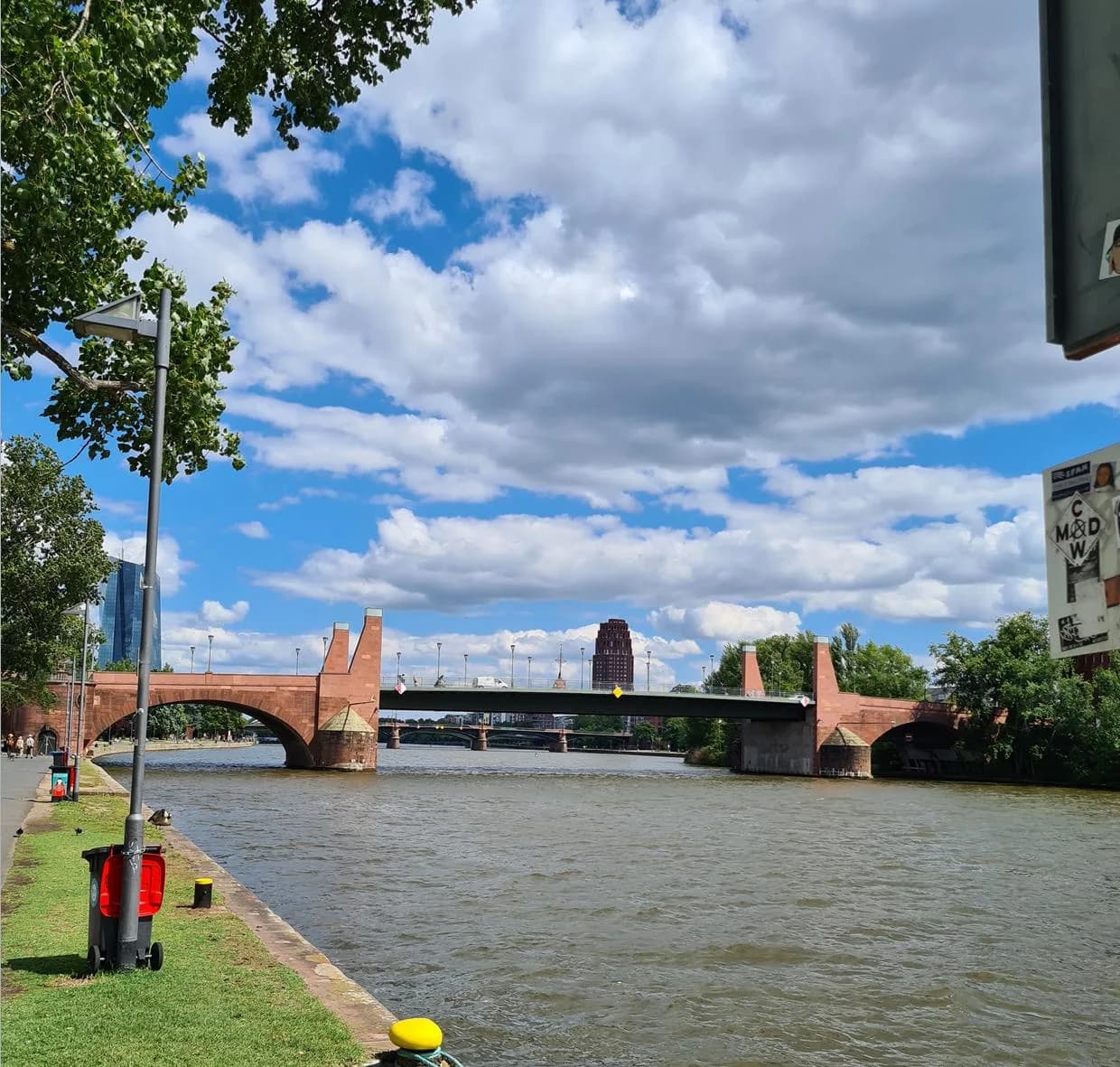
Alte Brücke (The Oldest Bridge)
L'Alte Brücke, le pont le plus ancien de Francfort, est un témoignage vivant de l'histoire fascinante de la ville. Construit en 1222, ce pont en pierre remplace un gué naturel qui était autrefois utilisé pour traverser le Main. Marchez sur ses pierres et imaginez les marchands, les voyageurs et les cavaliers qui l'ont emprunté au fil des siècles. Aujourd'hui, l'Alte Brücke est non seulement un lien architectural important, mais aussi un symbole de la richesse culturelle et historique de Francfort. Explorez l'Alte Brücke et découvrez comment ce pont a façonné l'évolution de Francfort, de sa fondation à sa transformation en centre financier et commercial majeur. À travers ses arches majestueuses et ses structures défensives, l'Alte Brücke raconte l'histoire d'une ville née d'un gué et devenue une puissance urbaine florissante.
Le plus vieux pont et le plus vieux pont documenté (1222) sur le Main (rivière) dans la ville. Le pont le plus ancien était probablement en bois, celui actuel a été construit et agrandi plus tard.
Histoire
**Frankfurt:** Born at the Ford.
**Ford**= Shallow part of a river where people could cross on foot or on horseback.)
Frankfurt grew around a natural ford in the Main River, somewhere in the area of today's Alte Brücke (Old Bridge). We don't know the exact position of the original ford, but historians generally place the historic crossing somewhere in this part of the river.
Before there was a bridge, this shallow section of the Main allowed people, horses, and carts to cross the river. The crossing was important because Frankfurt stood at the intersection of long-distance routes connecting different parts of Central Europe. Travelers and merchants could cross the Main here and continue their journeys in different directions.
The location also had another major advantage: the Domhügel (Cathedral Hill), just north of the river, provided higher and safer ground for settlement. Over time, the combination of a useful river crossing, important routes, and protected high ground attracted people, trade, and eventually political power.
From Ford to Bridge
For centuries, the river was crossed using the natural ford. But as Frankfurt grew, relying on a shallow crossing was no longer enough. A permanent bridge made it possible to cross the Main more reliably, especially for the growing movement of merchants, goods, and people.
The Alte Brücke is Frankfurt's oldest bridge and the oldest documented bridge across the Main in the city. It is first mentioned in a document from 1222. The earliest bridge was probably wooden, while the stone bridge that we associate with the Alte Brücke today developed through later rebuilding and expansion.
The bridge connected the historic center on the northern bank with Sachsenhausen on the southern bank. For centuries, it was the city's most important connection across the Main and one of the major routes through Frankfurt.
**This was a major transformation:**
**Before the bridge:**
People had to find and use the natural ford.
**After the bridge:**
People could cross at a fixed, controlled point.
That made movement more predictable and helped Frankfurt strengthen its position as a commercial and strategic center. The bridge also became important for controlling traffic into the city and collecting tolls from people and goods crossing it.
**Why “Frankfurt”?**
The name Frankfurt itself preserves the memory of the original crossing.
The earliest recorded form of the name, Franconofurd, appears in 794 AD. It is generally understood as “the ford of the Franks.”
Franco → the Franks, the Germanic people who controlled the region
furd → an old Germanic word meaning ford, a place where a river could be crossed
So:
Franconofurd → Frankfurt
“The Franks' ford.”
The name therefore describes the geographical feature that helped make the settlement important in the first place.
And the bridge came much later. When the Alte Brücke was first documented in 1222, Frankfurt had already existed for centuries. The bridge did not create Frankfurt — it replaced the natural crossing that had helped create the city.
So Frankfurt's story can be understood as a simple evolution:
natural ford → settlement → Frankish royal center → medieval bridge → trading city → financial center
Frankfurt was, quite literally, a city born from a river crossing.
Anecdotes
- Historiquement, une tour de pont se trouvait du côté de Francfort.
- Le pont était autrefois bordé de structures défensives et de portes.
- Le célèbre Brickegickel (coq du pont) de Francfort est associé au pont depuis des siècles.
- Le passage sur le Main était l'une des raisons pour lesquelles Francfort est devenue stratégiquement importante.
Conseils du guide
- Visitez le musée sur le pont pour en apprendre davantage sur son histoire.
- Ne manquez pas le célèbre coq du pont, le Brickegickel, un symbole de la ville.
Horaires d'ouverture
24/7 - External Visit